On this page
A stone whirled at a steady speed is accelerating the whole time, because the direction of its velocity keeps changing. Ask for its average acceleration over half a revolution and it is tempting to write zero ("the speed didn't change") or v²/r ("that's the acceleration in circular motion"). Neither answer is right. The fix is one definition, applied carefully.
What does average acceleration mean in circular motion?
Average acceleration is the change in velocity divided by the time interval, a_avg = Δv/Δt, as defined in NCERT's Class 11 chapter Motion in a Plane and in OpenStax University Physics, section 4.2. The Δv is a vector difference, final velocity minus initial velocity, not a difference of speeds.
In uniform circular motion the instantaneous acceleration has magnitude a_c = v²/r and points toward the centre, according to OpenStax University Physics, section 4.4. Over a finite arc that inward arrow keeps rotating, so the average comes out smaller than v²/r.
If vector subtraction feels shaky, our guide on finding change in velocity using vector subtraction walks through it with arrows. The same end-point thinking separates path length from displacement, covered in distance vs displacement on a circular track.
How do you find average acceleration over a half revolution?
Take a particle moving at speed v on a circle of radius r.
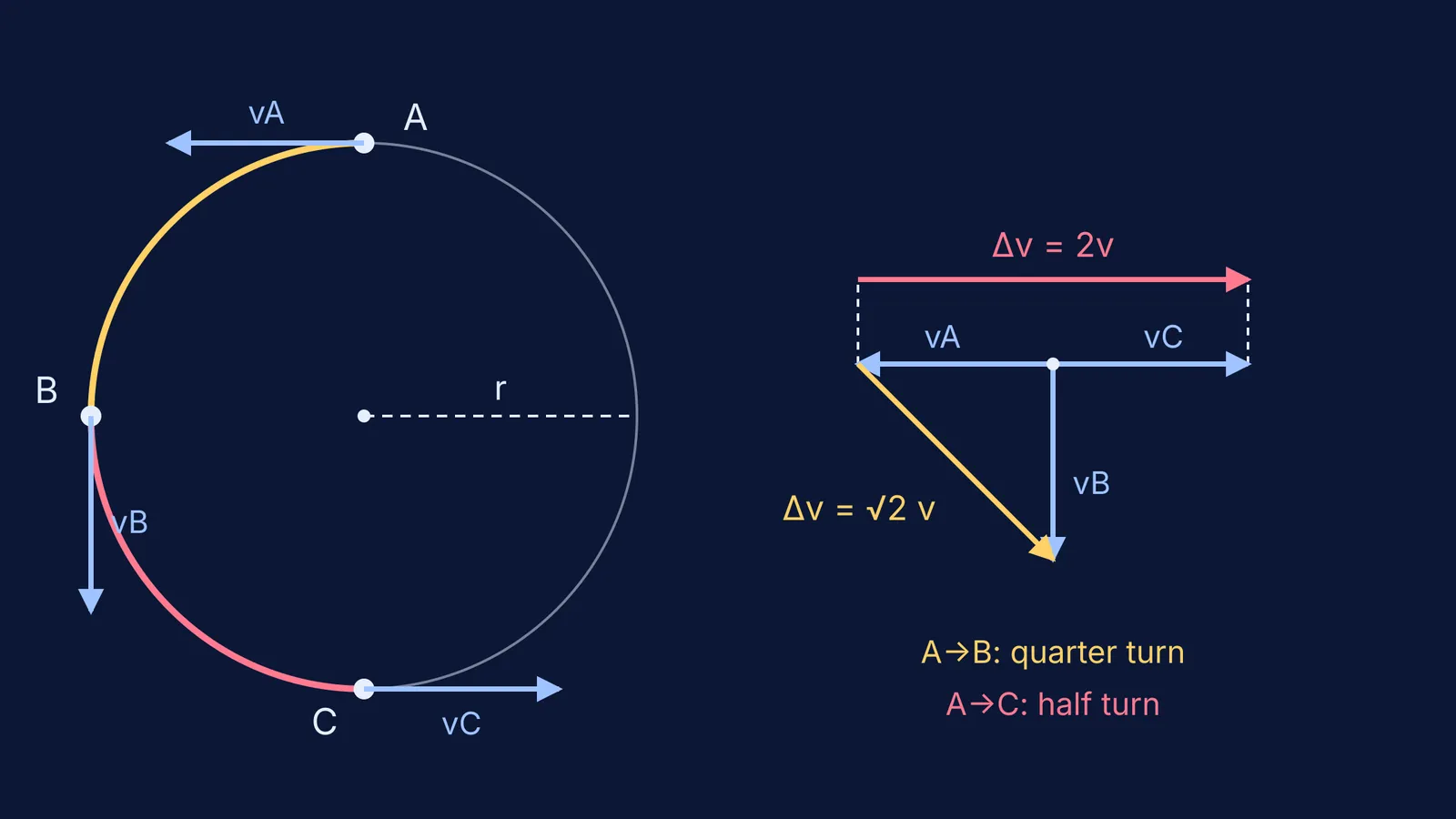
At the start its velocity is v along the tangent.
After half a turn it is diametrically opposite, moving at v in exactly the opposite direction.
So Δv = (−v) − (v), and |Δv| = 2v.
The time is half the circumference divided by the speed: Δt = πr/v.
Average acceleration: |a_avg| = 2v ÷ (πr/v) = 2v²/(πr).
Because 2/π ≈ 0.637, the half-turn average is about 64% of the centripetal value v²/r given by OpenStax. Its direction is along Δv, opposite to the starting velocity, which is the inward direction at the middle of the arc.
What is the average acceleration in a quarter revolution?
After a quarter turn the velocity has rotated by 90°. Two arrows of equal length v at right angles give |Δv| = √(v² + v²) = √2 v. The time is a quarter of the circumference over the speed, Δt = πr/(2v). So |a_avg| = √2 v ÷ (πr/(2v)) = 2√2 v²/(πr), about 0.90 of the OpenStax value v²/r.
The factor sin(θ/2)/(θ/2) is close to 1 for a tiny arc, which is why the instantaneous value is v²/r, and it shrinks as the arc grows. Over a full turn sin(π) = 0, so the average acceleration is zero. Exercise 3.16(c) in NCERT's Motion in a Plane asks you to judge exactly that statement.
Worked example: the stone on a string
Exercise 3.14 in NCERT's Motion in a Plane describes a stone on an 80 cm string making 14 revolutions in 25 s at constant speed. Here is that set-up extended to half and quarter turns.
Period: T = 25/14 ≈ 1.786 s.
Speed: v = 2πr/T = 2π(0.8)/1.786 ≈ 2.81 m/s.
Centripetal acceleration: v²/r ≈ 9.90 m/s².
Half turn: |Δv| = 2v ≈ 5.63 m/s in Δt = T/2 ≈ 0.893 s, so |a_avg| ≈ 6.31 m/s².
Quarter turn: |Δv| = √2 v ≈ 3.98 m/s in Δt = T/4 ≈ 0.446 s, so |a_avg| ≈ 8.92 m/s².
Full turn: Δv = 0, so a_avg = 0.
Check the ratios: 6.31/9.90 ≈ 0.637 and 8.92/9.90 ≈ 0.900, matching 2/π and 2√2/π. If your ratios come out different, recheck Δt as well as Δv: using the wrong fraction of the period is an easy slip.
Which mistakes cost marks on these questions?
Subtracting speeds instead of velocity vectors, which gives zero.
Writing v²/r for an average over a finite arc.
Using the full period T instead of T/2 or T/4.
Putting θ in degrees into the general formula.
Treating "magnitude of acceleration" as "rate of change of speed"; our post on the difference between d|v|/dt and |dv/dt| in curved motion untangles that one.
A velocity arrow that swings round while the speed stays fixed is easier to see than to read about, and the Fermi Simulation Lab has interactive simulations for ideas like that. For practice, the Fermi Problem Library has worked problems with a step-by-step solver that explains the reasoning rather than printing an answer, so you can see whether your Δv or your Δt went wrong.
Next time a question says "average", draw two arrows first and divide by the time second.