

On this page
Many students confuse the rate of change of speed with the magnitude of acceleration. When you are driving on a straight highway, hitting the accelerator increases both your speed and your velocity in the same way. But physics makes a sharp distinction as soon as you turn the steering wheel. According to the NCERT Class 11 Physics syllabus, acceleration is a vector that responds to any change in velocity—whether that is a change in how fast you are going, a change in your direction, or both.
What is the rate of change of speed (d|v|/dt)?
The rate of change of speed, written mathematically as d|v|/dt, is exactly what you read on a car's speedometer as it ticks up or down. It measures how quickly the magnitude of your velocity is changing over time.
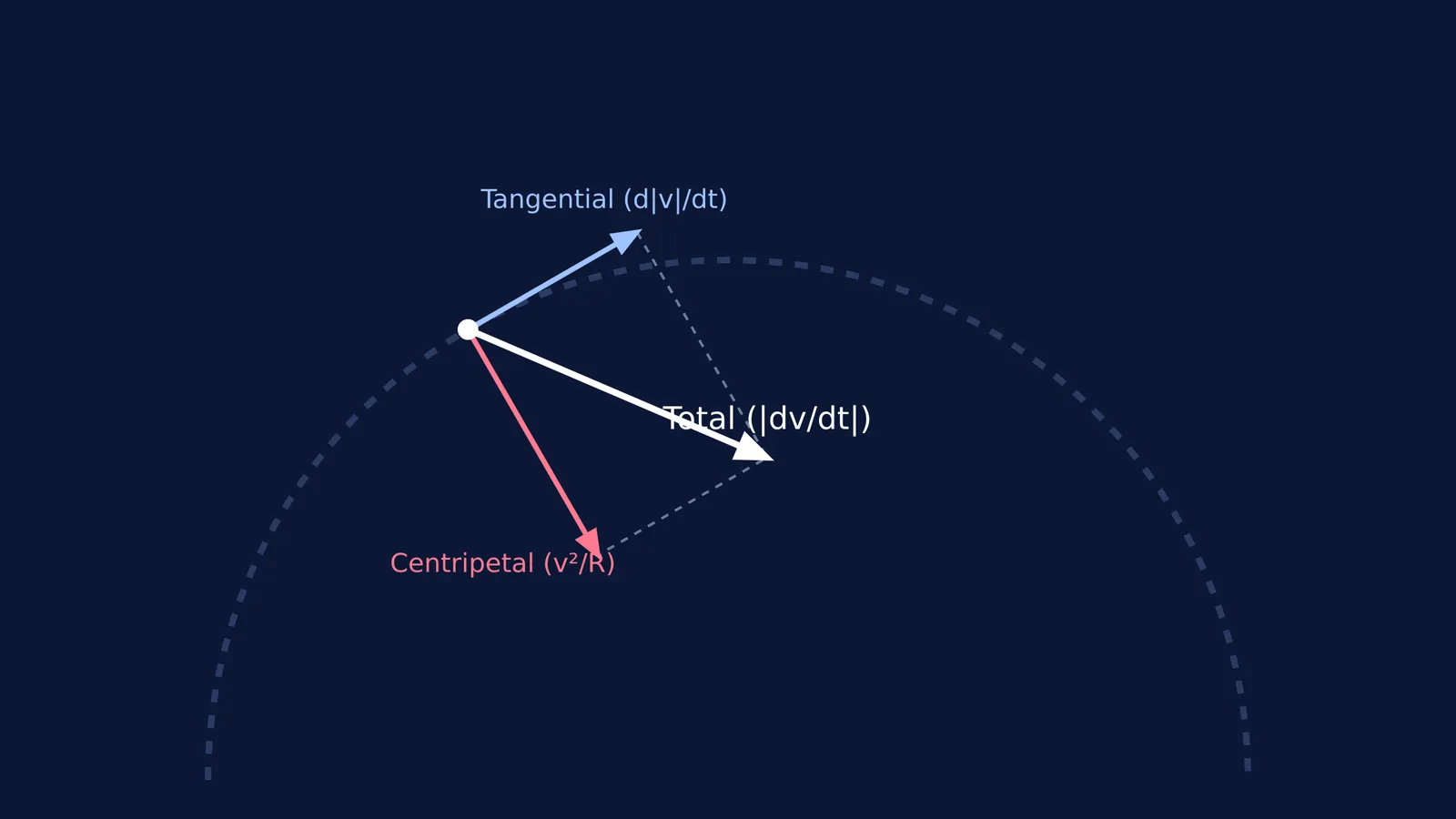
In physics, this is known as the tangential acceleration because it acts directly along your path. It only has the power to make you go faster or slower, not to turn you. If you drive around a roundabout at a perfectly steady 40 km/h, your rate of change of speed is exactly zero, even though you are constantly changing direction.
What is the magnitude of acceleration (|dv/dt|)?
The magnitude of acceleration, written as |dv/dt|, looks at the rate of change of the entire velocity vector. Because velocity includes both a number (speed) and a heading (direction), changing your direction requires an acceleration even if your speed is locked in.
When you turn a corner, the road pushes you inward. This creates a centripetal acceleration (equal to v²/R, where R is the radius of your turn). The total acceleration magnitude |dv/dt| is the geometric sum of both the tangential part (speeding up) and the centripetal part (turning). It is the true measure of the net force acting on the object divided by its mass.
When are d|v|/dt and |dv/dt| equal?
The difference between the two terms boils down to the shape of the path you take:
In a straight line: You are not turning, so the centripetal component is zero. Here, the magnitude of acceleration is exactly equal to the rate of change of speed.
On a curved path: You always have some centripetal acceleration keeping you on the curve. Because the total acceleration is the vector sum of both perpendicular parts, the magnitude of acceleration (|dv/dt|) is strictly greater than the rate of change of speed (d|v|/dt).
A worked example on a circular track
Imagine a car moving along a circular track with a radius (R) of 50 metres. At a certain instant, its speed (v) is 20 m/s, and the driver hits the brakes so the speed drops at a rate of 3 m/s². Let us calculate both values to see the difference clearly.
Rate of change of speed (d|v|/dt): This is exactly the braking rate. So, the tangential acceleration is 3 m/s². If we only cared about the speedometer, this is the number we would use.
Centripetal acceleration (v²/R): We use the current speed and the turn radius to find this component. It is 20² / 50 = 400 / 50 = 8 m/s². This is the acceleration responsible for turning the car.
Magnitude of acceleration (|dv/dt|): We combine the tangential and centripetal components using Pythagoras' theorem because they always sit at 90° to each other.
|dv/dt| = √(3² + 8²) = √(9 + 64) = √73 ≈ 8.54 m/s².
Even though the car's speedometer is only changing by 3 m/s every second, its total velocity vector is changing at a rate of 8.54 m/s² because of the tight turn. This distinction is crucial for setting up equations correctly in mechanics problems.
If you find it hard to picture how these vectors add up, the Fermi Simulation Lab lets you drive a car along different tracks and watch the acceleration vector stretch and turn in real time. For more step-by-step breakdowns of tricky kinematic definitions, you can explore the Fermi Concept Library.
To see how these principles apply to specific equations, you can read Motion in a plane from r(t): velocity and acceleration vectors. If you are looking to work backwards from acceleration to find velocity, check out Acceleration given as a function of v or x: how to integrate it.


