

On this page
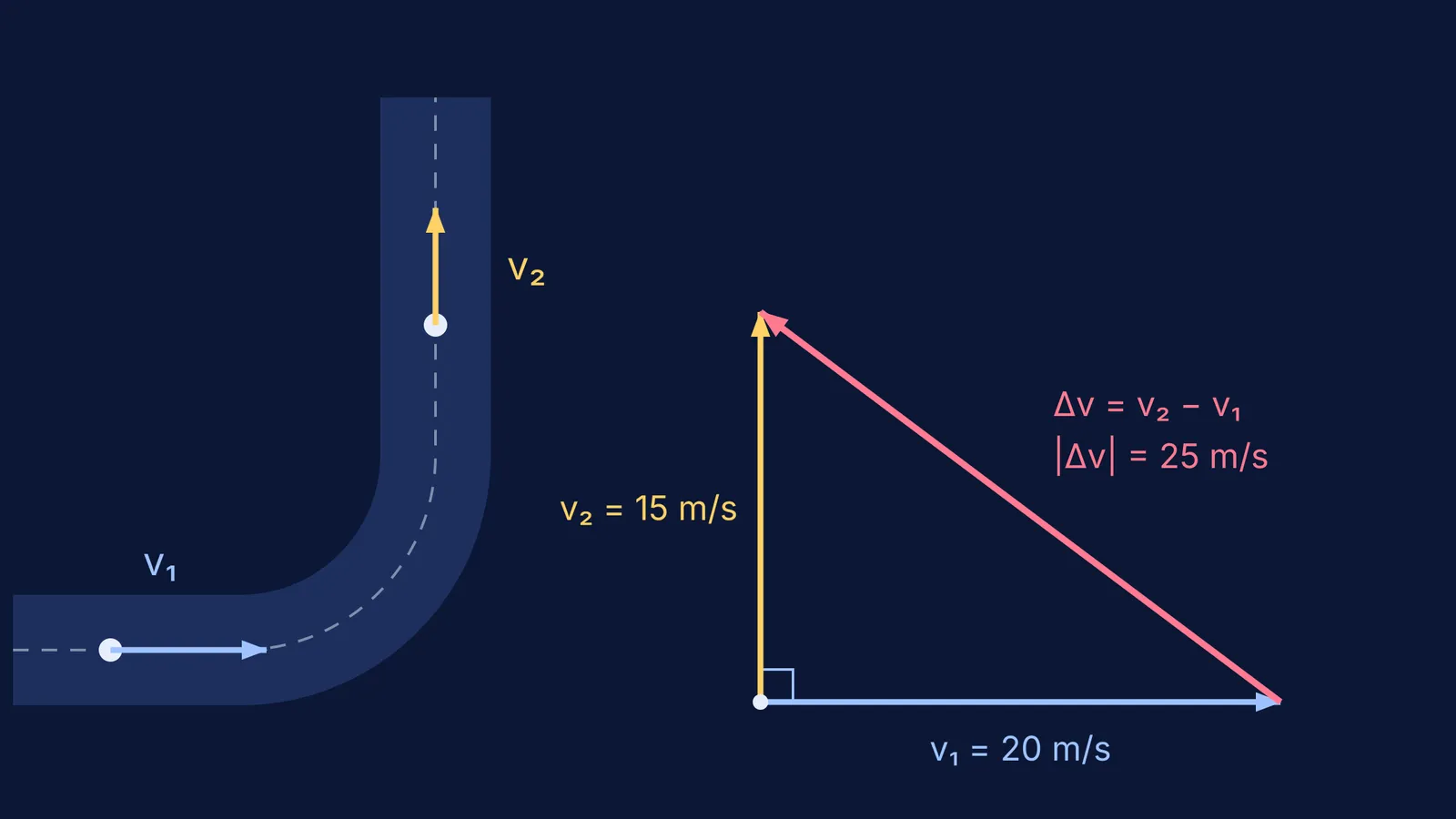
A car enters a corner at 20 m/s heading east and leaves it at 15 m/s heading north. Its speed dropped by 5 m/s. Its velocity changed by 25 m/s. Both numbers are correct, but they answer different questions. Here is how to get the second one every time.
What does change in velocity mean?
Velocity is a vector: it has a size (the speed) and a direction. The NCERT Class 11 Physics chapter Motion in a Plane defines average acceleration as the change in velocity divided by the time interval, Δv/Δt (Section 3.7).
The change in velocity is Δv = v₂ − v₁, final velocity minus initial velocity, and the minus sign means vector subtraction, not ordinary subtraction of two numbers.
The same NCERT chapter defines the difference of two vectors as A − B = A + (−B) (Section 3.4), where −B has the same size as B and the opposite direction (Section 3.3). So Δv = v₂ + (−v₁): reverse the first velocity and add it to the second.
How do you find change in velocity by components?
Use this method in exams: every step can be checked.
Choose axes and write them down, for example east = +x, north = +y.
Write each velocity in components: v = vₓ î + vᵧ ĵ.
Subtract component by component: Δvₓ = v₂ₓ − v₁ₓ and Δvᵧ = v₂ᵧ − v₁ᵧ.
Find the size with |Δv| = √(Δvₓ² + Δvᵧ²) and the direction with tan θ = Δvᵧ/Δvₓ, then use the signs to pick the quadrant.
OpenStax University Physics writes step 3 as D = A − B = (Aₓ − Bₓ) î + (Aᵧ − Bᵧ) ĵ.
Worked example: the car at the corner
Take east = +x and north = +y.
v₁ = 20 î + 0 ĵ m/s
v₂ = 0 î + 15 ĵ m/s
Δv = (0 − 20) î + (15 − 0) ĵ = −20 î + 15 ĵ m/s
|Δv| = √(400 + 225) = √625 = 25 m/s
tan θ = 15/20 = 0.75, so θ ≈ 37°. Δvₓ is negative and Δvᵧ is positive, so Δv points 37° north of west.
If the turn takes 5 s, the average acceleration is 25/5 = 5 m/s², pointing 37° north of west, towards the inside of the turn. Note that Δv points neither east nor north: it points in a direction the car never travelled.
If you keep getting the direction wrong in problems like this, the Fermi Problem Library has worked problems with a step-by-step solver that explains the reasoning rather than printing an answer.
How do you find change in velocity with the triangle law?
Draw v₁ and v₂ from the same point, to scale. Δv is the arrow from the tip of v₁ to the tip of v₂.
This works because v₁ + Δv = v₂, which is the head-to-tail triangle law of addition that NCERT describes in Section 3.4. For the car, the two velocities and Δv make a right-angled triangle with sides 20, 15 and 25 m/s, as in the diagram at the top.
Or follow NCERT's Figure 3.5: draw v₂, then add −v₁ head to tail. The arrow from the start of v₂ to the end of −v₁ is the same Δv.
To practise drawing the triangle first, try our vector addition simulation predictions.
Why is change in speed not change in velocity?
Change in speed subtracts two numbers: |v₂| − |v₁| = 15 − 20 = −5 m/s. Change in velocity subtracts two arrows: |v₂ − v₁| = 25 m/s. The two agree only when both velocities point the same way.
The extreme case is a car taking the corner at a steady 10 m/s. Its change in speed is zero. Its change in velocity is −10 î + 10 ĵ m/s, with size 10√2 ≈ 14.1 m/s. That is why OpenStax notes that even if the speed is constant, a particle can have acceleration if it moves along a curved trajectory such as a circle.
The same idea explains why the acceleration in circular motion keeps turning, covered in is centripetal acceleration constant in uniform circular motion.
A 30-second checklist before you write the answer
Axes are stated in your working.
You subtracted final minus initial, not the other way round.
Every component has its sign, including zeros.
The angle is placed in the right quadrant.
The answer gives a size and a direction.
You re-read the question: does it ask for change in speed or change in velocity?
If vectors themselves still feel shaky, the Fermi Concept Library gives each concept its own lesson and its place in the map, so you can revisit vector components before the next corner.


