

On this page
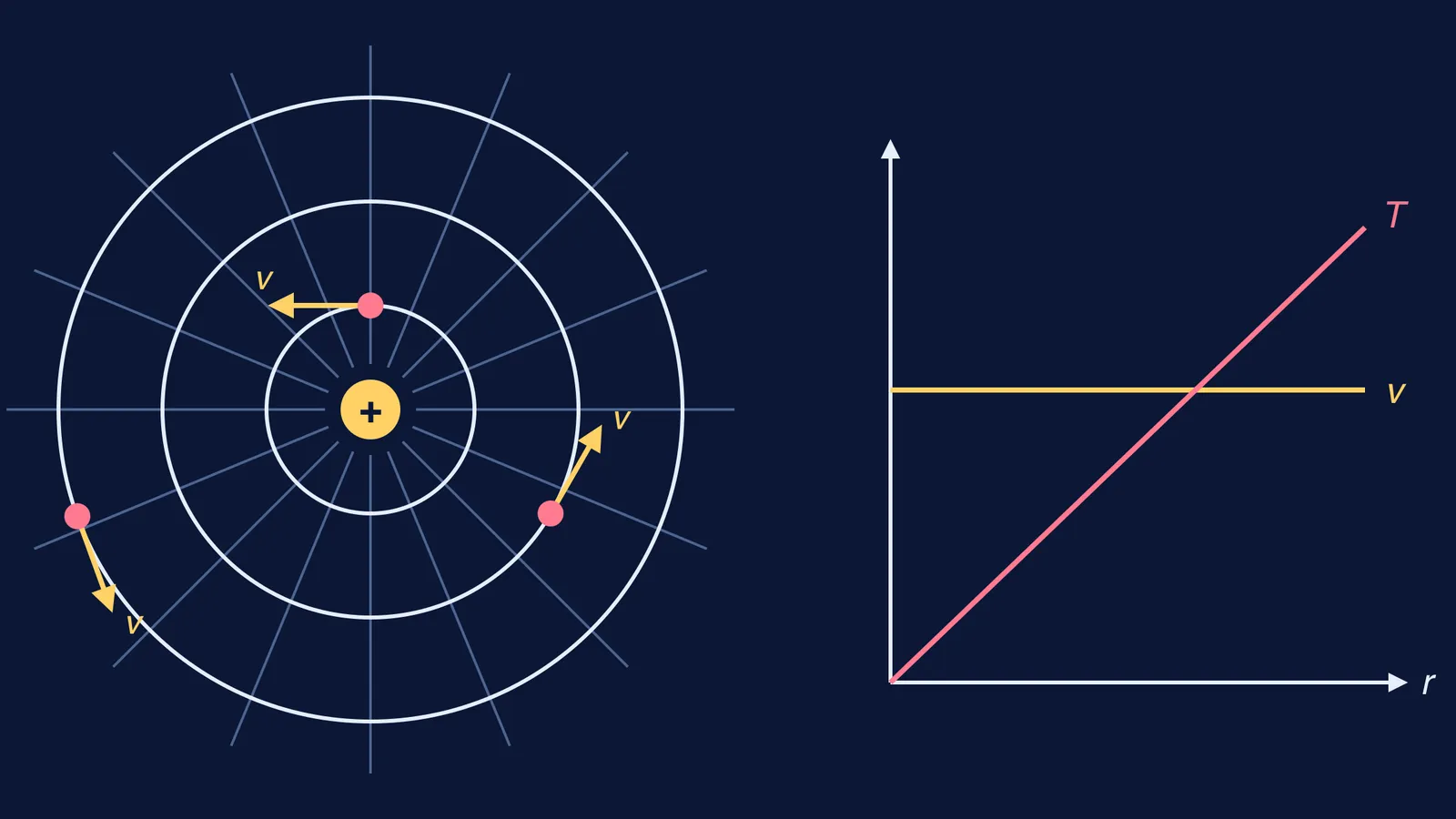
A classic electrostatics question: a charged particle circles a long, uniformly charged wire. How fast does it go, and what changes if the circle is bigger? The surprise is that the speed does not change at all. The time to go round once does.
Why is the speed independent of the radius?
Start with the field. For an infinitely long line with charge per unit length λ, Gauss's law gives a field that points straight out from the line and has magnitude E = λ/(2πε₀r), where r is the perpendicular distance from the line (OpenStax University Physics, Volume 2, section 6.3). If you want to see that result built from a cylindrical Gaussian surface, our walkthrough of the electric field of an infinite line charge using Gauss's law does it step by step.
The key feature is the 1/r. A point charge's field falls as 1/r², which is why planets in bigger orbits move more slowly. A line charge's field falls only as 1/r, and that single power of r is exactly what the circular-motion equation also contains.
How do you derive the orbital speed around a line charge?
Take a particle of charge q and mass m, with q and λ of opposite sign so the force pulls inward. Ignore gravity and radiation, as exam questions do.
Electric force on the particle: F = qE = qλ/(2πε₀r), in magnitude.
This force supplies the centripetal force: qλ/(2πε₀r) = mv²/r.
Multiply both sides by r. The r disappears: qλ/(2πε₀) = mv².
So v = √(qλ/(2πε₀m)), or v = √(2kqλ/m) with k = 1/(4πε₀).
Nothing on the right depends on r. Every circular orbit around the same line, near or far, has the same speed. It is the same move you make for a satellite, where GMm/r² = mv²/r gives v = √(GM/r); compare it with our orbital velocity and time period derivation for satellites and you can see the different power of r doing all the work.
Worked example: how fast does an electron circle a charged wire?
An electron orbits a long straight wire carrying a uniform positive charge of λ = 1.0 nC/m (1.0 × 10⁻⁹ C/m). Find its speed, and its period at r = 1 cm and r = 2 cm.
Use the CODATA values published by NIST: electron charge e = 1.602176634 × 10⁻¹⁹ C (NIST), electron mass m = 9.1093837139 × 10⁻³¹ kg (NIST) and ε₀ = 8.8541878188 × 10⁻¹² F/m (NIST).
2πε₀ = 5.563 × 10⁻¹¹ F/m.
eλ/(2πε₀) = (1.602 × 10⁻²⁸) ÷ (5.563 × 10⁻¹¹) = 2.880 × 10⁻¹⁸ J. This is mv².
v² = 2.880 × 10⁻¹⁸ ÷ 9.109 × 10⁻³¹ = 3.162 × 10¹² m²/s².
v ≈ 1.78 × 10⁶ m/s, at every radius.
That is about 0.6% of the speed of light, c = 299,792,458 m/s (NIST), so the non-relativistic formula is fine. The kinetic energy, half of mv², is 1.44 × 10⁻¹⁸ J, about 9.0 eV.
Does the time period depend on the radius?
Yes, and this is the trap. Students who have just proved that v is independent of r often write that "everything" is independent of r. The period is T = 2πr/v, and with v fixed, T is directly proportional to r.
At r = 1 cm: T = 2π(0.01 m) ÷ (1.78 × 10⁶ m/s) ≈ 3.5 × 10⁻⁸ s, or 35 ns.
At r = 2 cm: T ≈ 71 ns. Double the radius, double the period.
The same logic gives angular speed ω = v/r, which falls as 1/r, and centripetal acceleration v²/r, which also falls as 1/r. Only the speed and the kinetic energy stay fixed. If the idea that acceleration changes while speed does not feels slippery, read why centripetal acceleration is not constant even in uniform circular motion.
What should you check before writing the answer?
Signs: is the force attractive? An electron needs a positive line; a proton needs a negative one.
Units: λ in C/m, not C. Convert nC/m to 10⁻⁹ C/m.
Did r cancel? If your speed still has r in it, you used the point-charge field by mistake.
Which quantity is asked: v and KE are constant; T grows as r; ω and acceleration fall as 1/r.
If your working goes wrong at step 2 of the derivation, the Fermi Problem Library has worked problems with a step-by-step solver that explains the reasoning rather than printing an answer, so you can see where the force balance should come from. For the field itself, the line charge and Gauss's law each have their own lesson in the Fermi Concept Library.
Next time you see a charge circling a wire, write the force balance, cancel the r, and then ask which quantity the question actually wants.


