

On this page
If a JEE or Class 11 question gives you an L-shaped plate and asks where its centre of mass is, you do not need calculus. You need two rectangles, two centres and one weighted average.
How do you find the centre of mass of an L-shaped lamina?
A lamina is a thin flat plate, and uniform means its mass is spread evenly, so each piece's mass is proportional to its area. NCERT's Class 11 chapter on systems of particles and rotational motion defines the centre of mass of a system as X = Σmᵢxᵢ/M and Y = Σmᵢyᵢ/M, where M is the total mass. The same chapter shows, by symmetry, that a homogeneous body of regular shape has its centre of mass at its geometric centre, so a uniform rectangle's centre is where its diagonals cross.
So the method is:
Put the origin at the outer corner of the L, with x along the bottom edge and y up the side.
Cut the L into two rectangles that do not overlap.
Write down each rectangle's area and the coordinates of its centre.
Take the area-weighted average: X = (A₁x₁ + A₂x₂)/(A₁ + A₂), and the same for Y.
Worked example 1: NCERT's 3 kg L-shaped lamina
In Example 6.3 of the NCERT Class 11 physics chapter, the L is 2 m wide and 2 m tall with arms 1 m thick, and its total mass is 3 kg. NCERT cuts it into three 1 m squares of 1 kg each and gets a centre of mass at (5/6 m, 5/6 m).
Two rectangles give the same answer:
Bottom rectangle, 2 m by 1 m: mass 2 kg, centre (1, 0.5).
Top square, 1 m by 1 m: mass 1 kg, centre (0.5, 1.5).
X = (2×1 + 1×0.5)/3 = 5/6 m, and Y = (2×0.5 + 1×1.5)/3 = 5/6 m.
The answer lies on the diagonal y = x because this L is symmetric about that line, the point NCERT asks you to spot after the example.
Worked example 2: an L with unequal arms
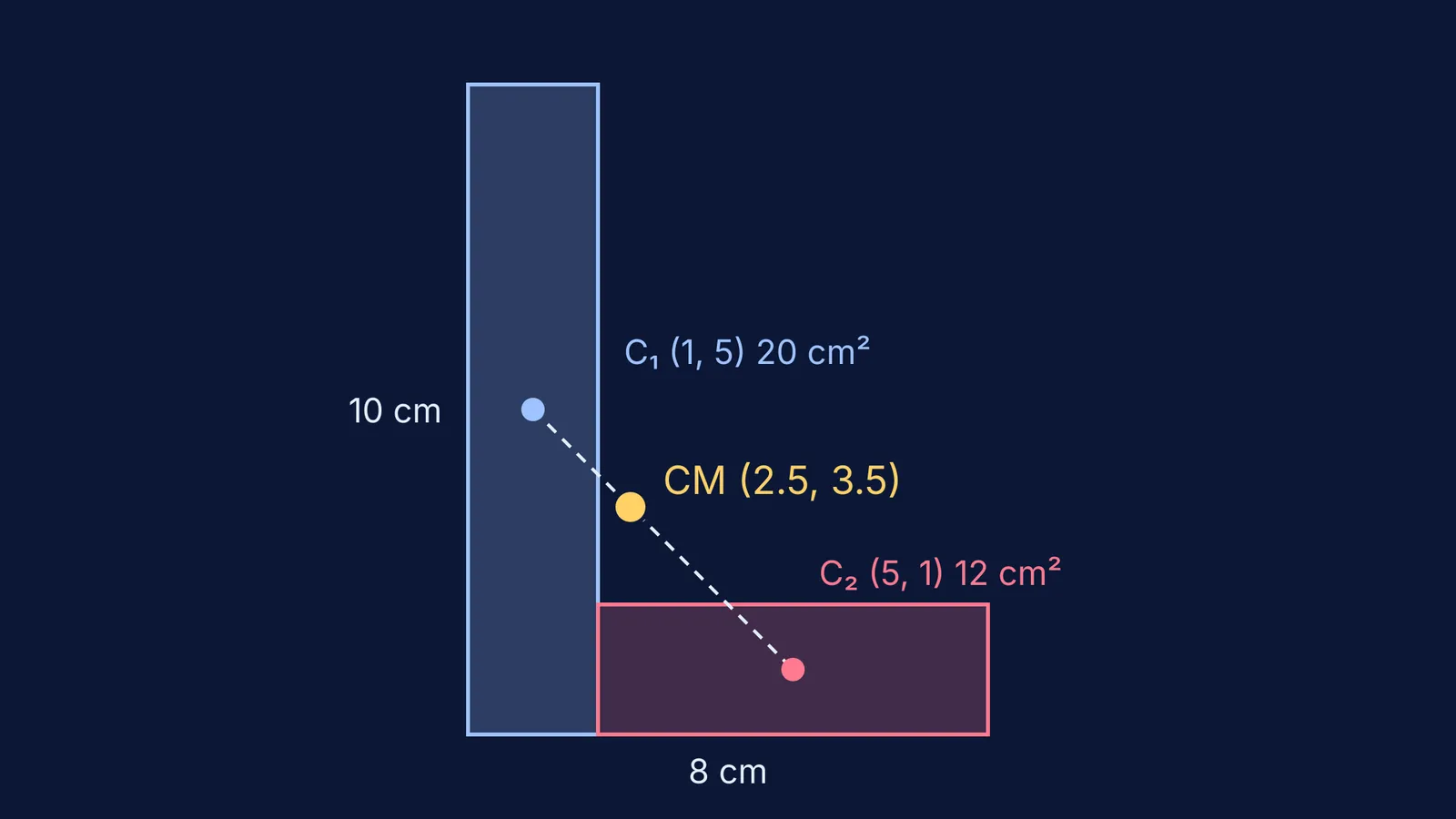
Now one without that symmetry, the shape in the diagram above: 10 cm tall, 8 cm wide, both arms 2 cm thick.
Rectangle 1, the upright, 2 cm by 10 cm: area 20 cm², centre (1, 5).
Rectangle 2, the foot to its right, 6 cm by 2 cm: area 12 cm², centre (5, 1).
X = (20×1 + 12×5)/32 = 2.5 cm, and Y = (20×5 + 12×1)/32 = 3.5 cm.
The centre of mass sits on the line joining the two centres and divides it in the ratio 12 : 20, closer to the bigger piece. Notice too that (2.5, 3.5) falls in the empty corner of the L, not on the plate. That is normal for bent shapes; our post on whether the centre of mass can lie outside the body explains why.
Does it matter which way you split the L?
No, and that gives you a free check. Cut the same L the other way: a full-width foot, 8 cm by 2 cm (area 16 cm², centre (4, 1)), plus the upright above it, 2 cm by 8 cm (area 16 cm², centre (1, 6)). Then X = (16×4 + 16×1)/32 = 2.5 cm and Y = (16×1 + 16×6)/32 = 3.5 cm. Same point.
A third route is subtraction. Take the full 8 cm by 10 cm rectangle (area 80 cm², centre (4, 5)) and remove the missing 6 cm by 8 cm block (area 48 cm², centre (5, 6)) as if it had negative area: X = (80×4 − 48×5)/32 = 2.5 cm and Y = (80×5 − 48×6)/32 = 3.5 cm. It is the same idea as finding the moment of inertia of a disc with a hole cut out.
What mistakes cost marks on this question?
Overlapping rectangles. If both rectangles include the corner square, it is counted twice and the answer drifts towards the corner.
Weighting by length. For a plate, the weights are areas (or masses), not side lengths.
Mixed origins. Measure every centre from the same origin.
Assuming uniform mass. NCERT ends its example by asking what happens if the squares had different masses: then you weight by mass, not area. For mass that changes smoothly, see how to find the centre of mass of a rod with variable density.
Skipping the sanity check. The answer must lie on the line between the two centres, closer to the heavier piece.
If you keep slipping on one of these steps, the Fermi Problem Library has worked problems with a step-by-step solver that explains the reasoning rather than printing an answer, so you can see where your working went off. To revise the idea itself, the Fermi Concept Library covers every concept in physics, each with its own lesson and its place in the map.
Try a T-shape or a U-shape next: same cuts, same average, one more rectangle.


