

On this page
A uniform disc has a circular hole punched in it, off-centre, and the question asks where the centre of mass is now. Integrating over that odd shape is slow. The faster route, used in many textbook and exam solutions, is to pretend the hole is a disc of negative mass.
Why does treating the hole as negative mass work?
The centre of mass of a system is the mass-weighted average of the positions of its parts, X = Σmᵢxᵢ / Σmᵢ, as defined in the NCERT Class 11 Physics chapter on systems of particles and rotational motion. Nothing in that sum cares how you divide the body into parts. So split the complete disc into two pieces: the plate you are left with, and the circle that was cut out.
Complete disc = remaining plate + cut-out circle.
You already know two of these three centres of mass. The same NCERT chapter shows, using reflection symmetry, that homogeneous rings, discs and spheres have their centre of mass at their geometric centre. So the complete disc balances at its middle, and the cut-out circle balances at the middle of the hole. Rearrange the weighted average for the one piece you don't know and you get the shift formula:
x_cm = (m₁x₁ − m₂x₂) / (m₁ − m₂)
Here m₁ and x₁ are the mass and centre of the complete disc, and m₂ and x₂ are those of the removed piece. The minus signs are the "negative mass": you add the hole to the system with mass −m₂.
How do you find the centre of mass of a disc with a hole cut out?
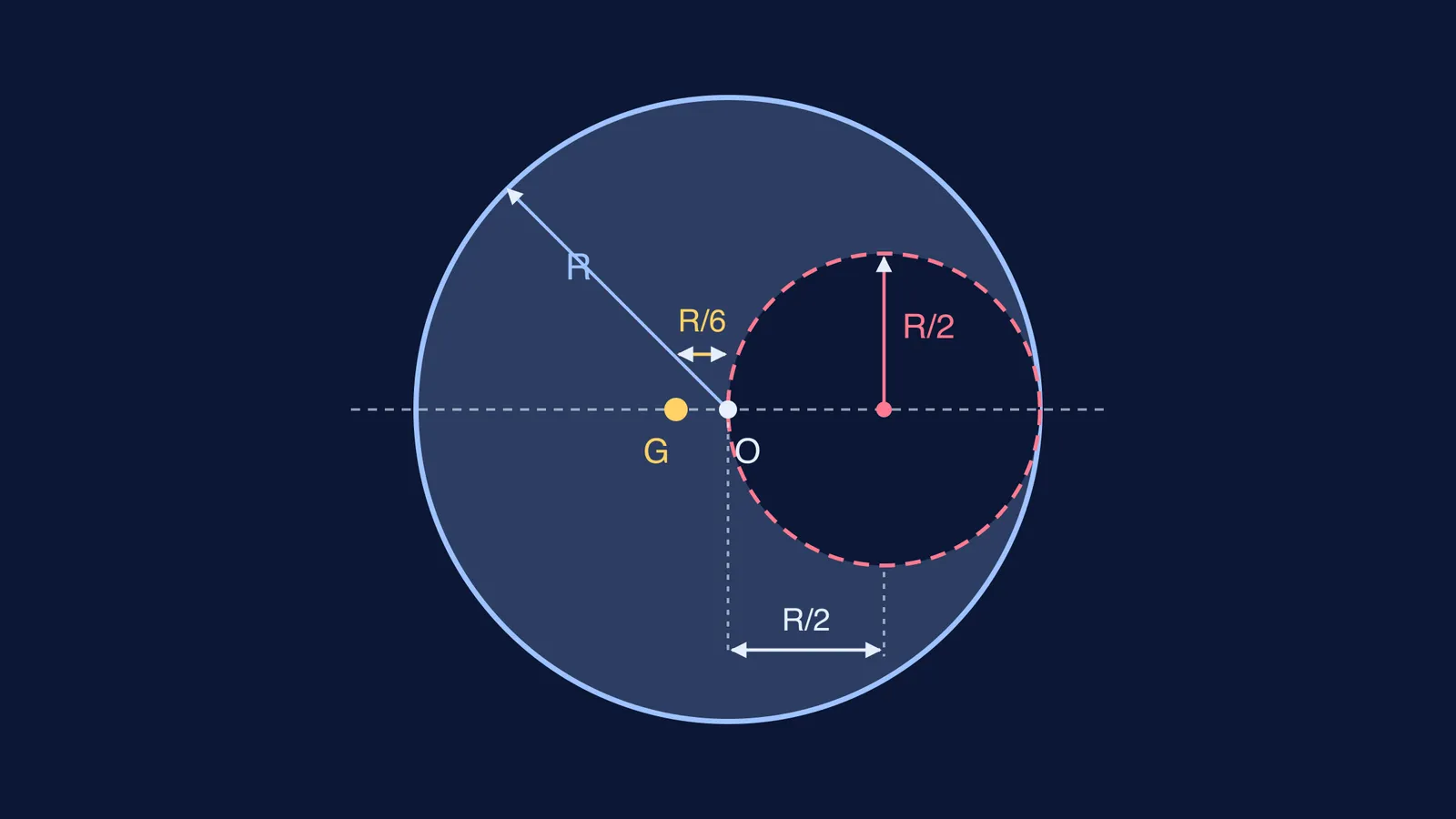
A uniform disc of radius R has a circular hole of radius R/2 cut out of it. The centre of the hole is R/2 from the centre of the disc. Find the new centre of mass.
Put the origin at the disc's centre O and run the x-axis through the hole's centre. The shape is symmetric about this axis, so the answer lies on it and y = 0.
For a uniform plate, mass goes with area. The complete disc has area πR²; call its mass M. The hole has area π(R/2)² = πR²/4, so its mass is M/4.
Positions: the complete disc is centred at x₁ = 0 and the hole at x₂ = R/2.
Substitute: x = (M × 0 − (M/4)(R/2)) / (M − M/4) = (−MR/8) / (3M/4) = −R/6.
The centre of mass is R/6 from O, on the side away from the hole. Check the direction every time: you removed mass from the right, so the balance point has to move left.
What does the shift look like with real numbers?
A disc of radius 12 cm has a hole of radius 4 cm whose centre is 6 cm from O. The area ratio is 16/144 = 1/9, so the removed mass is M/9. Then x = −(M/9)(6) / (8M/9) = −6/8 = −0.75 cm.
In general, for a disc of radius R with a hole of radius r centred at distance d, the centre of mass moves r²d/(R² − r²) away from the hole. For a solid sphere with a spherical cavity, mass goes with volume, so you use r³ instead of r².
What mistakes cost marks on this question?
Using the radius ratio instead of the area ratio. A hole with half the radius removes a quarter of the mass, not half.
Dividing by M instead of M − m₂. The mass that is left goes in the denominator.
Getting the sign wrong and putting the centre of mass on the hole's side.
Using areas for a three-dimensional body with a cavity, where you need volumes.
Where else does the subtraction trick show up?
The whole-minus-part idea works for any simple shape with a simple piece missing. You will meet it in moment of inertia problems with a portion removed, where you subtract the removed piece's moment of inertia, and in the electric field of a charged sheet with a circular hole, where you superpose a disc of opposite charge.
It also explains why a centre of mass can lie outside the body. The OpenStax University Physics section on centre of mass makes the point with a hollow sphere: its centre of mass is at its geometric centre, where there is no mass at all. Cut a big enough hole near the middle of a disc and the same thing can happen.
If you keep losing marks to a sign or a ratio, work a few variants in the Fermi Problem Library, where a step-by-step solver explains the reasoning rather than printing an answer. If the weighted-average definition itself feels shaky, the Fermi Concept Library gives each concept its own lesson and its place in the map.
Next time you see a plate with a hole, write "whole minus part" first, then the formula.


