

On this page
India counts every person once a decade. Census 2027 is the 16th Indian census and the 8th since independence, and the government calls it the largest census exercise in the world, according to a Press Information Bureau backgrounder on Census 2027. It is also India's first census by digital means: enumerators collect data on a mobile app, and households could enter their own details online before the houselisting visit.
What is an enumeration block in the census?
A houselisting block is a small mapped area, the basic unit of the fieldwork. For Census 2027 these blocks are drawn digitally on satellite imagery so that no area is missed or counted twice (PIB).
The Registrar General of India mapped 24.25 lakh houselisting blocks, each a micro-unit of up to 800 people, PTI reported in ThePrint. Each houselisting block normally becomes the enumeration block for the head count, and a block with more work than one enumerator can manage is split into smaller sub-blocks.
The blocks sit inside a fixed map. Administrative units were frozen as of 1 January 2026, and the frame has 784 districts and 6,39,902 villages, against 640 districts in 2011 (PIB).
What happens in the two phases of the census?
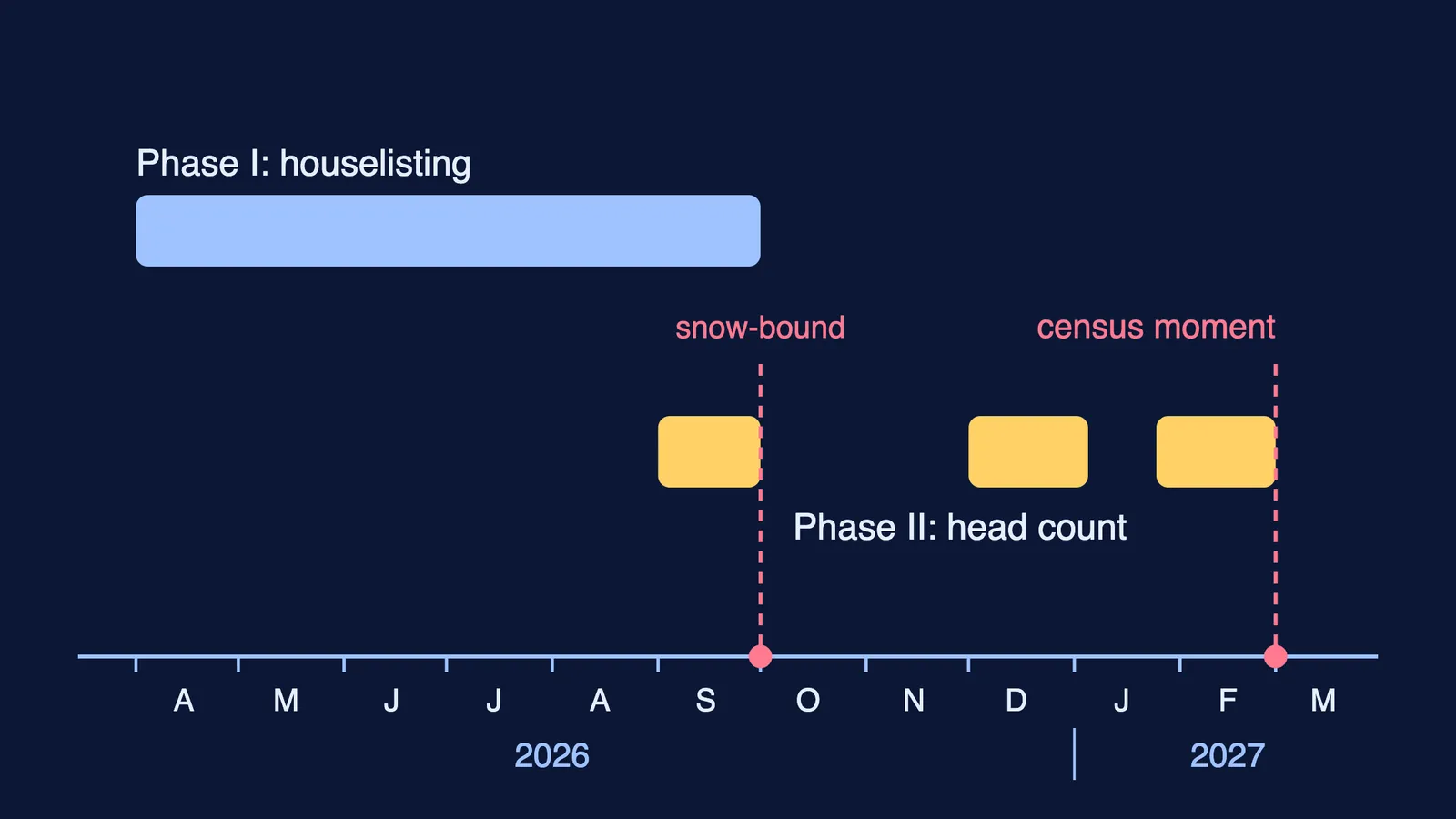
The PIB backgrounder sets out two phases.
Phase I, Houselisting and Housing Census. Held between April and September 2026, in a 30-day window each state or union territory chose, with an optional 15-day self-enumeration period just before it. Households that filled in their details online got a Self-Enumeration ID, which the enumerator used to confirm them. This phase records buildings and households: floor, walls and roof, drinking water, latrine, cooking fuel, and assets from a radio to a car. PIB's chart of the questions lists 34 items.
Phase II, Population Enumeration. The head count: demographic, socio-economic, cultural, migration and fertility details for each person. It also records caste; until 2011 the census enumerated only Scheduled Castes and Scheduled Tribes.
Houselisting has finished everywhere except Manipur, where it was deferred, according to the PTI report. Ladakh and snow-bound areas were counted from 1 to 30 September 2026. Goa, Uttar Pradesh, Punjab and the rest of Uttarakhand are scheduled for 1 December 2026 to 4 January 2027 because of assembly elections, and the rest of India for 25 January to 28 February 2027.
How much work does one enumerator do?
Here is a worked example using only the official numbers from ThePrint and PIB.
Blocks: 24.25 lakh, each up to 800 people.
Ceiling of the frame: 24.25 lakh × 800 = 194 crore people. That is the most the blocks could hold, not a population figure.
Time: for most of India, 25 January to 28 February 2027 is 35 days.
One full block, one enumerator: 800 ÷ 35 ≈ 23 people a day, every day, each answer recorded and checked.
Workforce: about 31 lakh enumerators and supervisors, plus more than 1 lakh other census functionaries.
If you enjoy this kind of estimate, the Fermi Problem Library has worked problems with a step-by-step solver that explains the reasoning rather than printing an answer.
A census asks everyone. A survey asks a sample and scales up, which is why exit polls can go wrong when the sample is off. Animals need other methods, as in how India's tiger census uses pug marks and faecal pellets.
What is census data used for?
Seats in Parliament. Article 82 of the Constitution says Lok Sabha seats among states, and the constituencies within them, are readjusted after each census. It also says that until the figures of the first census taken after 2026 are published, seats among states need not be readjusted from the 1971 census, nor constituencies from the 2001 census.
Planning and schemes. The census helps target government schemes and plan food, water, energy and infrastructure, PIB says.
Is my census data safe, and what should my family do?
Under Section 15 of the Census Act, 1948, personal information given to the census is strictly confidential: it cannot be made public under the RTI Act, used as evidence in court, or shared with any institution (PIB). Data is encrypted end to end and stored in data centres designated as Critical Information Infrastructure.
A short family checklist for the head count:
Know your dates: 25 January to 28 February 2027 for most of India, or 1 December 2026 to 4 January 2027 in Goa, Uttar Pradesh, Punjab and most of Uttarakhand (PTI in ThePrint).
Decide who will answer for the household when the enumerator visits.
Keep the census moment in mind: it is the instant that decides who is included.
Students: when results appear, read the tables yourself. Our guide to cleaning survey data for school projects is a good start, and the Fermi Concept Library has a lesson for each concept in mathematics.
The next time someone quotes a census figure, you will know it began with one enumerator, one block and one fixed moment.


