

On this page
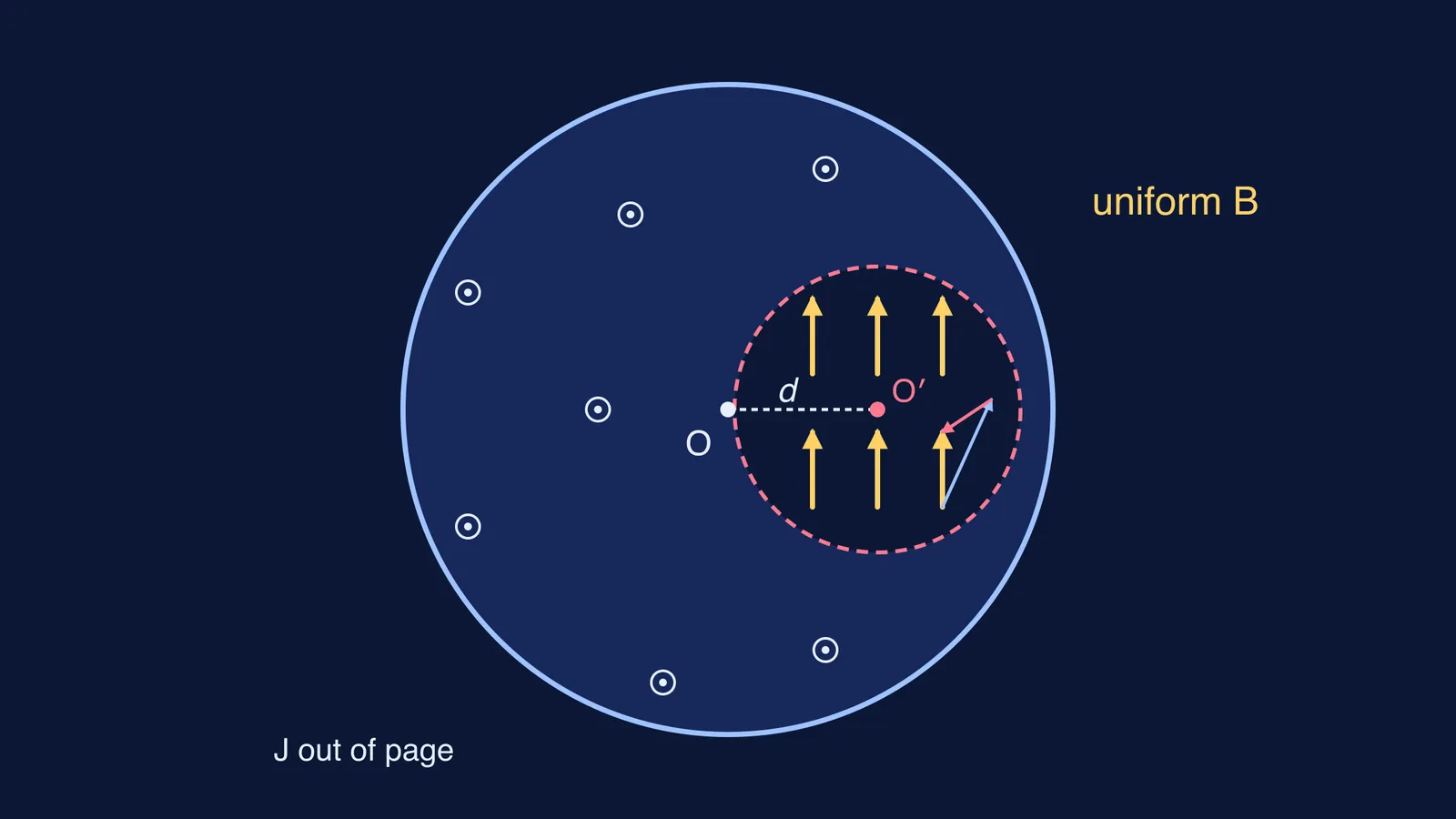
A long cylindrical conductor of radius a has a straight hole of radius b drilled along its length, with the hole's axis a distance d from the cylinder's axis. Current flows along the length, spread evenly through the remaining metal. What is the magnetic field inside the hole? It is the same at every point in the hole. Here is why.
Why can't you use Ampère's law directly?
Ampère's law says that the line integral of B around any closed path equals μ₀ times the current passing through a surface bounded by that path, as stated in OpenStax University Physics Volume 2, section 12.5. The law is always true, but it only hands you B when symmetry makes B the same size all the way round your loop.
An off-centre hole breaks that symmetry: the field strength changes as you go round any circle. The way out is superposition, because magnetic fields from separate currents add as vectors.
How does superposition give the field inside the cavity?
The trick, used in Christopher Baird's solution to Jackson problem 5.6, is to see the hollow conductor as two solid ones laid on top of each other.
Fill the hole. Imagine metal everywhere, carrying current density J. Inside a solid wire, Ampère's law gives B = μ₀I₀r/(2πa²) for r ≤ a, where I₀ is the total current (OpenStax, Example 12.7). Writing I₀ = Jπa², this becomes B₁ = μ₀Jr/2, circling the axis. As a vector, B₁ = (μ₀/2) J × r, with r measured from the cylinder's axis O.
Cancel the filling. Add a second cylinder exactly the shape of the hole, carrying current density −J. By the same result, inside it B₂ = −(μ₀/2) J × r′, with r′ measured from the hole's axis O′.
Add them. The two position vectors differ by a fixed vector: r − r′ = d, pointing from O to O′. So B = (μ₀/2) J × (r − r′) = (μ₀/2) J × d.
Nothing in the answer depends on where you stand in the hole. The field in the cavity is uniform, with magnitude B = μ₀Jd/2, and it points perpendicular to both the current and the line joining the two axes, which is the boxed result in Baird's solution.
The same "add the missing piece with the opposite sign" move appears in electrostatics too. We use it for an electric field on the axis of a charged sheet with a circular hole.
Worked example: how strong is the field in the hole?
Take a copper rod of radius a = 5.0 mm with a hole of radius b = 2.0 mm, axes d = 2.5 mm apart, carrying I = 21 A along its length. Use μ₀ = 4π × 10⁻⁷ T·m/A (OpenStax College Physics 2e).
Metal area: π(a² − b²) = π(25 − 4) mm² = 21π mm², about 6.6 × 10⁻⁵ m².
Current density: J = 21 A ÷ (21π × 10⁻⁶ m²) = 10⁶/π A/m², about 3.18 × 10⁵ A/m².
Field: B = μ₀Jd/2 = (4π × 10⁻⁷)(10⁶/π)(2.5 × 10⁻³)/2 = 5.0 × 10⁻⁴ T, or 0.5 mT.
In terms of the total current, B = μ₀Id/[2π(a² − b²)], which gives the same 0.5 mT. For direction, let the current come out of the page and the hole sit to the right of the axis: J × d then points straight up, everywhere in the hole. New to J? Read our explainer on what current density is and why it is a vector.
What mistakes cost marks on this problem?
Using the total current I for the filled cylinder. The filled cylinder carries Jπa², not I. Find J from the metal area first.
Dropping the minus sign on the cavity current. Without it you get a field that grows across the hole, not a constant one.
Measuring r′ from O instead of from the hole's own axis O′.
Saying the field points along d or along the wire. It is perpendicular to both.
Using μ₀Jd/2 in the metal. There the cavity-shaped cylinder acts like an outside wire, with a field that falls off as 1/r′, so the total is not uniform.
How do you practise the superposition trick?
When a shape looks awkward, ask whether it is a symmetric shape minus another symmetric shape. If yes, solve each piece with Gauss's or Ampère's law, give the missing piece the opposite sign, and add vectors at the point you care about. A good warm-up is the magnetic field midway between two parallel wires.
If you want more problems built on this move, the Fermi Problem Library has worked problems with a step-by-step solver that explains the reasoning rather than printing an answer. If Ampère's law itself is the gap, the Fermi Concept Library gives each concept its own lesson and its place in the map.
Next time you see a hole in a wire: fill it, cancel it, add.


