

On this page
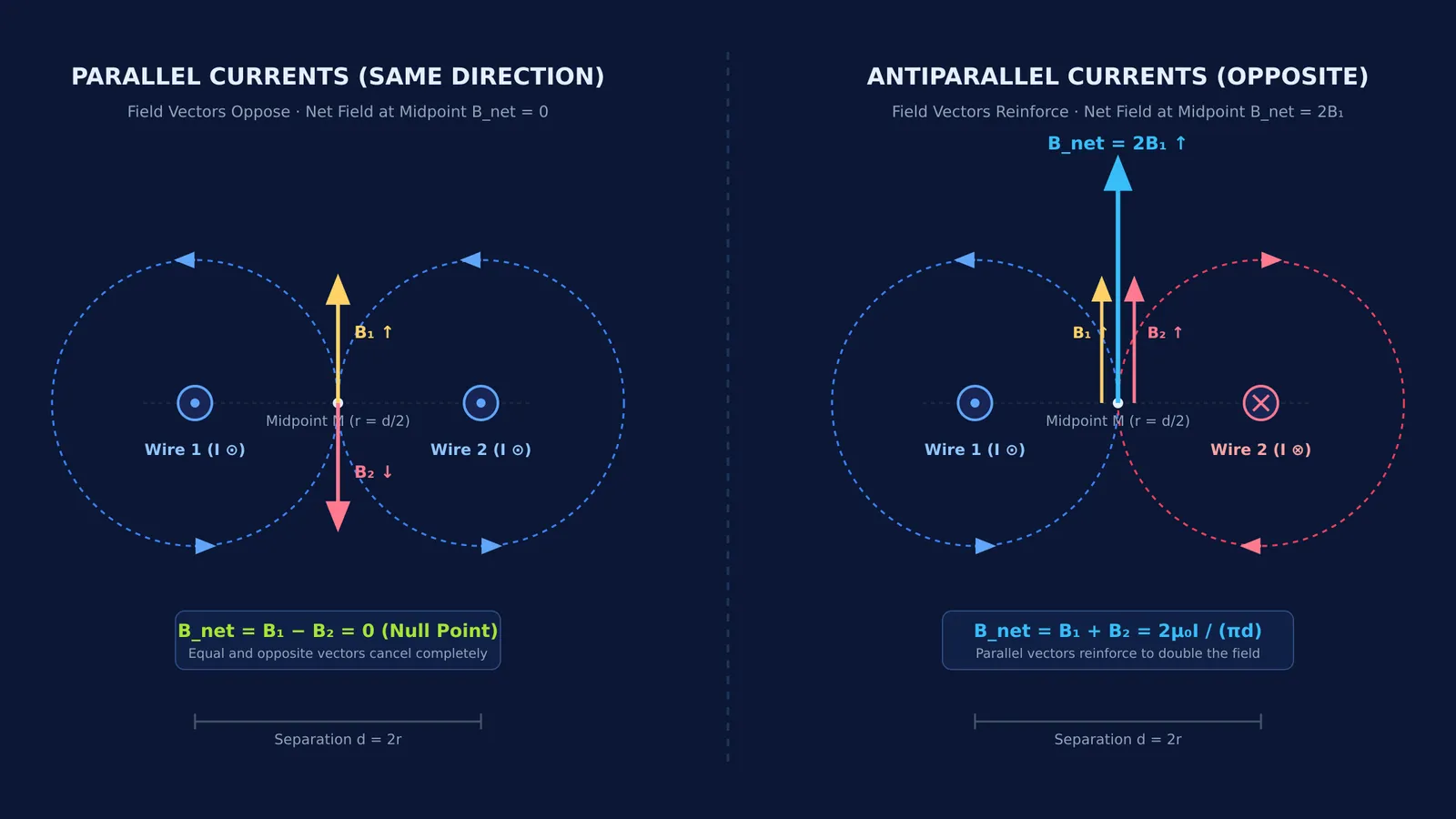
When two long, straight parallel conductors carry steady electric currents, each establishes a cylindrical magnetic field in the surrounding space. The net magnetic field at any point is determined by the vector superposition of these individual fields. At the midpoint between two wires, this vector addition leads to two contrasting outcomes depending on current direction: fields from equal parallel currents cancel to zero, while fields from opposite currents reinforce each other to double the field of a single wire.
Why does the magnetic field cancel at the midpoint?
According to OpenStax University Physics, an infinitely long straight wire carrying current I produces a magnetic field B = (μ₀ I) / (2π r) at perpendicular distance r. The vacuum permeability constant μ₀ is catalogued by NIST CODATA as 1.25663706127 × 10⁻⁶ N·A⁻² and commonly approximated as 4π × 10⁻⁷ T·m/A.
To determine field orientation, apply the right-hand thumb rule derived from Biot-Savart and Ampère's law: pointing your right thumb along the current curls your fingers along concentric circular field lines.
Consider two parallel wires separated by distance d, both carrying equal current I directed out of the page (⊙):
At the midpoint (r = d / 2), Wire 1 circulates counter-clockwise, pointing upwards with magnitude B₁ = (μ₀ I) / (π d).
Wire 2 also circulates counter-clockwise, pointing downwards at the midpoint with magnitude B₂ = (μ₀ I) / (π d).
Because these vectors have equal magnitude and opposite directions, their vector sum vanishes: B_net = B₁ − B₂ = 0. The midpoint is a true null point where the net field is zero.
As explained in OpenStax University Physics, each wire feels the field of the other wire rather than the midpoint field. This interaction underlies the force between parallel currents and the definition of the ampere, which historically defined 1 A as producing 2 × 10⁻⁷ N/m at 1 metre separation.
What happens when the currents flow in opposite directions?
When currents flow in opposite directions (antiparallel currents), midpoint cancellation vanishes. Suppose Wire 1 carries current I out of the page (⊙), while Wire 2 carries current I into the page (⊗):
Wire 1 circulates counter-clockwise, directing B₁ = (μ₀ I) / (π d) upwards at the midpoint.
Wire 2 circulates clockwise, directing B₂ = (μ₀ I) / (π d) upwards at the midpoint as well.
Because both vectors point in the same direction, they add directly:
B_net = B₁ + B₂ = (μ₀ I) / (π d) + (μ₀ I) / (π d) = (2 μ₀ I) / (π d).
The net field at the midpoint is exactly twice the single-wire field. The Fermi Simulation Lab provides interactive simulations for the ideas that are easier to see than to read, allowing you to rotate conductor geometry and see vector fields superpose in real time.
How do you find the null point for unequal currents?
When currents are unequal (I₁ ≠ I₂), zero magnetic field occurs where individual field magnitudes balance:
Parallel currents (same direction): Fields oppose between the wires. Equating (μ₀ I₁) / (2π x) = (μ₀ I₂) / (2π (d − x)) simplifies to I₁ / x = I₂ / (d − x), giving x = d × I₁ / (I₁ + I₂) from Wire 1. The null point always lies between the wires, closer to the weaker current.
Antiparallel currents (opposite directions): Fields reinforce between the wires and oppose only in outer regions. For I₁ < I₂, balance occurs outside Wire 1 at distance x = d × I₁ / (I₂ − I₁). If opposite currents are equal, no finite null point exists.
How can you avoid common right-hand rule mistakes in exam numericals?
When setting up superposition problems, sign confusion in vector directions often causes errors. The Fermi Problem Library offers worked problems with a step-by-step solver that explains the reasoning rather than printing an answer, helping students verify vector directions before calculating numerical values.
Following standard superposition numericals in OpenStax University Physics, consider two long parallel wires separated by d = 20 cm (0.20 m) carrying parallel currents I₁ = 6 A and I₂ = 2 A:
At the midpoint (r = 0.10 m): Wire 1 produces B₁ = 1.2 × 10⁻⁵ T upwards and Wire 2 produces B₂ = 0.4 × 10⁻⁵ T downwards. The net field is B_net = 1.2 × 10⁻⁵ − 0.4 × 10⁻⁵ = 0.8 × 10⁻⁵ T (8.0 μT) directed upwards.
Locating the null point: Using x = d × I₁ / (I₁ + I₂) = 20 cm × 6 / (6 + 2) = 15 cm from Wire 1 (5 cm from Wire 2), where both fields balance at 40 A/m to cancel completely.
Follow this 4-step checklist on parallel wire problems to avoid magnetic right-hand-rule mistakes:
Mark current directions: Sketch ⊙ and ⊗ before writing formulas.
Draw tangent vectors: Sketch the tangent arrow for each circular field line at the target point independently.
Identify the null zone: Remember that parallel currents cancel between wires, while antiparallel currents cancel outside the weaker wire.
Simplify the ratio: Use I₁ / r₁ = I₂ / r₂ directly to eliminate common factors and avoid rounding errors.


