

On this page
A 4 metre fall with 20 metres of rope out gives a gentler catch than the same fall just above the belay with 2 metres out. The reason is one ratio, the fall factor, and Class 11 spring and energy physics explains it.
What is fall factor in rock climbing?
The fall factor is the height a climber falls divided by the length of rope available to absorb the fall (Wikipedia: Fall factor). Climbing from the ground it cannot exceed 1; on a multi-pitch route it can reach 2 if the leader falls past the belayer before clipping any protection.
Why a ratio? The rope is a spring, and a longer rope is a softer one: its stiffness is k = EA/L (modulus E, cross-section A, length L). The fall's energy goes into stretching it, ½kx². Double both the fall and the rope and you double the energy but halve the stiffness, so the peak force stays the same. That is the same energy bookkeeping as in why a trampoline can't bounce you higher for free.
What does a dynamic rope's impact force rating mean?
Impact force is the peak tension in the rope as it catches a fall. The UIAA's pictorial of EN 892 and UIAA 101 shows the drop test:
A single rope catches an 80 kg mass, and the peak force in the first drop must be 12 kN or less.
The rope must hold at least 5 drops without breaking.
It may stretch at most 40% in the first drop, and at most 10% when an 80 kg mass simply hangs on it.
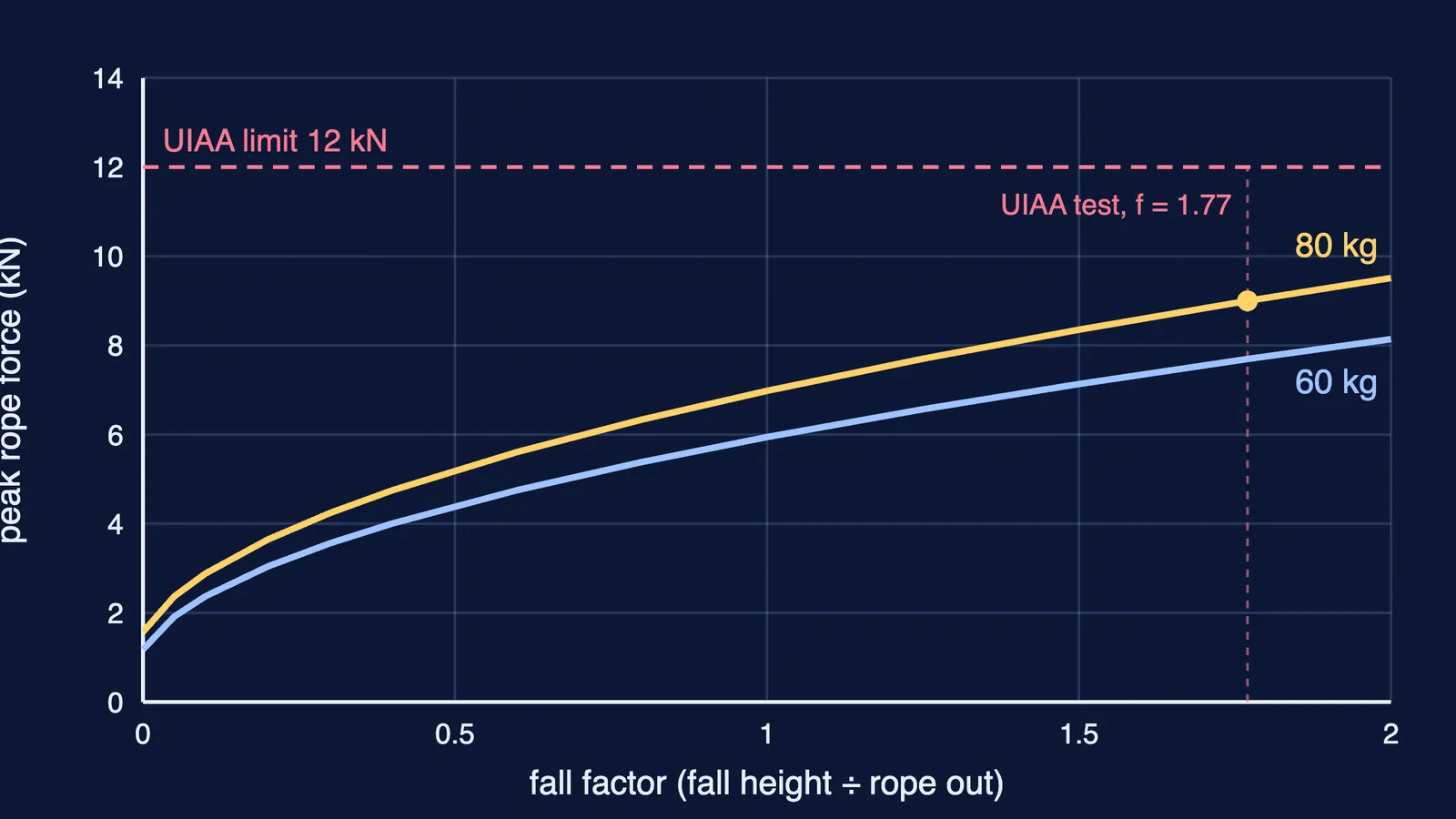
In Wikipedia's account of the test, the mass falls 4.6 m onto 2.6 m of rope, a fall factor of 1.77, and reaches about 9.5 m/s. The pictorial dates from 2020; the current UIAA 101, ninth edition, July 2025 requires ropes to meet EN 892:2012+A3:2023. A lower impact force on the label means a softer catch.
Worked example: how hard does a 4 m fall pull?
Modelling the rope as an ideal spring matched to its label, the peak rope force is F = mg + √((mg)² + F₀(F₀ − 2m₀g)(m/m₀)(f/f₀)), where F₀ is the label's impact force, m₀ = 80 kg and f₀ = 1.77 (derivation on Wikipedia). Take a rope labelled 9 kN and a 60 kg climber:
A 4 m fall with 20 m of rope out: f = 0.2, so F is about 3.0 kN.
A fall factor of 1: about 5.9 kN.
A 4 m fall with 2 m of rope out: f = 2, so F is about 8.1 kN.
Same drop, nearly 2.7 times the force. Real falls differ: carabiner friction makes the rope act shorter and raises the force, while rope slipping through the belay device lowers it. The UIAA and British Mountaineering Council guidance on connectors says that in normal falls on a dynamic rope the force on the top runner is very unlikely to go above 10 kN.
What does the kN rating on a carabiner mean?
One kilonewton is roughly the weight of a 102 kg mass (1000 N ÷ 9.81 m/s²). The standard requires carabiners to be marked with their strengths. The example in the UIAA and BMC guidance reads 22, 10 and 9 kN: the strength along the spine with the gate closed, across the minor axis, and along the spine with the gate open.
The guidance says a basic carabiner loaded lengthwise with the gate closed holds at least 20 kN, but is much weaker, typically 7 kN, across its minor axis. The minimum gate-open strength for a basic carabiner is 7 kN, raised from 6 kN by the 1998 standard.
How do you read the numbers before you climb?
This checklist explains the numbers; it does not replace training with a qualified instructor.
Check the rope's impact force on its label: lower means a softer catch.
Falls close to the belay have high fall factors; clipping protection above the belay brings the factor below 2.
Find the gate-open figure on every carabiner.
Load carabiners along the spine, and where a three-way load can't be avoided keep the angle between slings under 60°, as the UIAA and BMC guidance advises.
Never rely on slings alone to catch a fall: with no rope stretch, the guidance warns, forces above 25 kN are quite possible, enough to break a closed carabiner.
How does this help with exam physics?
Write mgh + mgx = ½kx², solve the quadratic for x, and F = kx gives the formula above. Revise work done by a variable force as the area under the F-x graph and strain energy per unit volume.
If the stretching spring is hard to picture, the Fermi Simulation Lab has interactive simulations for ideas that are easier to see than read. For numericals like this one, the Fermi Problem Library has a step-by-step solver that explains the reasoning, and Fermi's AI tutor works out what you already know and builds a plan for the session.


