

On this page
Picture a friend's car that won't start and a second car pulling it home on a rope. JEE-style questions ask: how hard is the rope pulling? The answer depends on only one of the two cars, and it changes sharply if the rope goes slack and snaps tight.
What is the tension in a tow rope between two accelerating cars?
Tension is "a pulling force that acts along a stretched flexible connector, such as a rope or cable", in the words of OpenStax University Physics. In a tow, it is the only forward force on the towed car, because that car's engine is off.
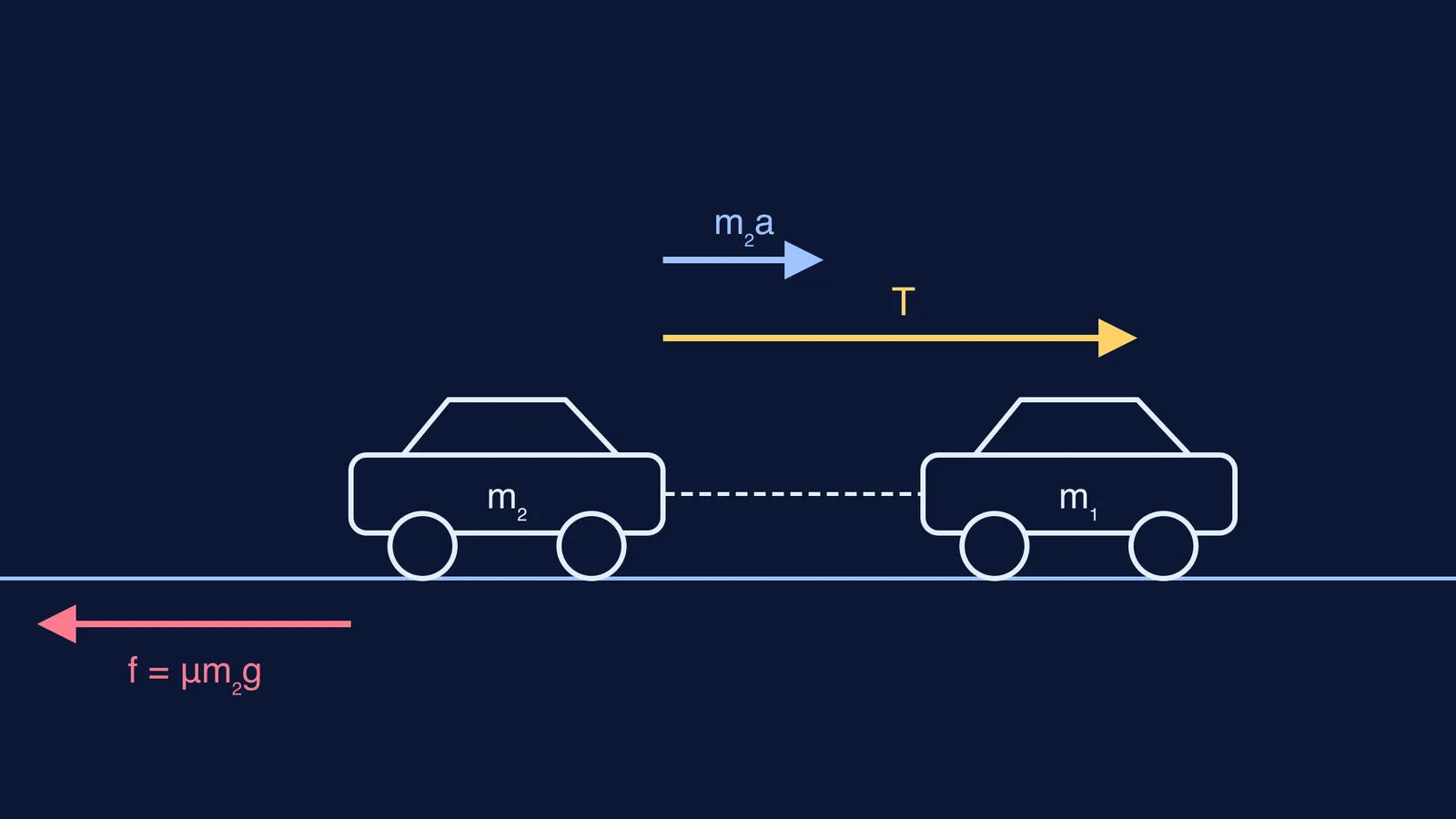
So write Newton's second law for the towed car alone, with mass m₂. Forward: the tension T. Backward: a resistance force. Textbooks model it like friction, f = μN, the form used in the OpenStax friction chapter, with N = m₂g on a level road. Then:
T − μm₂g = m₂a, so T = m₂(a + μg).
The rope has two jobs: give the towed car its acceleration (m₂a) and cancel its resistance (μm₂g). If the cars cruise at a steady speed, a = 0 and the rope only fights resistance.
Why doesn't the front car's mass appear in the answer?
Because the rope's back end touches only the towed car. The front car's mass matters for finding a in the first place: treat both cars as one body, and a is the driving force minus the total resistance, divided by m₁ + m₂. Once you know a, the tension comes from the back car alone. Our guide on when to treat connected blocks as one system walks through that two-step habit.
Worked example: a 1,000 kg car on a tow rope
Take m₂ = 1,000 kg, a = 0.5 m/s² and g = 9.8 m/s², the value OpenStax uses in its examples.
Textbook version, with μ = 0.1: T = 1,000 × (0.5 + 0.98) = 1,480 N. Of that, 500 N accelerates the car and 980 N cancels resistance.
Real-road version: a car rolling freely on its tyres feels rolling resistance, not sliding friction. A Transportation Research Board report says that in standard tests, most new passenger tyres have reported rolling resistance coefficients of 0.007 to 0.014. With 0.012, T = 1,000 × (0.5 + 0.118) ≈ 618 N. Across that whole range, T runs from about 569 N to 637 N.
On a real road at low towing speed, most of the rope's pull goes into accelerating the car, not fighting the road. An exam μ of 0.1 is an idealised number, about 7 to 14 times a new tyre's coefficient, so always use the value the question gives rather than importing real-world data.
What breaks first if the tow rope jerks?
Now suppose the rope is slack, the towed car is at rest, and the front car (m₁ = 1,200 kg) is already moving at 2 m/s when the rope snaps taut. By the impulse-momentum theorem, the change of momentum "is exactly equal to the impulse that was applied" (OpenStax).
If the rope barely stretches and we ignore the engine during the brief jerk, the cars quickly share a common speed, found from momentum conservation: v = 1,200 × 2 ÷ 2,200 ≈ 1.09 m/s. The impulse on the towed car is 1,000 × 1.09 ≈ 1,090 N s.
If the jerk lasts 0.1 s, the average tension is about 10,900 N, roughly 18 times the steady 618 N pull.
If a stretchier rope spreads it over 0.5 s, the average falls to about 2,180 N.
Same impulse, shorter time, bigger force: the reason a cushion stops an egg breaking.
So what breaks first? In a light rope the tension is the same all along its length, so the jerk loads every part equally and the weakest part fails: the rope itself, a knot, or the point where it is tied to a car. Our post on what happens when a slack string becomes taut works the same idea with blocks. In real life, take up the slack gently before pulling away, use towing equipment meant for the job, and follow your local traffic rules on towing.
Checklist for tow-rope problems
Draw the towed car on its own: T forward, resistance backward.
Read what μ stands for (sliding friction or rolling resistance) and use the value given.
If a is not given, find it from both cars as one system first.
On level ground, T = m₂(a + μg). On a slope, resistance becomes μm₂g cos θ, and going uphill you add m₂g sin θ.
For a jerk, switch to momentum and impulse; steady-state F = ma will badly underestimate the force.
If a step in your own working doesn't match, the Fermi Problem Library has worked problems with a step-by-step solver that explains the reasoning rather than printing an answer. If tension or impulse feels shaky, the Fermi Concept Library gives each concept its own lesson and its place in the map.


