

On this page
You pull a small yellow disc out of a parts box for a school practical, and all it says is 104. It is not 104 pF. Here is how to read the three common types, find the negative leg of an electrolytic, and choose a safe voltage rating.
How do you read a capacitor code like 104?
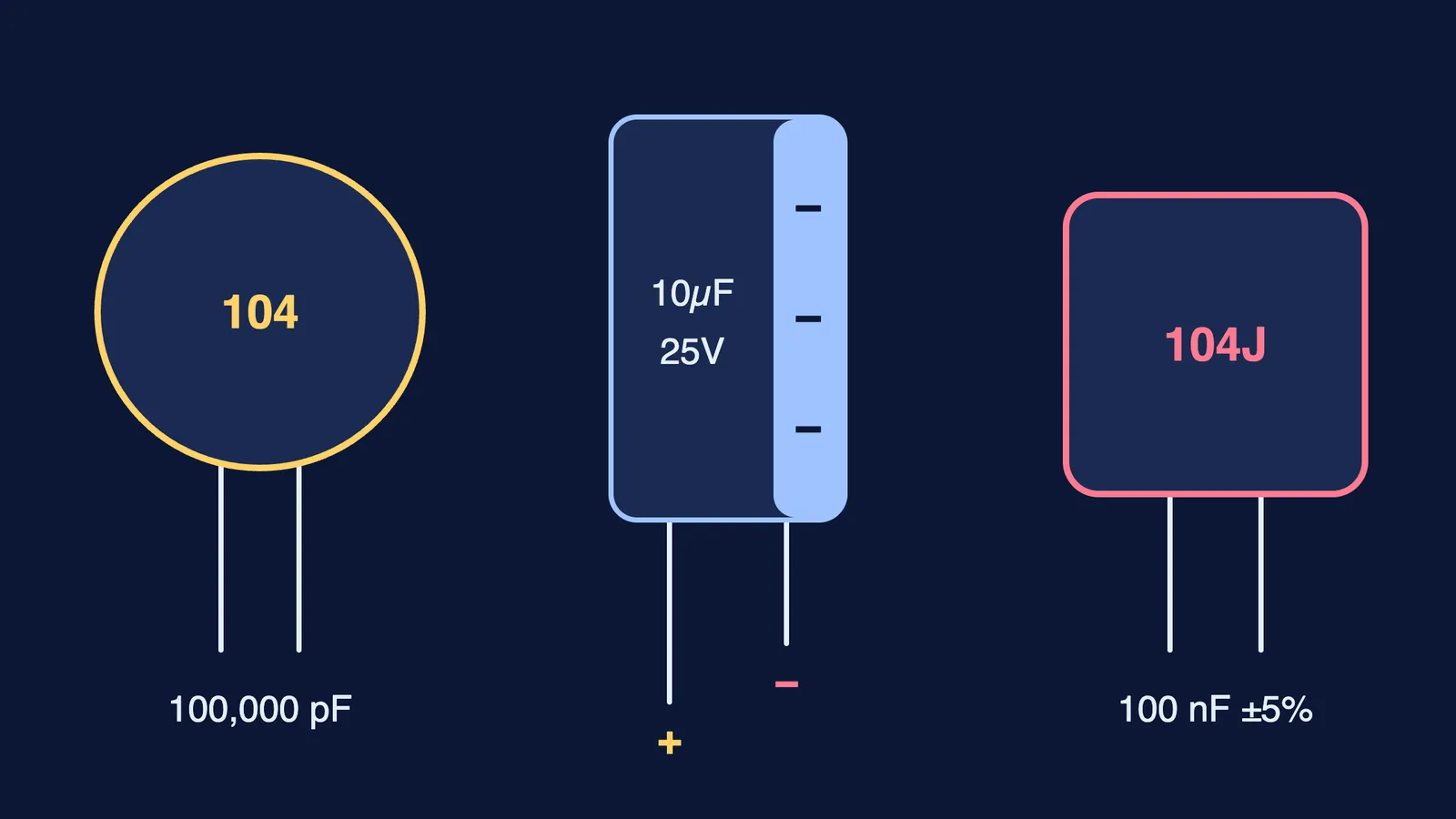
Small ceramic capacitors usually carry a three-digit code in picofarads instead of a printed value. SparkFun's capacitor identification guide gives the rule: the first two digits are the significant digits of the value, and the third digit is the power of ten. So 104 is 10 followed by four zeros: 100,000 pF, which is 100 nF or 0.1 µF.
Write down the first two digits.
Add as many zeros as the third digit says.
Read the answer in picofarads; divide by 1,000 for nF, or by 1,000,000 for µF.
Check for a letter after the digits. According to Electronics Tutorials, J means 5%, K means 10% and M means 20% tolerance.
Worked examples, using that rule:
101: 10 and one zero, so 100 pF.
220: 22 and no zeros, so 22 pF, as SparkFun's own table lists it.
472: 47 and two zeros, so 4,700 pF, or 4.7 nF.
222K: 2,200 pF (2.2 nF) with 10% tolerance, so anything from 1,980 to 2,420 pF is in spec.
104J: 100 nF with 5% tolerance, so 95 to 105 nF.
105: 1,000,000 pF, which is 1 µF.
Ceramic, electrolytic or film: which one do you have?
Ceramic: SparkFun describes the ones in its kit as small, non-polarised capacitors with a yellow blob for a body, rated 50 V and marked with the three-digit code (SparkFun).
Electrolytic: cylindrical bodies that look like small soda cans, usually with higher capacitance than ceramics. They are polarised and print the value and voltage directly, such as "1µF/50V" (SparkFun).
Film: these use plastic dielectrics such as polyester (Mylar), polypropylene or polycarbonate (Electronics Tutorials). Like ceramics they are non-polarised and can be fitted either way round (Electronics Tutorials). If a film capacitor carries a three-digit code, read it exactly as above.
The material between the plates is what sets these families apart; see what dielectric constant means.
Which leg of an electrolytic capacitor is negative?
SparkFun's guide says the stripe painted on the body usually marks the negative lead, and the positive lead is longer (SparkFun). The positive leg has to stay at a higher DC potential than the negative one; fitted backwards, the guide warns, electrolytics are prone to explode.
Nippon Chemi-Con's precautions for aluminium electrolytic capacitors says never to apply a reverse voltage or AC. Connected the wrong way, it says, the capacitor can short-circuit or be damaged as its pressure relief vent opens early. Even bipolar electrolytics, it adds, must not be used in AC circuits.
What voltage rating should a capacitor have?
The voltage printed on a capacitor is the maximum DC potential it can withstand without damage (SparkFun). Electronics Tutorials advises choosing a rating at least 50% above the supply voltage. Chemi-Con adds that the DC voltage plus the peak of any ripple must stay below the rated voltage, and that a surge rating does not guarantee long-term use at that level (Chemi-Con).
Two worked examples using that 50% margin:
A 9 V battery circuit: 9 × 1.5 = 13.5 V. A 25 V electrolytic is fine; a 10 V one is not.
A 12 V adapter with 2 V of ripple on top: the peak is 14 V, and 14 × 1.5 = 21 V, so a 25 V part still works, while a 16 V part is too close.
Capacitors in series do not simply add their ratings: see maximum voltage across capacitors in series with different ratings.
A 30-second check before you switch on
Decode the value and match it to the circuit diagram.
Check that the tolerance letter is close enough for the job.
If it is an electrolytic, put the stripe on the lower-voltage side.
Check that the rating is at least 1.5 times the highest voltage, ripple included, following the 50% margin from Electronics Tutorials.
Discharge before handling. Chemi-Con warns capacitors can recharge by themselves, recommends discharging through a resistor of about 1 kΩ, and says never to touch the terminals with bare hands (Chemi-Con).
How long discharge takes is an RC question, worked through in our post on when a capacitor's stored energy falls to half. To watch charge build up and drain away, try the interactive simulations in the Fermi Simulation Lab. If capacitance itself still feels fuzzy, Fermi's AI tutor can work out what you already know and build a plan for the session.


