
On this page
Business Services is Unit 4 of CBSE Class 11 Business Studies, and it is the unit closest to everyday life: the account a shop keeps with its bank, the policy on its stock, the parcel it posts to a customer. Here is what the current syllabus asks for.
What does the CBSE syllabus include in business services?
The CBSE Business Studies curriculum for 2026-27 lists these topics under Unit 4:
Business services: meaning and types
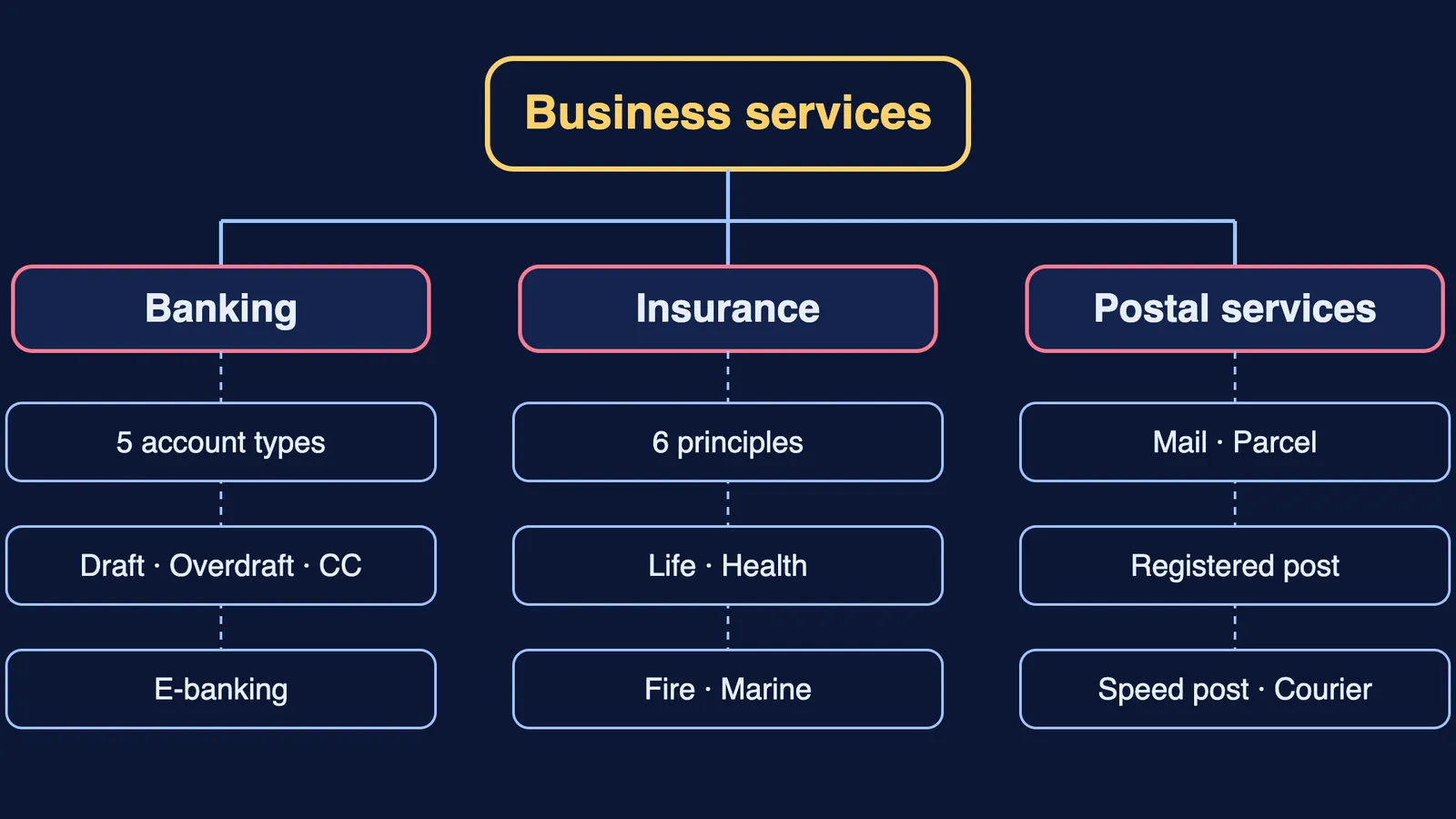
Bank accounts: savings, current, recurring, fixed deposit and multiple option deposit
Banking services: bank draft, bank overdraft and cash credit
E-banking: meaning and types of digital payments
Insurance: principles, and four types (life, health, fire and marine)
Postal services: mail, registered post, parcel, speed post and courier
The marks table groups Units 3 and 4 together for 14 of the 80 theory marks.
If you came looking for "communication and transport", note one change. In the current syllabus, transport, warehousing and communication appear in Unit 1 as auxiliaries to trade, at the level of meaning only; Unit 4's communication content is postal services. The NCERT chapter on business services still has long sections on transport, warehousing and telecom; ask your teacher how much of it your school will test.
What are business services?
NCERT defines business services as the services business enterprises use to carry on their activities, such as banking, insurance, transport, warehousing and communication (NCERT Business Studies, Chapter 4). The chapter sets them apart from social services, which are provided voluntarily for social goals, and personal services, such as tourism or restaurants, which each customer experiences differently.
The chapter also notes a service is intangible, cannot be stored, and is produced and consumed at the same time.
For where these auxiliaries fit in the wider map of commerce, see our notes on the nature and purpose of business in Class 11.
What are the types of bank accounts in Class 11?
The clearest definitions come from the RBI's Master Direction on interest rate on deposits:
Savings account: an interest-bearing demand deposit, with limits on the number and amount of withdrawals in a period.
Current account: a demand deposit that pays no interest and allows withdrawals any number of times.
Fixed deposit: a term deposit kept for a fixed period at a higher rate than a savings account, per NCERT.
Recurring deposit: the RBI direction names it as one kind of term deposit.
Multiple option deposit: SBI describes its MOD as a term deposit that can be linked to a savings account. Money above a set balance sweeps into the deposit automatically, and if the savings balance runs short, part of the deposit is broken and sent back (a "reverse sweep").
How are a bank draft, overdraft and cash credit different?
Bank draft: per NCERT, the bank issues a draft on its branch in the payee's town, where the payee collects the money.
Overdraft: Bank of Baroda describes it as a facility to withdraw more than your balance, up to a pre-approved limit, linked to a current or savings account.
Cash credit: the same page calls it a short-term working-capital loan, mainly for businesses, secured on stock or receivables. In both, interest is charged only on the amount used.
For e-banking, NCERT lists ATMs, point-of-sale machines, cards, digital cash and electronic fund transfer through NEFT and RTGS. If you also study Accountancy, the same bank entries return in our bank reconciliation statement guide.
What are the principles of insurance?
The CBSE syllabus names six; NCERT adds a seventh, mitigation.
Utmost good faith: you must disclose every material fact and the insurer must state its terms clearly; hiding a fact lets the insurer void the contract.
Insurable interest: you must stand to lose money if the thing or life insured is harmed.
Indemnity: fire and marine policies put you back where you were before the loss, never better off. It does not apply to life insurance.
Proximate cause: the insurer pays only when the main, direct cause of the loss is a risk named in the policy.
Subrogation: once the insurer pays, it takes over your rights in the damaged property.
Contribution: if the same property is insured with two insurers, they share the loss in proportion to the amounts each insured.
Mitigation: you must take reasonable steps to limit the damage.
How should you revise Unit 4?
Draw a one-page map of the three branches and their sub-topics.
Write one line per account type: who uses it and why.
Give each insurance principle one example in your own words.
Practise "distinguish between" answers: savings vs current, overdraft vs cash credit, life vs fire insurance.
If you take maths or computing alongside commerce, Fermi's AI tutor can work out what you already know and build a plan for the session. For Unit 2, read our comparison of forms of business organisation.