

On this page
Watch a tiny air bubble in a bottle of glycerine or thick oil. After a brief speed-up it climbs at a steady pace. That steady pace is the bubble's terminal velocity, and for a small bubble Stokes' law tells you what it is.
It turns the usual falling-ball question upside down, so it is good practice for Class 11 fluids and JEE Main.
What forces act on a rising air bubble?
Three forces act on a bubble of radius r moving through a liquid of viscosity η:
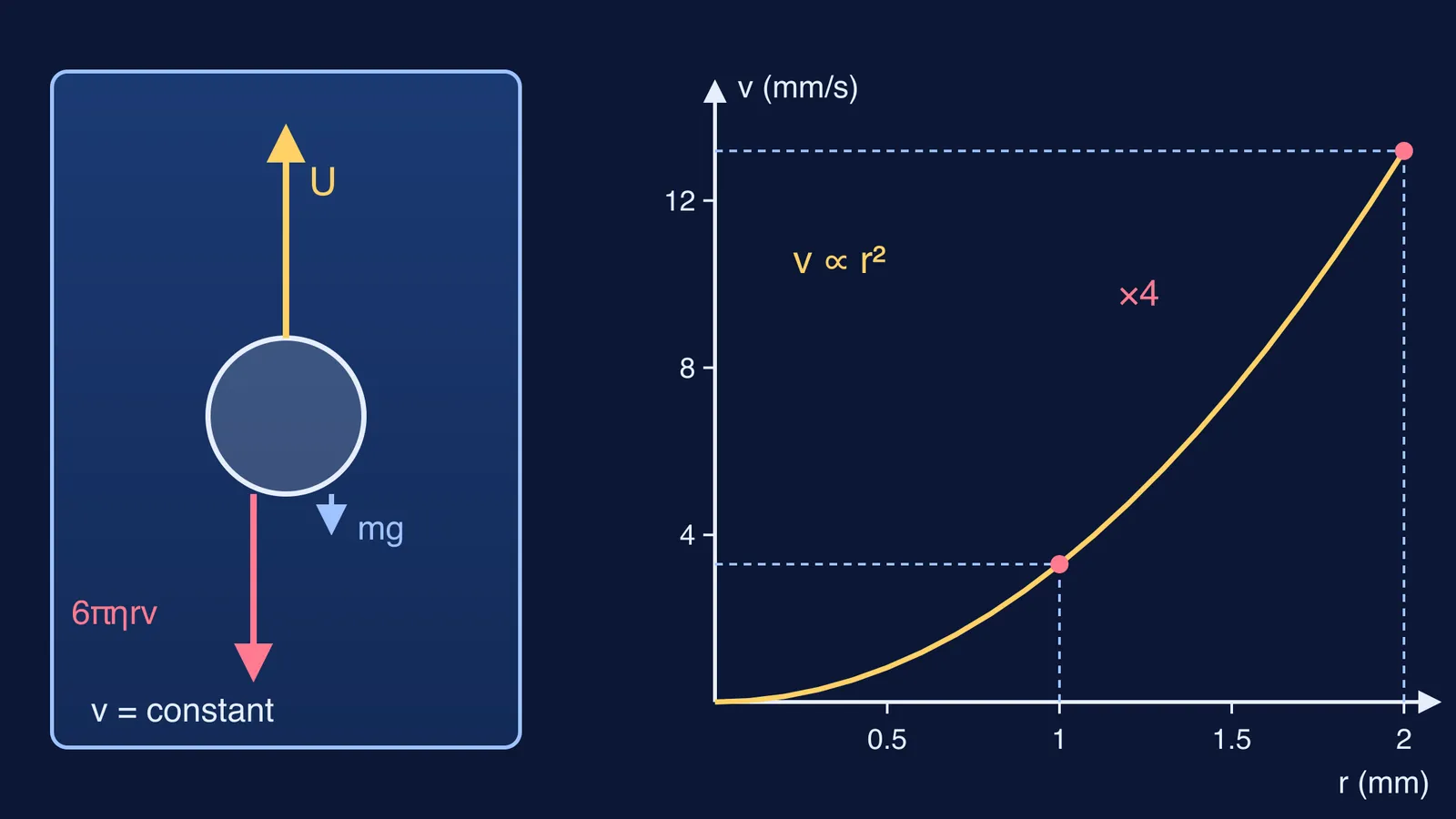
Upthrust U, upward, equal to the weight of liquid displaced: (4/3)πr³ρg, where ρ is the liquid's density.
Weight mg, downward: (4/3)πr³σg, where σ is the density of the air inside.
Viscous drag, opposite to the motion, so downward for a rising bubble.
NCERT's Class 11 Physics chapter on fluids gives the drag on a sphere of radius a as F = 6πηav, which is Stokes' law (NCERT Physics Part II, Chapter 9). The same chapter uses 1.2 kg m⁻³ for the density of air, so for a bubble in water or oil the weight is only about a thousandth of the upthrust.
Upthrust beats weight, so the bubble accelerates upward. Drag grows with v until it cancels the difference; then the net force is zero and the speed stops changing.
What is the terminal velocity of an air bubble rising in liquid?
At terminal velocity, the up forces equal the down forces:
(4/3)πr³ρg = (4/3)πr³σg + 6πηrv
Solve for v:
v = 2r²(ρ − σ)g / 9η
This is NCERT's Equation 9.18 with the two densities swapped, since in the textbook's falling sphere the first density is the sphere's (NCERT, Chapter 9). NCERT's key result: terminal velocity depends on the square of the radius and inversely on the viscosity.
Worked example: how fast does a 1 mm bubble rise in oil?
Use the oil from NCERT's Example 9.9: density 1.5 × 10³ kg m⁻³ and viscosity 0.99 Pa s (NCERT, Chapter 9). Take an air bubble of radius 1.0 mm, air at 1.2 kg m⁻³ and g = 9.8 m s⁻².
Density difference: 1500 − 1.2 = 1498.8 kg m⁻³. The air changes the answer by under 0.1%, so you can usually ignore it.
Numerator: 2 × (1.0 × 10⁻³)² × 1498.8 × 9.8 = 2.94 × 10⁻².
Denominator: 9 × 0.99 = 8.91.
v = 2.94 × 10⁻² ÷ 8.91 ≈ 3.3 × 10⁻³ m s⁻¹, about 3.3 mm per second.
Now double the radius to 2.0 mm. Since v ∝ r², the speed goes up four times, to about 13 mm per second. Halve it to 0.5 mm and the speed drops to a quarter, about 0.8 mm per second.
For the falling-ball version of the same idea, our post on finding viscosity from the terminal velocity of a steel ball walks through the lab practical. If you can set up the force balance but lose your way before the number, the Fermi Problem Library has worked problems with a step-by-step solver that explains the reasoning rather than printing an answer.
When does Stokes' law fail for bubbles?
Stokes' law only holds when the flow is slow and smooth. The Reynolds number is Re = ρuL/μ, and for a sphere the length L is its diameter (Wikipedia: Reynolds number). For Stokes' law to be accurate to within about 10%, Re must be below 1 (Wikipedia: Stokes's law).
Check the oil example: Re = 1500 × 0.0033 × 0.002 ÷ 0.99 ≈ 0.01. Safe.
Now try the same 1 mm bubble in water, whose viscosity is 1.0 mPa s at 20 °C (NCERT Table 9.2). The formula gives about 2.2 m s⁻¹ and an Re in the thousands, so that number means nothing. Stokes' law only suits air bubbles in water below roughly 0.06 mm radius. Bigger bubbles feel drag that grows faster than v, which our post on terminal velocity with linear versus quadratic drag explains.
For a drop with a perfectly clean surface, the Hadamard–Rybczynski solution of 1911 predicts a faster speed than Stokes. Ervik and Bjørklund note that in experiments small drops fall slower than that, closer to Stokes' hard-sphere result, because of surfactants (Ervik and Bjørklund, European Journal of Mechanics B/Fluids, 2017). In board and JEE questions, use 6πηrv unless told otherwise.
A checklist for bubble questions
Draw three arrows: upthrust up, weight down (tiny), drag opposite to the velocity.
Write up forces = down forces at terminal velocity before reaching for a formula.
Use the radius, not the diameter, in 6πηrv.
Check the sign: the bubble moves up.
For ratio questions, use v ∝ r²: triple the radius, nine times the speed.
If the answer looks too large, check that Re is below 1.
If the bubble grows as pressure falls, add the gas laws, as in our lake-bottom bubble problem.
If the r² rule is easier to see than to read, the Fermi Simulation Lab has interactive simulations for ideas like this one.


