

On this page
A police officer at a checkpoint never sees your blood, only a number from a box you blew into. Getting from breath to blood takes three ideas from your chemistry syllabus: a redox colour change, an electrochemical cell and Henry's law.
How does a breathalyser work?
Every breath tester does two jobs. It measures the ethanol in a sample of deep-lung air, using a chemical that changes colour, a fuel cell that produces a current, or infrared light. Then it converts that into an estimate of blood alcohol using a fixed ratio, which is an average rather than a constant that holds for every person.
What makes dichromate turn from orange to green?
The Breathalyzer, developed in the 1950s by Robert Borkenstein of the Indiana State Police, passed breath through a solution of potassium dichromate that oxidises ethanol into acetic acid and changes colour as it does so.
This is the school-lab test: orange dichromate(VI) ions are reduced to green chromium(III) ions when a primary alcohol is oxidised. The more ethanol, the more orange is used up, and a light beam through the solution measures the change.
Balance it by the ion-electron method. Each chromium goes from +6 to +3, so one dichromate ion gains 6 electrons. Each ethanol molecule loses 4 electrons on its way to acetic acid. Two dichromate ions (12 electrons) therefore match three ethanol molecules (12 electrons):
2Cr₂O₇²⁻ + 3C₂H₅OH + 16H⁺ → 4Cr³⁺ + 3CH₃COOH + 11H₂O
Check it: 4 Cr, 6 C, 34 H and 17 O on each side, and a charge of +12 on both. For more practice, see our post on redox balancing by the ion-electron method. The Fermi Problem Library has worked problems with a step-by-step solver that explains the reasoning rather than printing an answer.
How does a fuel-cell breathalyser turn alcohol into a reading?
Professional breath testers use platinum fuel cell sensors: ethanol is oxidised to acetic acid at the anode, and the current produced is measured and shown as an estimate of blood alcohol. One patent describes the two-step oxidation through acetaldehyde, with hydrogen ions moving to the lower platinum electrode and combining with oxygen to form water, and calls the current a precise indicator of the alcohol consumed. In half-equations:
Anode: C₂H₅OH + H₂O → CH₃COOH + 4H⁺ + 4e⁻
Cathode: O₂ + 4H⁺ + 4e⁻ → 2H₂O
Four electrons per ethanol molecule link the chemistry to the meter. Larger evidential instruments often measure infrared absorption instead, like the infrared analyser used in the Swedish study below.
How can breath tell you what is in your blood?
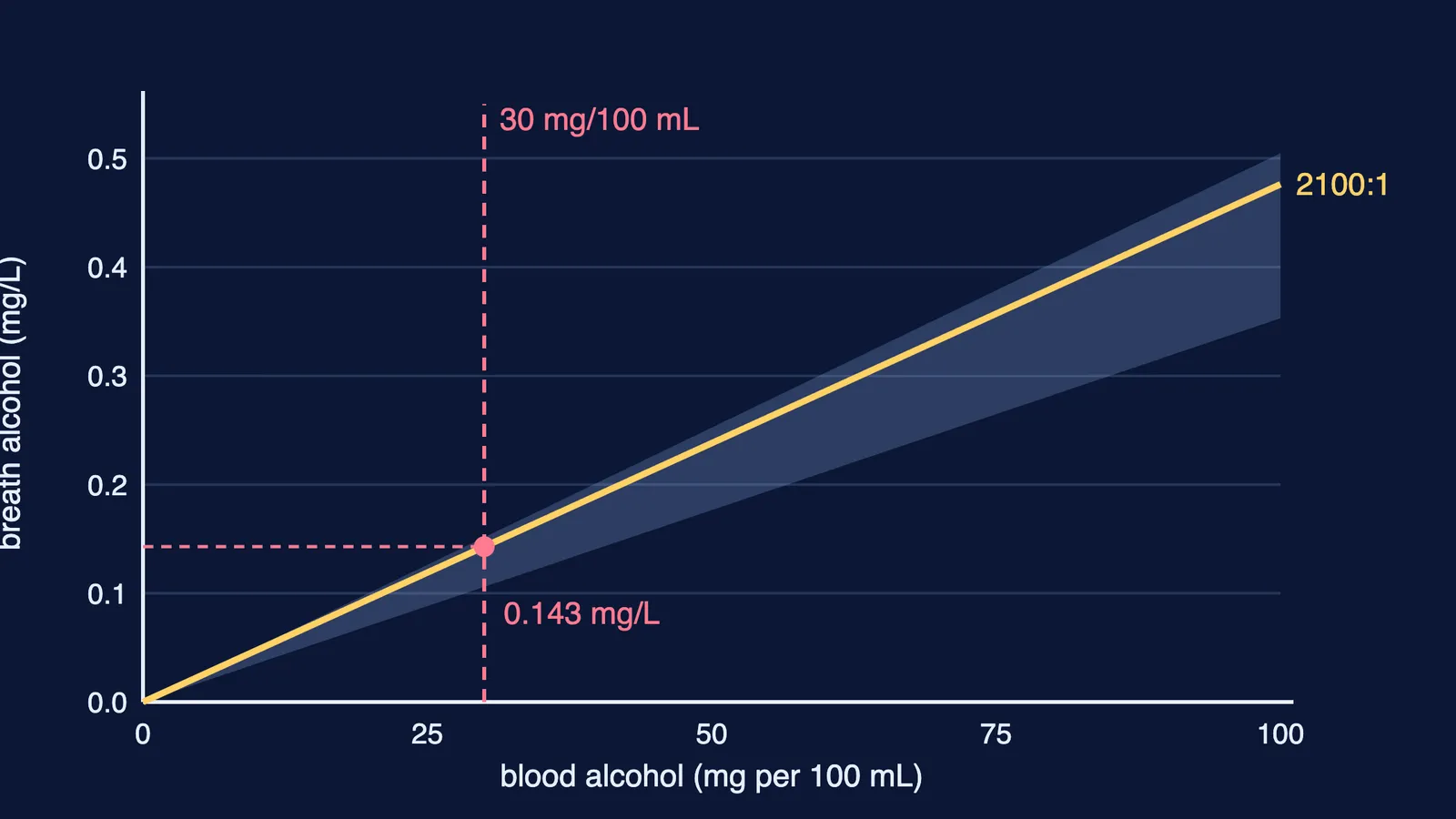
Blood flowing past your air sacs gives up some of its ethanol to the air. By Henry's law, at a fixed temperature the concentration dissolved in a liquid is proportional to the concentration in the air above it. The same page gives the standard figure: 1 mL of blood holds about 2100 times as much ethanol as 1 mL of deep-lung air.
That 2100 is an average, and the Duke page puts the range at 1500:1 to 3000:1. In a study of 799 drink-driving suspects in Sweden, Jones and Andersson found a mean blood-to-breath ratio of 2407, with 95% limits of agreement at 1981 and 2833. For the gas-law background, read Henry's law explained with a fizzy drink.
Worked example: what is India's limit in breath?
Under Section 185 of the Motor Vehicles Act, 1988, it is an offence to drive with alcohol exceeding 30 mg per 100 ml of blood detected in a test by a breath analyser.
Convert the limit: 30 mg per 100 mL is 300 mg per litre of blood.
Divide by the standard 2100:1 ratio: 300 ÷ 2100 ≈ 0.143 mg of ethanol per litre of breath.
Change the ratio: with the Swedish mean of 2407, the same 300 mg/L of blood gives only 300 ÷ 2407 ≈ 0.125 mg/L of breath.
Run it backwards: a breath reading of 0.143 mg/L multiplied by 2407 instead of 2100 gives about 344 mg/L, or 34 mg per 100 mL of blood.
Count the electrons: 1 mL of that breath holds 0.143 µg of ethanol, about 3.1 × 10⁻⁹ mol. At 4 electrons per molecule and 96,485 C per mole of electrons, that is roughly 1.2 millicoulombs.
Step 5 assumes a 1 mL sample whose ethanol all reacts, but it shows how small a charge the meter has to measure. If any step is shaky, the Fermi Concept Library gives every concept in chemistry its own lesson.
What can throw a reading off?
Mouth alcohol is one of the most common causes of falsely high readings, because the device assumes the ethanol came from deep in the lungs, not from a drink or mouthwash still in your mouth. None of this is a way around the test: if you have been drinking, the safe plan is not to drive. To see where dichromate sits among other oxidants, read why permanganate is a stronger oxidant than dichromate.


