On this page
The formula Tb = a/Rb is a standard result in the real-gases chapter of physical chemistry. Its derivation takes a few lines, and the same lines explain the shape of the Z against P graphs in your textbook.
What is the Boyle temperature?
The Boyle temperature is the temperature at which the second virial coefficient of a gas becomes zero, so attractive and repulsive forces between molecules balance out (Wikipedia: Boyle temperature).
At this temperature, a graph of Z against p is flat and close to 1 over a fairly large range of pressures, so even a non-ideal gas obeys Boyle's law fairly closely (Tatum, Heat and Thermodynamics, LibreTexts/06:_Properties_of_Gases/6.03:_Van_der_Waals_and_Other_Gases)).
Here Z is the compressibility factor, Z = PVm/RT, where Vm is the molar volume. If Z feels shaky, read our explainer on what Z > 1 and Z < 1 mean for a real gas first.
How do you derive Tb = a/Rb from the van der Waals equation?
This follows the derivation in Pearson's Introductory Chemical Thermodynamics on LibreTexts/1:_Measurement_energy_and_the_quantites_of_state/1.7:_Connecting_the_van_der_Waals_and_the_viral_equations:_the_Boyle_temperature).
Start from the van der Waals equation for one mole, solved for pressure: P = RT/(Vm − b) − a/Vm².
Multiply both sides by Vm/RT to get Z: Z = 1/(1 − b/Vm) − a/(RT·Vm).
At low pressure, Vm is large, so b/Vm is small. Expand 1/(1 − b/Vm) ≈ 1 + b/Vm. Then Z ≈ 1 + (b − a/RT)/Vm.
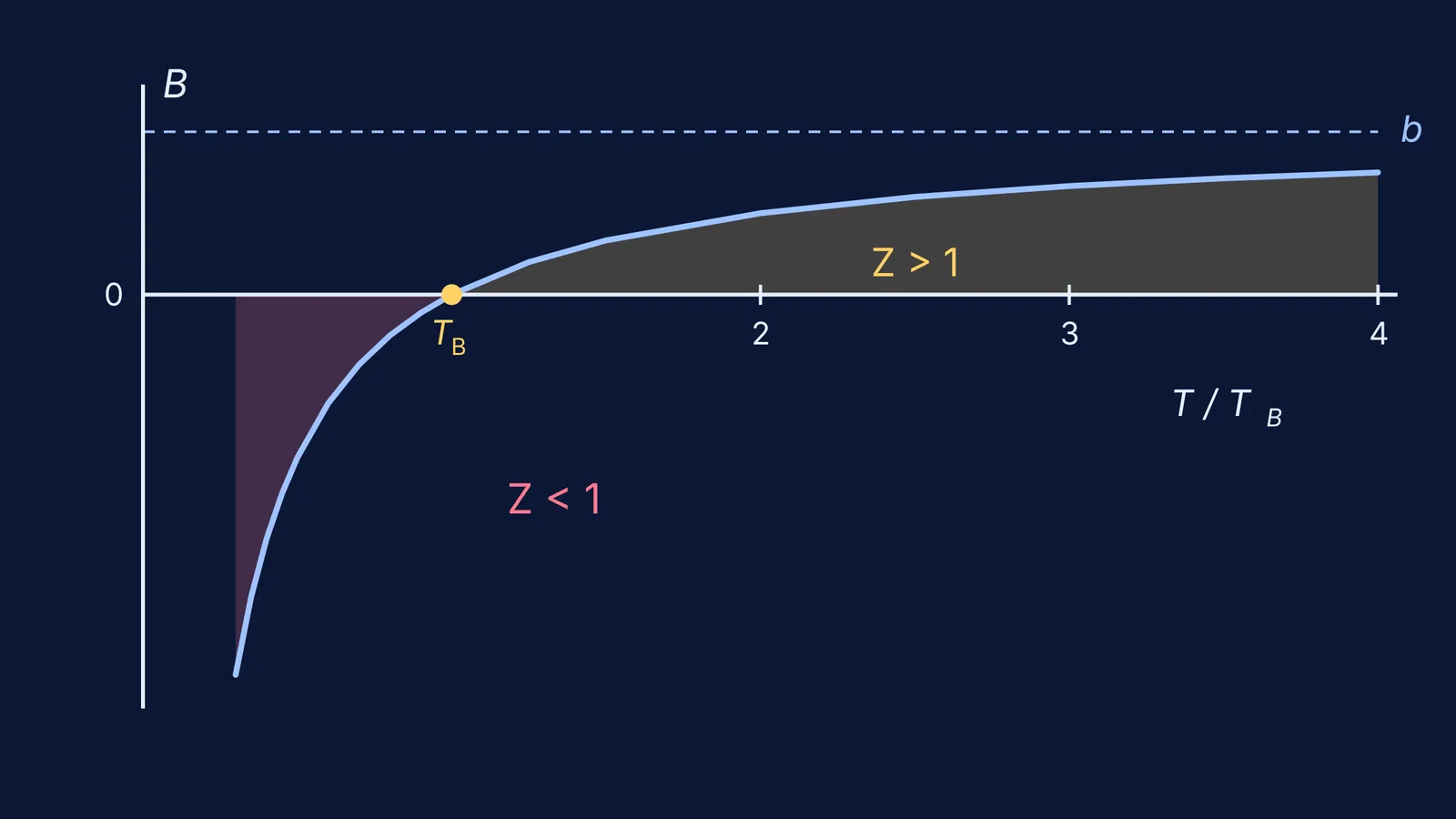
Compare with the virial form Z = 1 + B/Vm + … to read off the second virial coefficient: B = b − a/RT.
At the Boyle temperature, B = 0. So b = a/RTb, which gives Tb = a/Rb.
For a van der Waals gas, the critical temperature is Tc = 8a/27Rb, so Tb = (27/8)Tc (Tatum, LibreTexts/06:_Properties_of_Gases/6.03:_Van_der_Waals_and_Other_Gases)). How the critical temperature was first found is in our piece on Thomas Andrews and the critical temperature of carbon dioxide.
Why is Z < 1 below the Boyle temperature and Z > 1 above it?
Look at step 3 again: Z ≈ 1 + (b − a/RT)/Vm. Everything depends on the sign of b − a/RT.
b is the excluded volume: molecules take up space, which pushes Z above 1.
a/RT is attraction compared with thermal energy: molecules pull on each other, which pulls Z below 1.
b is fixed, but a/RT shrinks as T rises. So:
Below Tb, a/RT > b. B is negative, attraction wins, and Z < 1 at low pressure.
At Tb, a/RT = b. B is zero, the two effects cancel, and Z stays near 1.
Above Tb, a/RT < b. B is positive, molecular size wins, and Z > 1.
One caution: this rule describes low pressures. Squeeze any gas hard enough and molecular volume takes over, so curves below Tb dip first and then rise above 1.
Worked example: which gases are below their Boyle temperature at room temperature?
Use a in L² bar mol⁻² and b in L mol⁻¹ from the table of van der Waals constants). The NIST value of R is 8.314462618 J mol⁻¹ K⁻¹. Since 1 L bar = 100 J, that is R = 0.08314 L bar K⁻¹ mol⁻¹.
Nitrogen: a = 1.370, b = 0.0387. Rb = 0.08314 × 0.0387 = 0.003218. Tb = 1.370 / 0.003218 ≈ 426 K.
Hydrogen: a = 0.2476, b = 0.02661. Rb = 0.002212. Tb = 0.2476 / 0.002212 ≈ 112 K.
Helium: a = 0.0346, b = 0.0238. Tb ≈ 17.5 K.
Carbon dioxide: a = 3.6, b = 0.04267. Tb ≈ 1015 K.
Now compare each with room temperature, about 300 K. Nitrogen and carbon dioxide are below their Boyle temperatures, so the model predicts Z < 1 at low pressure. Hydrogen and helium are far above theirs, so Z > 1 from the start: the familiar graph where the H₂ curve rises while N₂ and CO₂ dip.
These are van der Waals estimates; measured values differ because the model is approximate. For more numbers, see real gases and the van der Waals equation, with worked numbers.
What mistakes do students make with the Boyle temperature formula?
Units mismatch. If a is in L² bar mol⁻², R must be in L bar K⁻¹ mol⁻¹. Using the NIST value 8.314 with these units gives an answer 100 times too small, because 1 L bar = 100 J.
Flipping the fraction. Tb = a/Rb, not b/Ra. A gas with stronger attraction (bigger a) needs a higher temperature to cancel it.
Confusing Tb with Tc. Tb = (27/8)Tc, so Tb is always the higher of the two for a van der Waals gas.
If a step trips you up, the Fermi Concept Library has a lesson for every concept in chemistry and physics. For practice, the Fermi Problem Library has worked problems with a step-by-step solver that explains the reasoning rather than printing an answer.