

On this page
Drop a block into a jar where oil floats on water and it may stop halfway down, with its top in the oil and its bottom in the water. Exam questions ask how much of the block sits in each layer. One balance answers it. The block's weight equals the buoyant force from both liquids added together.
Why does a block float at the oil-water interface?
OpenStax University Physics states Archimedes' principle as: "The buoyant force on an object equals the weight of the fluid it displaces."
The OpenStax density tables list olive oil at 920 kg/m³ and water at 4 °C at 1000 kg/m³ (OpenStax, section 14.1). Oil is less dense than water, so it forms the top layer. A block's density decides where the block ends up:
Less dense than the oil: it floats in the oil and never reaches the water, as long as the oil layer is deep enough.
Between oil and water: it sinks through the oil but cannot sink into the water, so it settles across the boundary.
Denser than water: it sinks to the bottom.
How do you find the fraction of the block in each liquid?
Take a block with uniform cross-section A, height h and density ρb. Let x be the length in water, so h − x is in oil. Assume the oil covers the block's top, and call the liquid densities ρw and ρo.
Weight of the block: ρb × A × h × g.
Buoyant force from the water: ρw × A × x × g.
Buoyant force from the oil: ρo × A × (h − x) × g.
For floating, weight = sum of the buoyant forces, so ρb h = ρw x + ρo (h − x).
A and g cancel. Solving gives:
Fraction in water: x/h = (ρb − ρo) ÷ (ρw − ρo)
Fraction in oil: (h − x)/h = (ρw − ρb) ÷ (ρw − ρo)
Worked example: a 10 cm cube in oil and water
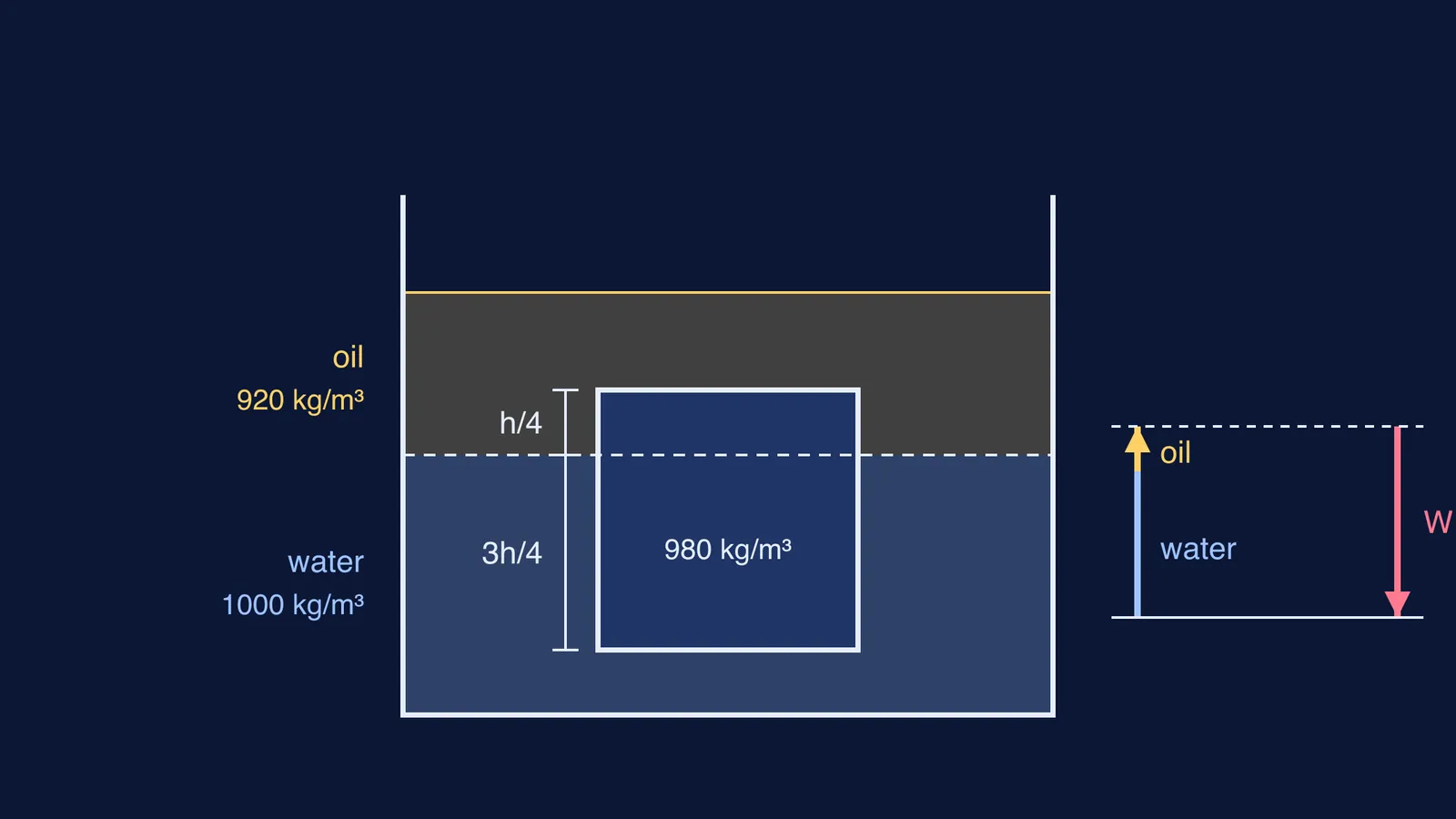
Use the OpenStax values from above: oil 920 kg/m³, water 1000 kg/m³. The block is a 10 cm cube with a density of 980 kg/m³.
Check that it straddles the boundary: 920 < 980 < 1000. It does.
Fraction in water = (980 − 920) ÷ (1000 − 920) = 60 ÷ 80 = 0.75.
So 7.5 cm of the block is in water and 2.5 cm is in oil.
Check per unit area: 1000 × 7.5 + 920 × 2.5 = 7500 + 2300 = 9800, and 980 × 10 = 9800. The forces balance.
If you forget the oil, you write 980 ÷ 1000 = 0.98 and put 9.8 cm in water. That is 2.3 cm too deep, because the oil is carrying 2300 of the 9800 units of weight.
What if the oil layer is too thin to cover the block?
The formula assumed the oil covers the block's top, which needs at least 2.5 cm of oil here. Suppose the oil layer is only 1 cm deep. Now the block has three zones: y cm in water, 1 cm in oil and the rest in air. With the same OpenStax densities, the balance becomes 1000 × y + 920 × 1 = 9800, so y = 8.88 cm. That puts 9.88 cm under the surface and 0.12 cm above the oil.
What mistakes do students make with two-liquid buoyancy?
Ignoring the oil's upthrust. This is the 0.98 trap above.
Using the depth of the oil layer instead of the length of block inside the oil. Only the displaced volume counts.
Thinking the water pushes the bottom and the oil only pushes the sides. The pressure on the bottom face already includes the weight of the oil column above the water, so the net upward push matches the weight of the displaced fluids. Our post on why buoyant force does not depend on depth works through this pressure argument.
Skipping the thin-layer check.
If your mistakes are about the method rather than the arithmetic, the Fermi Problem Library has worked problems with a step-by-step solver that explains the reasoning rather than printing an answer.
How should you practise two-liquid floating problems?
Use four steps every time:
Put the densities in order and decide where the block will settle.
Sketch the block and label the length in each fluid.
Write weight = sum of (density × submerged volume × g) for each fluid.
Check that the answer fits the layer thickness, then substitute back.
For variations, try finding a liquid's density from a U-tube with two liquids and working out the cavity in a floating hollow ball. If Archimedes' principle itself feels shaky, the Fermi Concept Library gives each physics concept its own lesson and shows where it fits in the map.
Next time you see oil on water, picture the block in between and write the balance before you reach for the formula.


