On this page
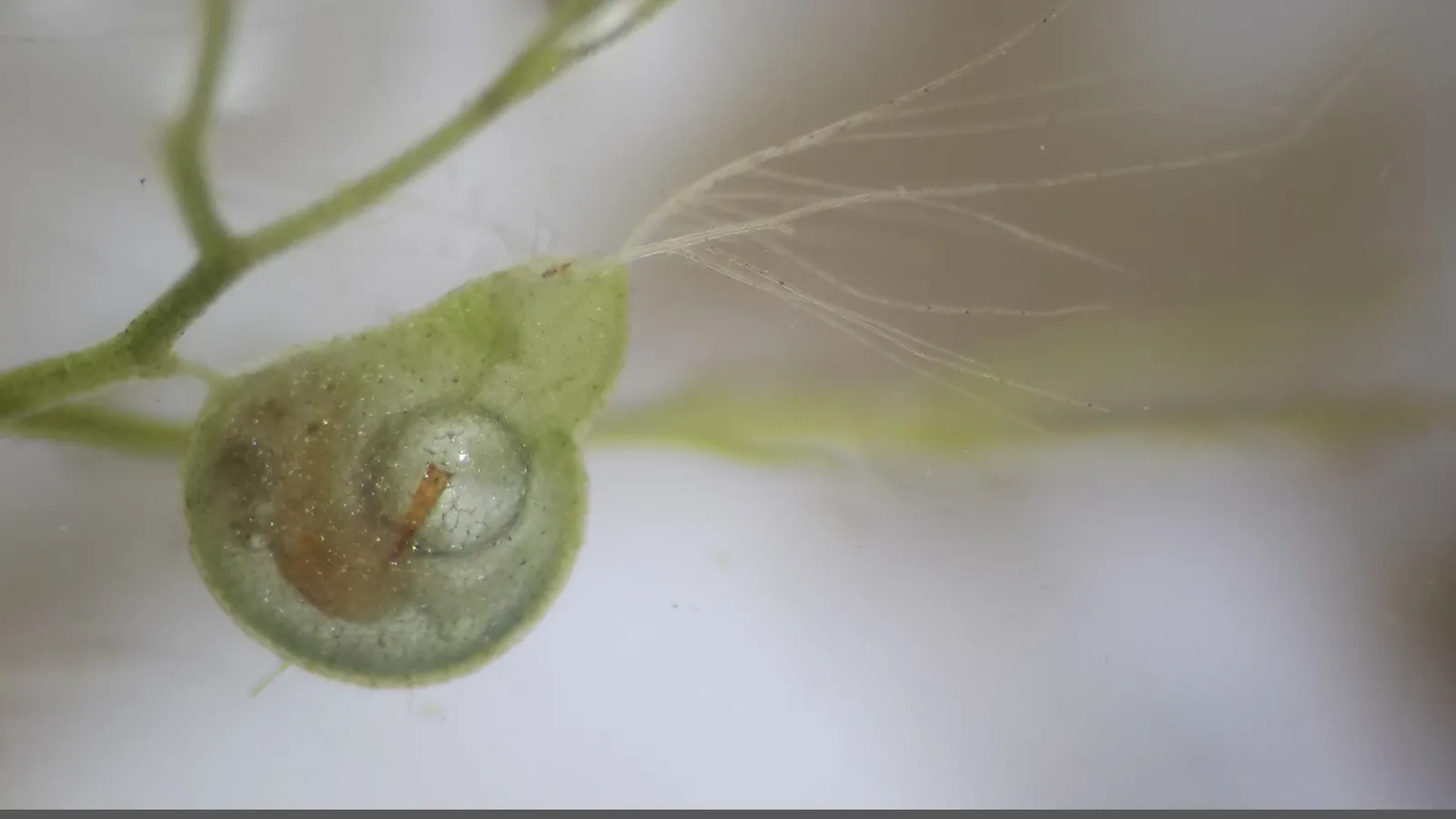
Look closely at the fine green threads floating in a village pond or flooded paddy field and you may find tiny round bags on the leaves, most smaller than a grain of rice. These are the traps of a bladderwort, a water plant that eats animals. It sucks them in.
What is a bladderwort and where does it grow in India?
Bladderworts belong to the genus *Utricularia*. A 2015 review in AoB Plants calls it the largest genus of carnivorous plants, with about 240 species. In the common aquatic type, the traps are hollow bladders typically 0.5 to 6 mm across; in aquatic species they mainly sit on leaves or leaf segments, and the plants have no true roots (same source).
India has plenty of them. The eFlora of India lists 42 *Utricularia* names for India, eight of them marked as synonyms of other species, and notes that the Botanical Survey of India's 1992 book *Bladderworts of India* reported 35 species. Some, like *U. aurea*, *U. gibba* and *U. stellaris*, are listed there as aquatic. New ones are still turning up: in 2020, botanists described *Utricularia kamarudeenii* from paddy fields in Kottayam district, Kerala, a species that resembles *U. aurea*.
To place it in a food web, see our guide to biotic and abiotic parts of a pond ecosystem.
How does a bladderwort trap prey underwater?
Here is the sequence, from the 2015 AoB Plants review by Poppinga and colleagues:
Set. Special glands pump water out of the closed bladder. Its walls bend inwards and the pressure inside drops below the pond's. The measured difference is about 0.14 bar in *U. vulgaris*.
Wait. A watertight trapdoor seals the mouth. In the common aquatic type, four trigger hairs stick out from the door.
Fire. A water flea or other tiny animal brushes a hair. The door buckles and swings open in about 0.5 ms.
Suck. The walls spring back out, and water rushes in, carrying the prey with it. The door shuts again.
Reset. The glands pump the water out again. In *U. vulgaris* the trap is ready again after about 15 to 30 minutes.
Recorded prey includes water fleas (Cladocera), copepods, ostracods, rotifers, nematodes and tardigrades.
How fast is the bladderwort trap?
Too fast for the human eye, which is why it was hard to study. In 2011, Olivier Vincent, Philippe Marmottant and colleagues filmed the door with high-speed video and found that suction is over in less than a millisecond, which ranks it among the fastest plant movements known. They also found the traps fire on their own after 5 to 20 hours, even with no prey around.
The AoB Plants review gives the headline numbers: capture lasts about half a millisecond, and in *U. inflata* the water being sucked in accelerates at up to 600 g and reaches a top speed of about 1.5 m/s. Unprompted, a trap can fire up to 60 times in a 20-day period.
Worked example: check the numbers with Class 11 physics
Two quick calculations, using only values from the AoB Plants review, make the numbers concrete.
1. How much suction is 0.14 bar?
1 bar = 100,000 Pa, so 0.14 bar = 14,000 Pa.
Water pressure at depth h is P = ρgh. Take ρ = 1000 kg/m³ and g = 9.8 m/s².
h = 14,000 ÷ (1000 × 9.8) ≈ 1.4 m.
So a bladder a few millimetres wide holds back a pressure difference equal to about 1.4 m of water, with its walls bent inwards, storing elastic energy.
2. Does 600 g make sense?
Suppose the water took the whole 0.5 ms to reach 1.5 m/s. Average acceleration = 1.5 ÷ 0.0005 = 3,000 m/s².
Divide by 9.8: that is about 310 g.
The reported peak is 600 g, roughly double. So the acceleration is not even across the half-millisecond.
What should you remember for exams and viva?
No true roots; in water-living species the bladders mainly sit on leaves.
The trap is active, not a passive pit: low pressure inside plus elastic energy stored in the bent walls does the work.
Indian examples to quote: *U. aurea*, *U. gibba* and *U. stellaris*, all listed as aquatic species in India.
In long answers, keep the order: set, wait, fire, suck, reset.
If "elastic energy" feels shaky, the Fermi Concept Library has a lesson for every concept in physics, chemistry, biology, mathematics and computing, each with its place in the map. For more pressure and acceleration practice, the Fermi Problem Library has worked problems with a step-by-step solver that explains the reasoning rather than printing an answer.
For another tiny water plant, read about Wolffia, the world's smallest flowering plant. To see a bladderwort's prey for yourself, try observing microorganisms in pond water under a microscope.