

On this page
Angiosperms, or flowering plants, dominate the Earth's flora and come in a massive variety of shapes and sizes. While you might picture a typical flower or a tall tree, the extreme ends of the angiosperm size scale look very different. The smallest of them all is *Wolffia*, a genus of aquatic plants that look like green specks floating on water.
What are the key facts about Wolffia?
*Wolffia*, commonly known as watermeal or rootless duckweed, is a genus of aquatic plants found in freshwater bodies around the world.
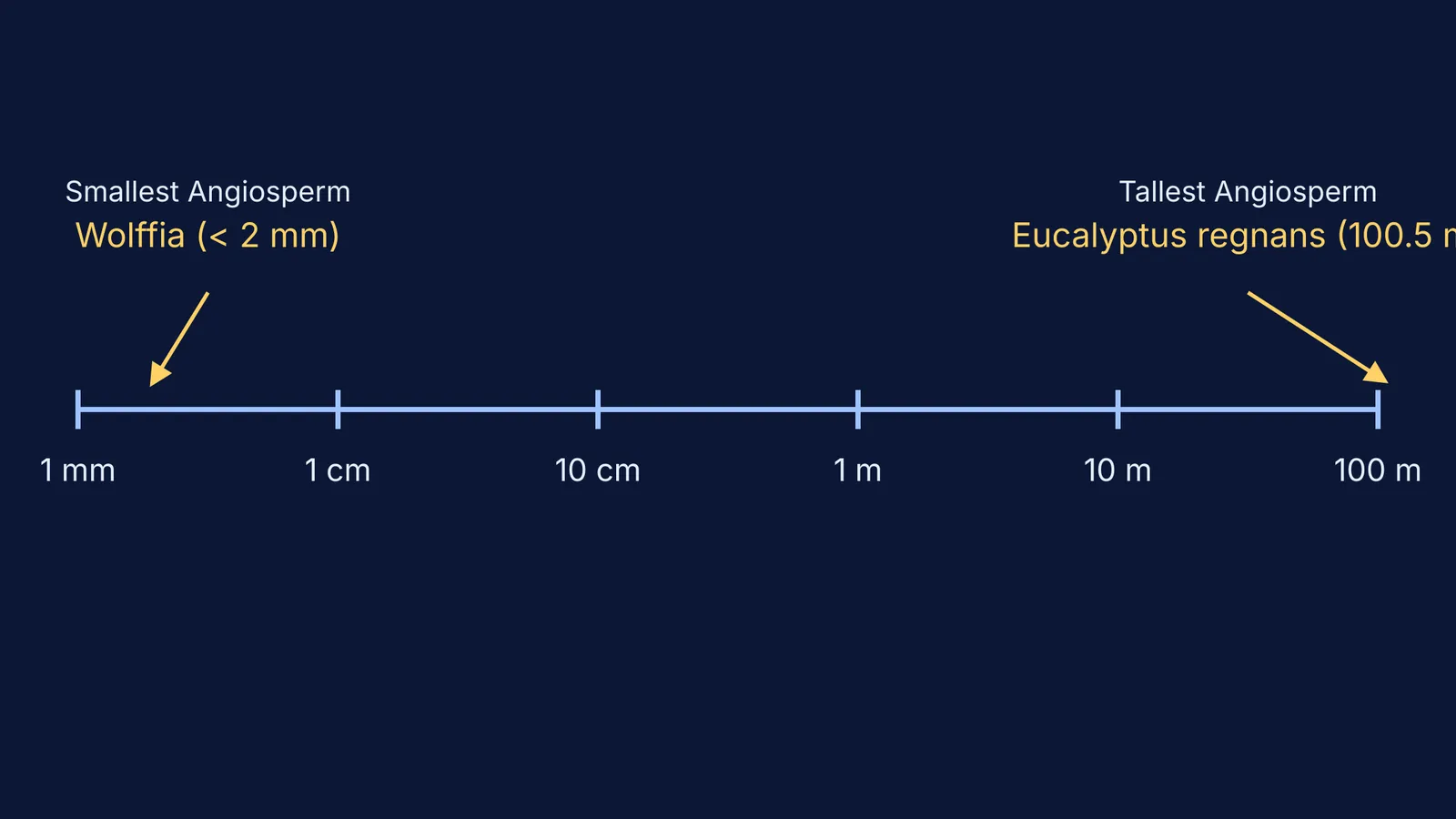
Size: Individual *Wolffia* plants are under 2 millimetres long.
Structure: They are entirely rootless and lack true stems or leaves; the plant body is just a simplified oval structure called a frond.
Growth: They have the fastest growth rate of any flowering plant, with a doubling time of just 29.3 hours.
Despite their microscopic size, they are true angiosperms because they occasionally produce tiny flowers consisting of a single stamen and pistil.
How does it survive with such a reduced structure?
The secret to *Wolffia*'s rapid growth and tiny size lies in its simplified genetics. A 2021 study published in *Genome Research* sequenced the genome of *Wolffia australiana* and found it has only about 15,000 protein-coding genes.
To optimise for fast vegetative growth, the plant shed genes that other plants use for root development, complex vascular tissue, and light signalling. Furthermore, only 13% of its genes follow a daily circadian rhythm, which means the plant does not limit its growth to specific times of the day.
How does Wolffia reproduce so quickly?
While *Wolffia* can reproduce sexually through its microscopic flowers, it relies almost exclusively on a highly efficient method of asexual reproduction. A mother frond possesses a small cavity from which it buds new daughter fronds.
Because it mostly reproduces vegetatively and is unconstrained by a circadian rhythm, *Wolffia* multiplies continuously. This budding process allows the plant to form dense, green mats across the surface of quiet ponds and lakes in a matter of days.
Can Wolffia be used as a food source?
Because of its rapid doubling time and nutrient density, *Wolffia* has been harvested from the wild and consumed as a vegetable in parts of Southeast Asia for generations.
It is considered a highly efficient source of plant-based protein. The dried plant mass contains about 20% protein and provides a complete profile of essential amino acids. Its ability to grow in small freshwater bodies without complex agriculture makes it a promising candidate for sustainable food security.
How does Wolffia compare to the largest angiosperms?
The contrast between the smallest and largest angiosperms highlights the adaptability of the group. While *Wolffia* sits at the microscopic end of the scale, the largest angiosperm is *Eucalyptus regnans*, commonly known as the Mountain Ash.
The tallest living specimen of *Eucalyptus regnans*, named "Centurion", stands 100.5 metres tall. This means a fully grown Mountain Ash is over 50,000 times taller than a 2-millimetre *Wolffia* frond. Both plants use the same fundamental reproductive strategy of flowers and seeds, yet they have adapted to entirely different physical extremes.
A size comparison checklist for exams
When revising plant kingdoms, categorising the extremes helps you recall the typical characteristics of the group. Use this quick comparison for your notes:
Smallest Angiosperm: *Wolffia* (Rootless duckweed, under 2 mm, fastest doubling time).
Largest/Tallest Angiosperm: *Eucalyptus regnans* (Mountain Ash, over 100 m, massive carbon storage).
Habitat Adaptations: *Wolffia* is a hydrophyte adapted to float and reproduce rapidly; *Eucalyptus* is adapted to grow tall and outcompete forest canopy competitors.
If you are struggling to picture the differences between plant families or remember the exceptions to the rules, the Fermi Concept Library holds a complete map of biology concepts. It breaks down plant anatomy and taxonomy with clear visual lessons, so you do not have to rely on rote memorisation.
For more on plant biology and how different species adapt, read about how hydrophytes survive: the adaptations of aquatic plants, explore why plant growth is open and indeterminate compared to animals, or test yourself on plant groups: odd one out exceptions in algae to gymnosperms.


