

On this page
What does open form of growth mean in plants?
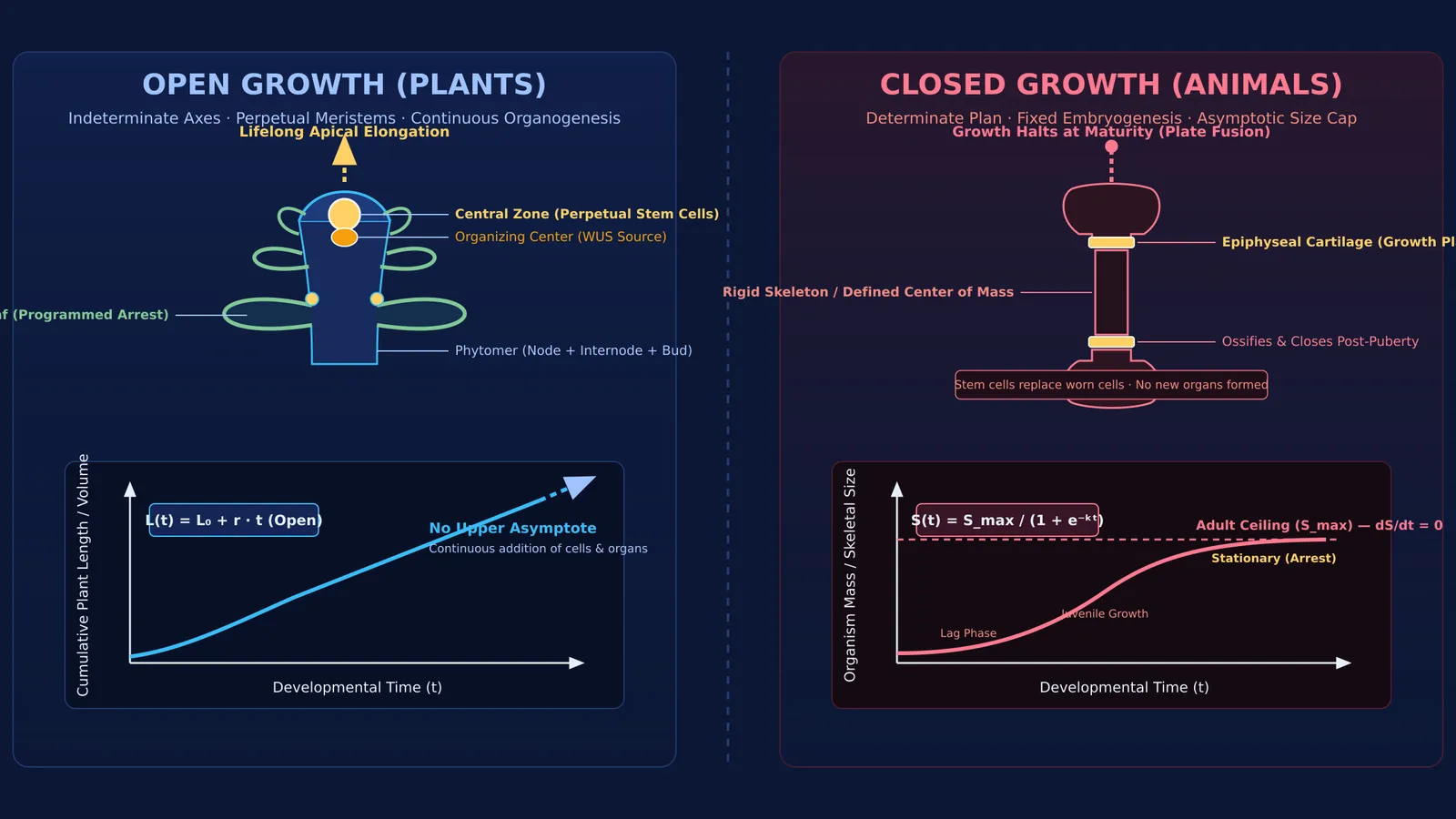
The NCERT Class 11 Biology curriculum defines the open form of growth as the pattern wherein new cells are constantly added to the plant body by the activity of meristems. Because meristematic cells divide and self-perpetuate indefinitely, plants retain the capacity for unlimited elongation and branching—a phenomenon known as indeterminate growth.
In contrast, animals follow a closed, determinate pattern. Early embryogenesis establishes three germ layers—ectoderm, mesoderm, and endoderm—which construct a complete body plan. Once an animal matures, skeletal enlargement halts.
Meristems sustain this addition at high rates. According to NCERT data, a single maize root apical meristem can produce more than 17,500 new cells per hour, while cells in a watermelon expand in volume by up to 350,000 times.
Why do plants grow continuously while animals stop?
This contrast reflects how multicellularity evolved. As Elliot M. Meyerowitz showed in Science, plants and animals diverged from distinct unicellular ancestors, developing multicellular mechanisms independently.
Mobility caps animal growth. Animals are mobile heterotrophs that move to feed, mate, and escape predators. This lifestyle requires bilateral symmetry, coordinated locomotion, and a stable center of mass. An adult bird or mammal cannot add limbs or expand its frame indefinitely without compromising movement.
Plants are sessile autotrophs anchored to the soil. Unable to walk toward light or water, they forage by physical elongation. Rigid cellulose walls prevent the cell migration that shapes animal embryos, so plants expand by repeatedly adding modular phytomers—units consisting of a node, internode, leaf, and axillary bud. Over time, stems adapt to support demands through stem modifications.
While animals retain adult stem cells in intestinal crypts and bone marrow, these populations are homeostatic. They replace worn tissues within an existing blueprint; they never construct new organs post-embryonically.
How do meristems maintain their stem cell reservoirs?
To sustain lifelong growth without forming tumours or exhausting initials, plants maintain specialized niches. As Renze Heidstra and Sabrina Sabatini reviewed in Nature Reviews Molecular Cell Biology, plant meristems balance self-renewal with differentiation.
In the shoot apical meristem, this balance relies on a genetic circuit. Research by Klaus F. X. Mayer and colleagues in Cell81703-1) showed that the organizing center expresses the homeobox transcription factor WUSCHEL. WUS signals upward to maintain stem cell identity in the central zone. In return, these stem cells secrete the peptide CLAVATA3 (CLV3), which binds CLAVATA1 receptors to repress WUS. This negative feedback loop stabilizes the stem cell reservoir over centuries.
Primary apical meristems drive longitudinal elongation, while secondary lateral meristems—the vascular and cork cambium—add girth, as detailed in our guide to apical, intercalary, and lateral meristems. Their elongation follows distinct mathematical dynamics, explored in our breakdown of arithmetic and geometric plant growth equations.
The Fermi Concept Library covers every concept in physics, chemistry, biology, mathematics and computing, each with its own lesson and its place in the map, helping you trace how molecular feedback loops govern macroscopic development.
Which plant organs exhibit determinate rather than open growth?
While primary axes remain indeterminate, not every plant structure grows indefinitely. Plant architecture combines indeterminate axes with determinate lateral organs.
Foliage leaves, sepals, petals, stamens, and fruits are determinate. A leaf primordium initiates at the shoot flank, divides through marginal meristems until reaching its programmed dimensions, and then arrests permanently.
Plant differentiation is also open. Unlike animal cells whose fates are largely fixed by early embryonic lineage, plant cell fate depends on physical position. A daughter cell pushed to the root perimeter forms epidermis, while a cell positioned centrally matures into vascular tissue.
How can you solve open versus closed growth questions systematically?
To tackle exam questions on plant development, use this four-step diagnostic framework:
Identify the anatomical structure: Determine whether the part is an indeterminate axis (shoot apex, primary root, lateral cambium) or a determinate appendage (leaf, flower, animal limb).
Examine stem cell maintenance: Check whether stem cells self-perpetuate indefinitely via feedback signaling (meristematic initials) or arrest after organ formation (floral meristem, mammalian growth plate).
Check organogenesis capacity: Assess whether new organs are generated post-embryonically (open growth) or whether division is limited to tissue renewal (closed animal growth).
Classify the growth curve: Determine whether growth proceeds via continuous arithmetic addition or levels off into a sigmoidal plateau with a fixed maximum size (S_max).
Here is how this framework applies in practice:
Banyan prop root: Primary root meristem with an active quiescent center constantly adding vascular tissue into the soil. Classification: open, indeterminate growth.
Mango leaf or fruit: Temporary marginal meristems arrest once target area and volume are reached. Classification: closed, determinate growth.
Human femur bone: Epiphyseal cartilage proliferation ossifies into solid bone after puberty. Classification: closed, determinate growth.
For multi-step botanical reasoning and assertion-reason questions, the Fermi Problem Library provides worked problems with a step-by-step solver that explains the reasoning rather than printing an answer.


