On this page
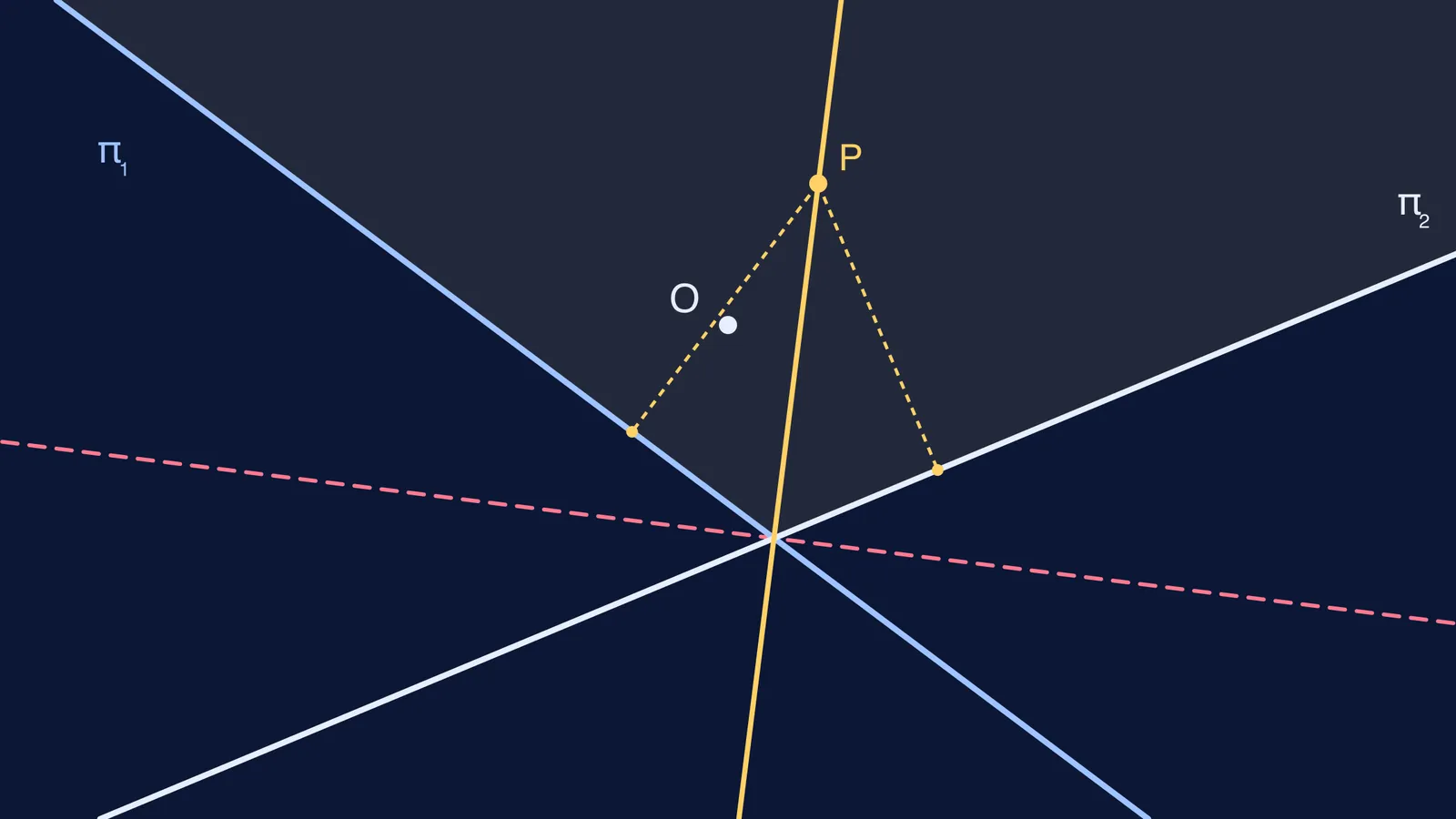
Two intersecting planes make two pairs of angles, so there are two bisector planes. Every point on a bisector is equally far from both planes, and that one idea gives both equations. Exams test picking the right one, so here is a sign rule and a worked example where the wording trips people up.
Why does a bisector plane come from equal distances?
The distance of a point (x₁, y₁, z₁) from the plane ax + by + cz + d = 0 is |ax₁ + by₁ + cz₁ + d| / √(a² + b² + c²), as set out in this summary of the point-to-plane distance formula. Our post on deriving the distance of a point from a plane builds it from scratch.
Now take a point P(x, y, z) on a bisector. Its distances from the two planes are equal:
|a₁x + b₁y + c₁z + d₁| / √(a₁² + b₁² + c₁²) = |a₂x + b₂y + c₂z + d₂| / √(a₂² + b₂² + c₂²)
Two absolute values are equal when the insides are equal or opposite: hence the ± and two planes.
What is the equation of the plane bisecting the angle between two planes?
For the planes a₁x + b₁y + c₁z + d₁ = 0 and a₂x + b₂y + c₂z + d₂ = 0, the bisector planes are (a₁x + b₁y + c₁z + d₁)/√(a₁² + b₁² + c₁²) = ±(a₂x + b₂y + c₂z + d₂)/√(a₂² + b₂² + c₂²), with each sign giving one bisector (Matherama, Planes II; Careers360).
Which bisector contains the origin?
The expression ax + by + cz + d keeps one sign on each side of a plane. At the origin it equals d. So if d₁ and d₂ are both positive, the origin is on the positive side of both planes.
Any point in the same angle as the origin is also on the positive side of both planes, so its two signed distances are equal, not opposite. That gives the rule:
Rewrite the planes so d₁ and d₂ have the same sign (multiply one equation by −1 if needed).
Take the + sign. That plane bisects the angle containing the origin.
Is that the acute or the obtuse bisector?
With d₁ and d₂ of the same sign, work out a₁a₂ + b₁b₂ + c₁c₂. If it is negative, the origin lies in the acute angle, so the + sign gives the acute bisector; if it is positive, the origin lies in the obtuse angle (Matherama). For the angle itself, see our walkthrough of the angle between two planes using normal vectors.
Worked example: 3x − 6y + 2z + 5 = 0 and 4x − 12y + 3z − 3 = 0
Match the signs. Here d₁ = 5 and d₂ = −3, so rewrite the second plane as −4x + 12y − 3z + 3 = 0.
Find the normal lengths: √(9 + 36 + 4) = 7 and √(16 + 144 + 9) = 13.
Take the + sign for the origin's angle: (3x − 6y + 2z + 5)/7 = (−4x + 12y − 3z + 3)/13. Cross-multiplying gives 39x − 78y + 26z + 65 = −28x + 84y − 21z + 21, so 67x − 162y + 47z + 44 = 0.
The − sign gives the other bisector: 39x − 78y + 26z + 65 = 28x − 84y + 21z − 21, so 11x + 6y + 5z + 86 = 0.
Classify: (3)(−4) + (−6)(12) + (2)(−3) = −90, which is negative. The origin lies in the acute angle, so 67x − 162y + 47z + 44 = 0 bisects the acute angle. The acute angle is only about 8.5° (cos θ = 90/91).
Check: the point (−44/67, 0, 0) on this bisector is about 0.433 from each plane.
This pair of planes appears in a practice question on Sarthaks eConnect asking for the bisector "which contains the origin". Its solution skips matching the signs, so its + sign gives 11x + 6y + 5z + 86 = 0, and it answers "None of these" because neither plane is among its options. Read as the angle containing the origin, the answer is 67x − 162y + 47z + 44 = 0.
How do you avoid the usual sign mistakes?
Fix the sign of d before you write any ±.
Divide by each normal's length; skip this and the plane is not a bisector.
Check one point on your answer against both distances.
For the acute bisector, use the a₁a₂ + b₁b₂ + c₁c₂ test, not a guess.
If you lost a mark on a sign and cannot see where, the Fermi Problem Library has worked problems with a step-by-step solver that explains the reasoning rather than printing an answer. The λ method for a plane through the intersection of two planes pairs well with this one.
Now try the steps on 2x − y + 2z + 3 = 0 and 3x − 2y + 6z + 8 = 0.