On this page
You can often guess what a bird eats before you see it eat. Look at two things: the beak, which picks up and handles food, and the feet, which hold the bird where that food is. Below are the main types, an Indian bird for each, and a three-step check.
Does beak shape really tell you what a bird eats?
Mostly, yes. In a 2020 study in Nature Ecology & Evolution, Alex Pigot and colleagues measured nine body traits across more than 99% of the world's bird species (PubMed record of the study). A species' position in that trait space predicted its trophic level, diet and foraging behaviour with 70-85% accuracy. Unrelated birds that eat the same food have evolved similar shapes, which is why the types below work across bird families.
What are the types of bird beaks according to food?
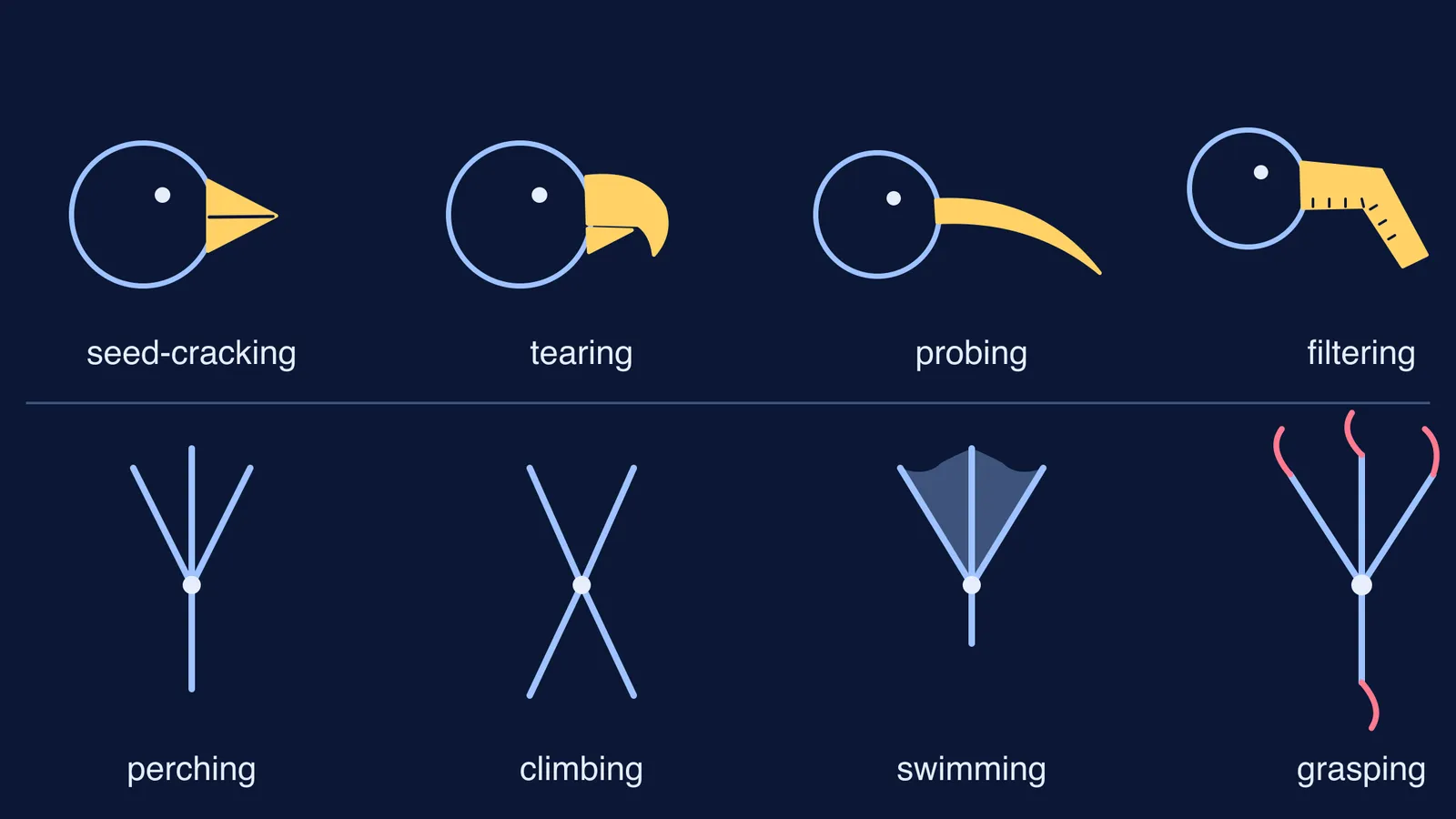
Biologists Paul Ehrlich, David Dobkin and Darryl Wheye describe seed-eaters as having short, stout bills for cracking and husking seeds, and probing feeders as having long, slender bills (Stanford Birds essay on bills). Here are four types, each with a bird you can see in India.
Seed-cracking (short, thick, cone-shaped). The house sparrow has a stout, conical bill built for seeds, and studies in temperate farmland put seeds at about 90% of its diet (house sparrow).
Tearing (hooked tip, sharp edges). The shikra, a small hawk resident on India's plains and lower hills, eats rodents, squirrels, small birds, lizards and insects (shikra).
Probing (slender, often long or curved). The purple sunbird's bill is fairly short but down-curved, and its brush-tipped, tube-shaped tongue helps it drink nectar from flowers (purple sunbird).
Filtering (lined with comb-like plates). The greater flamingo, seen at sanctuaries in Gujarat, feeds with its head down, sucking in water and straining out small shrimp and other tiny food (greater flamingo).
A flamingo's bill holds rows of horny plates that work as a sieve, and its tongue pumps water through them up to four times a second (Stanford Birds essay on flamingo feeding).
What are the types of bird feet?
Feet follow food too, because a bird must perch, cling, grab or swim wherever its food is. Toes are numbered I to IV, and toe I, the hallux, usually points backwards (Lisa Nupen, African Birdlife, 2016).
Perching (three toes forward, one back). This anisodactyl pattern is found in more than three-quarters of bird species, including sparrows and pigeons, according to the same article. The fully opposed back toe is ideal for gripping branches (Stanford Birds essay on feet).
Climbing (two toes forward, two back). Woodpeckers have this zygodactyl foot, which suits climbing in woodpeckers and grasping in parrots (Lisa Nupen, African Birdlife, 2016). A woodpecker's feet work with its stiff tail feathers to brace it on a trunk (Stanford Birds essay on bills). The black-rumped flameback of the Indian plains feeds mainly on beetle larvae from under bark (black-rumped flameback).
Grasping (raptorial). Birds of prey have powerful feet, sharp curved claws and rough pads under the toes, and the osprey adds spines for gripping slippery fish (Stanford Birds essay on feet).
Swimming (webbed). Swimming birds usually have webbing between the toes, so the feet work as paddles. The Indian spot-billed duck, resident in freshwater wetlands across India, dabbles for plants, rice and snails (Indian spot-billed duck).
How do you work out a bird's food from its beak and feet?
Use this three-step check on any bird or diagram:
Beak: short and thick, hooked, slender and curved, or lined with plates? Write the food that shape suits.
Feet: three-and-one, two-and-two, curved talons or webbed? Write where the bird stands or moves while feeding.
Match: if both clues point to the same way of life, that is your answer. If they disagree, look the bird up.
Worked example. A pink bird stands in a shallow salt pan in Kutch, head down in the water, with a sharply bent bill. Step 1: plates inside the bill mean filtering tiny food from water. Step 2: it feeds standing in water, not on branches. Step 3: both clues agree, so this is a greater flamingo, a filter feeder. Now try a small grey hawk on a roadside neem tree with a hooked beak and curved claws: tearing beak plus grasping feet gives you a shikra, a hunter of lizards, rodents and small birds.
To revise, use the blank-table method for plant and animal examples: list the eight beak and foot types down one side and fill in an Indian bird for each from memory. Then see how Robert MacArthur's warblers share one tree, and how the same body-fits-lifestyle logic explains how polar bears and camels adapt to their habitats.
If the bigger idea behind all this, adaptation, still feels fuzzy, the Fermi Concept Library has a lesson on every biology concept and shows its place in the map, so you can see how adaptation links to natural selection. You can also ask Fermi's AI tutor to draw the four foot types and check your labels as you go.