

On this page
In the 1950s, Robert MacArthur, then a graduate student at Yale, took on a puzzle. Five similar warbler species, all eating insects, were breeding in the same northeastern conifer forests. If two species competing for the same food cannot live together for long, how were five of them managing it? His answer is still taught as a textbook example of how competing species coexist (Ecological Society of America).
What did Robert MacArthur find about warblers in 1958?
MacArthur's paper, "Population Ecology of Some Warblers of Northeastern Coniferous Forests", appeared in Ecology, volume 39, pages 599 to 619, in October 1958 (DOI record). The fieldwork, done in 1956 and 1957, formed his doctoral research (ESA). One of his study sites was a patch of spruce woods behind Bass Harbor Lighthouse in Acadia National Park, Maine (US National Park Service).
The five species were the Cape May, myrtle (now called yellow-rumped), black-throated green, Blackburnian and bay-breasted warblers (Stanford Birds essay). MacArthur was born in Toronto in 1930, trained first in mathematics, taught at the University of Pennsylvania and Princeton, and died aged 42 (US National Park Service).
How did five warblers share one spruce tree?
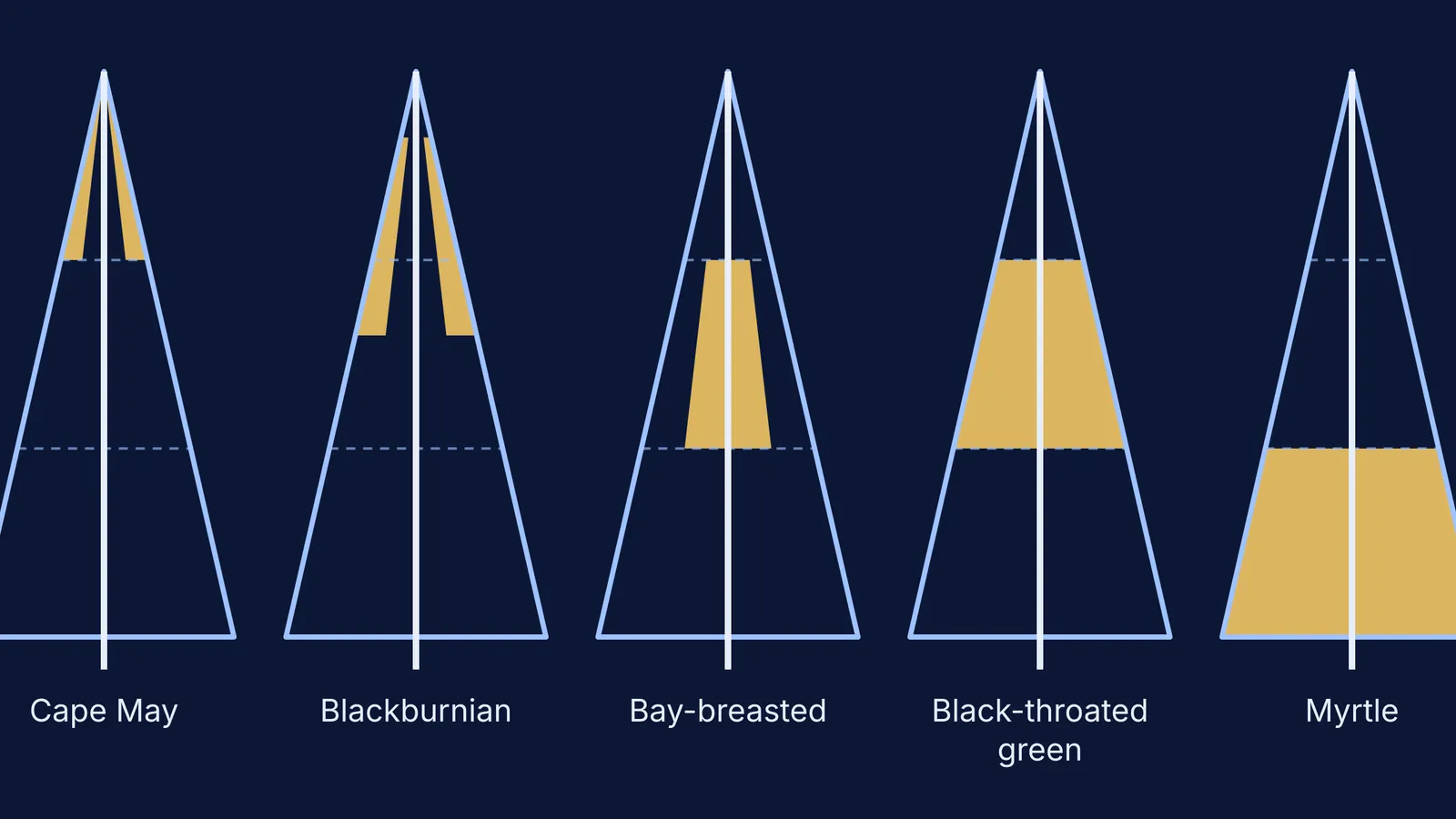
MacArthur divided each tree into zones by measuring down from the top and out from the trunk, 16 positions in all, then recorded where each bird fed (Stanford Birds essay). Each species split its time among those zones differently:
Cape May: mostly the outside of the treetop. It caught flying insects in the air far more often than the Blackburnian, and tended to move up and down rather than side to side.
Blackburnian: the upper and outer parts of conifers (Smithsonian's National Zoo).
Bay-breasted: mostly the middle interior, closer to the trunk.
Black-throated green: the dense branches in the middle (ESA). It hovered much more than the bay-breasted.
Myrtle: searched down in the lowest branches (US National Park Service), moved from zone to zone and had the most varied feeding habits.
Timing differed too. The species have somewhat different nesting times, so their peak food needs do not fall together (Stanford Birds essay).
What is resource partitioning?
Resource partitioning is when species that use the same kind of resource divide it by place, time or method, so they compete less. The Ecological Society of America calls MacArthur's warbler drawings "remarkable examples of niche partitioning that promotes coexistence" (ESA). Partitioning is the way round a rule ecologists call competitive exclusion: two species competing for exactly the same limited resource cannot coexist for long. Garrett Hardin reviewed that idea in a 1960 Science paper titled "The Competitive Exclusion Principle" (DOI record).
If the difference between where a species lives and the role it plays still feels blurry, read our explainer on habitat versus niche. See more cases in these examples of interspecific competition, and watch one species push out another in our two-species competitive exclusion simulation.
Does MacArthur's warbler result still hold?
Mostly, with a twist. A 2025 study in Biology Letters re-examined the idea across 13 warbler species in a forest in northern New York, combining foraging records, body measurements and DNA from droppings (Penn State news). Body shape closely tracked foraging behaviour, but diet did not: across 2,237 invertebrate taxa detected, closely related warblers ate similar invertebrates regardless of where they foraged (Miller et al., 2025).
More than 75% of the dropping samples contained the area's most common insect, a snipefly (Penn State news). "MacArthur was right in that these warblers are partitioning their habitat in fine ways, but it's a little more complex than he originally thought," said David Toews, a Penn State biologist and an author of the study.
How do you explain MacArthur's warblers in an exam answer?
Use this five-step frame:
Name the problem: similar species, same food, same habitat.
Name the study: MacArthur, five warbler species, 1958.
Give the evidence: each species fed in a different zone of the same tree.
Name the outcome: competition reduced, coexistence possible.
Name the term: resource partitioning.
A model three-mark answer: "MacArthur studied five closely related warbler species that eat insects in the same conifer trees. He found each species fed mainly in a different part of the tree, for example the Cape May at the outer top and the bay-breasted in the middle interior, and they also hunted differently. By dividing the shared food this way, a process called resource partitioning, they avoided competitive exclusion and coexisted."
Three mistakes to check for before you submit:
Saying the birds lived in different trees. They shared the same trees.
Saying they ate completely different food. The difference was mainly where and how they fed.
Mixing up habitat (the forest) with niche (the bird's role and feeding zone).
If niche, habitat and competition keep blurring together, the Fermi Concept Library gives each concept its own lesson and shows where it sits in the map of biology. To see how competition plays out over time, try the Fermi Simulation Lab, which has interactive simulations for ideas that are easier to see than to read.
Next time you see two birds in one tree, check where each one is feeding.


