On this page
Near the end of its Class 12 chapter on biodiversity, NCERT names two international meetings in one short paragraph. It is easy to skim, yet a question can hinge on a date, a city or a pledge. Here is what each meeting agreed and how to write it in an exam.
What does NCERT say about the Earth Summit and Johannesburg?
The passage is in Chapter 13, Biodiversity and Conservation, of the NCERT Class 12 Biology textbook (page 225 in the 2026-27 reprint). It starts from the idea that "biodiversity knows no political boundaries", then makes two claims:
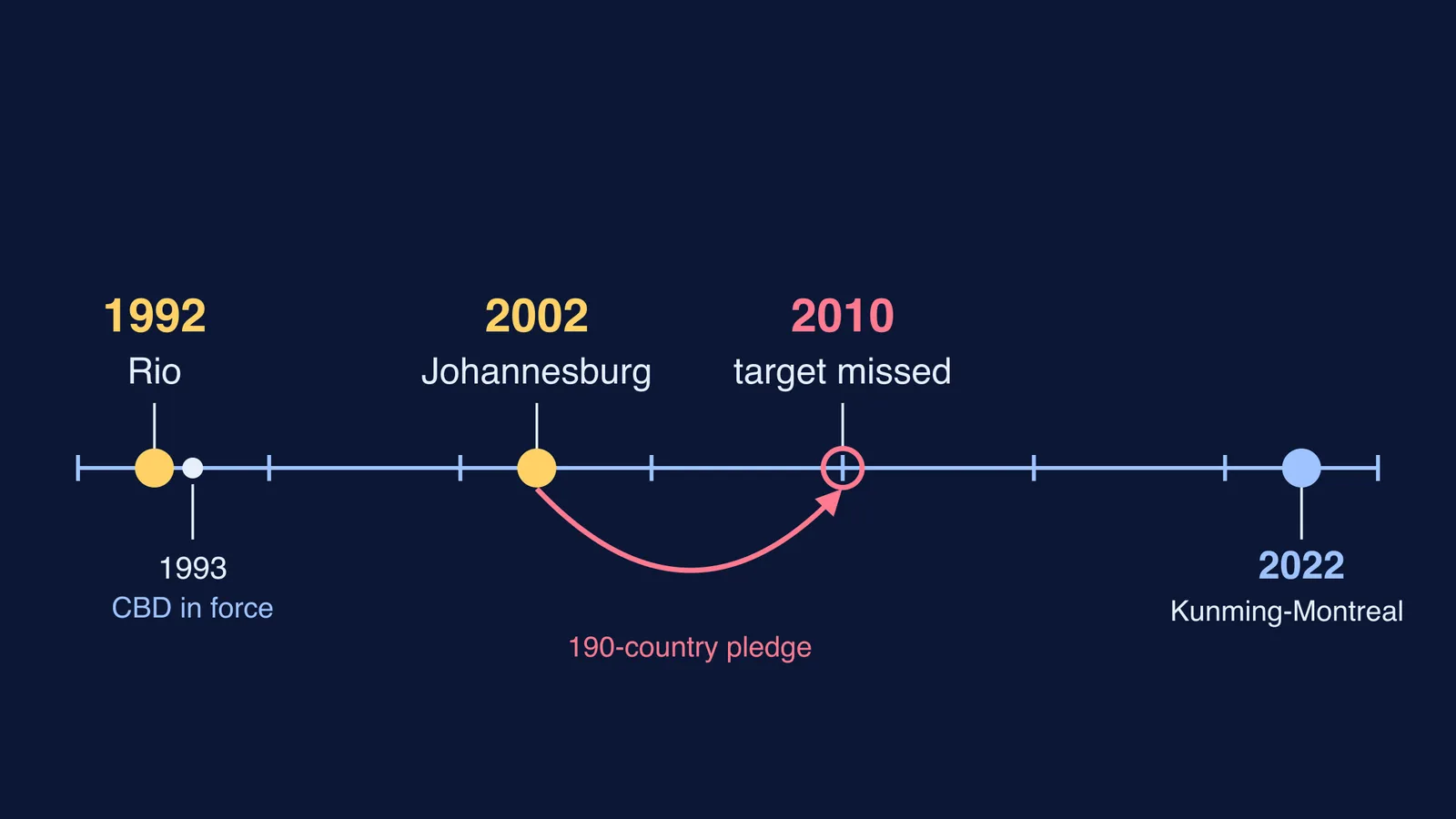
The Convention on Biological Diversity ("The Earth Summit"), held in Rio de Janeiro in 1992, called on all nations to conserve biodiversity and use its benefits sustainably.
At the World Summit on Sustainable Development in Johannesburg, South Africa, in 2002, 190 countries pledged to achieve by 2010 a significant reduction in the current rate of biodiversity loss.
What was agreed at the Earth Summit in Rio in 1992?
The Earth Summit's official name was the United Nations Conference on Environment and Development, held in Rio de Janeiro on 3-14 June 1992, according to the United Nations. People from 179 countries took part, and its outcomes included the UN climate change convention and the Convention on Biological Diversity.
The Convention on Biological Diversity (CBD) was opened for signature on 5 June 1992 at the Rio Earth Summit and collected 168 signatures by June 1993, according to the CBD's own history page. It entered into force on 29 December 1993, 90 days after the 30th ratification.
The CBD has three objectives: conservation of biological diversity, sustainable use of its components, and fair and equitable sharing of the benefits from genetic resources (CBD). India has been a party since 19 May 1994, according to the CBD country profile for India.
What did countries agree at Johannesburg in 2002?
The World Summit on Sustainable Development met in Johannesburg from 26 August to 4 September 2002 and adopted a political declaration and a plan of implementation, according to the United Nations.
The 2010 target itself was first adopted by the parties to the CBD in April 2002, in decision VI/26, and was then endorsed at Johannesburg, as the CBD's 2010 target page records. Its full wording was to "achieve by 2010 a significant reduction of the current rate of biodiversity loss at the global, regional and national level as a contribution to poverty alleviation and to the benefit of all life on Earth".
Paragraph 44 of the Johannesburg Plan of Implementation says biodiversity "is currently being lost at unprecedented rates due to human activities" and that meeting the 2010 goal would need new money and technical help for developing countries.
Was the 2010 biodiversity target met?
No. The CBD's third Global Biodiversity Outlook, published in 2010, states plainly that the target agreed in 2002 "has not been met".
The same report found that the abundance of vertebrate species, based on assessed populations, fell by nearly a third on average between 1970 and 2006 (GBO-3).
Countries tried again: the Kunming-Montreal Global Biodiversity Framework, adopted in December 2022, sets 4 goals for 2050 and 23 targets for 2030, according to the CBD. This is beyond the NCERT text, but it helps you see one story rather than two dates.
How do you answer an exam question on these summits?
Learn the facts from the NCERT passage as a chain of four links:
Where and when: Rio de Janeiro, Brazil, 1992; Johannesburg, South Africa, 2002.
What: Rio gave the Convention on Biological Diversity; Johannesburg was the World Summit on Sustainable Development.
The pledge: 190 countries, a significant reduction in the rate of biodiversity loss by 2010.
Why: biodiversity knows no political boundaries, so conservation needs every nation.
Here is a model answer for a 3-mark question such as "Why is biodiversity conservation a global responsibility? Name two international efforts."
Biodiversity knows no political boundaries, so its conservation is a collective responsibility of all nations.
The Convention on Biological Diversity, signed at the Earth Summit in Rio de Janeiro in 1992, called on all nations to conserve biodiversity and use its benefits sustainably.
At the World Summit on Sustainable Development in Johannesburg in 2002, 190 countries pledged to significantly reduce the rate of biodiversity loss by 2010.
Common slips: swapping the cities, dating the Johannesburg meeting to 2010, and saying the summits "stopped" biodiversity loss. The pledge was to slow the rate of loss, and it was missed.
The summits are the global layer of conservation; pair them with the national layer NCERT lists alongside them. Read our guides to India's four biodiversity hotspots, in situ and ex situ conservation examples and India's share of world biodiversity. If an idea such as endemism is still fuzzy, the Fermi Concept Library gives each concept its own lesson and its place in the map.