On this page
Questions like "X is binomial with n = 5 and P(X = 1) = P(X = 2). Find p" need less algebra than they seem to. Write the two probabilities, cancel what they share, solve, and check that the answer is a real probability.
What is the binomial formula you start from?
The NIST/SEMATECH e-Handbook of Statistical Methods gives the binomial probability of exactly x successes in n trials as P(x) = nCx p^x (1 − p)^(n − x), for x = 0, 1, 2, ..., n. In that formula, p is the probability of success on a single trial, and it stays the same for every trial (NIST, same page). We write q = 1 − p to keep the lines short.
If you are not sure your situation is binomial in the first place, run the four-condition test in when is a distribution binomial before using the formula.
How do you find p if P(X = 1) = P(X = 2)?
Take n = 5.
Write both sides. P(X = 1) = 5C1 p q^4 = 5p q^4. P(X = 2) = 5C2 p^2 q^3 = 10p^2 q^3.
Set them equal: 5p q^4 = 10p^2 q^3.
Cancel the common factors. Both sides share 5, p and q^3. Dividing by p q^3 is allowed only if p is not 0 and q is not 0, so note that and keep going: q = 2p.
Substitute q = 1 − p: 1 − p = 2p, so p = 1/3.
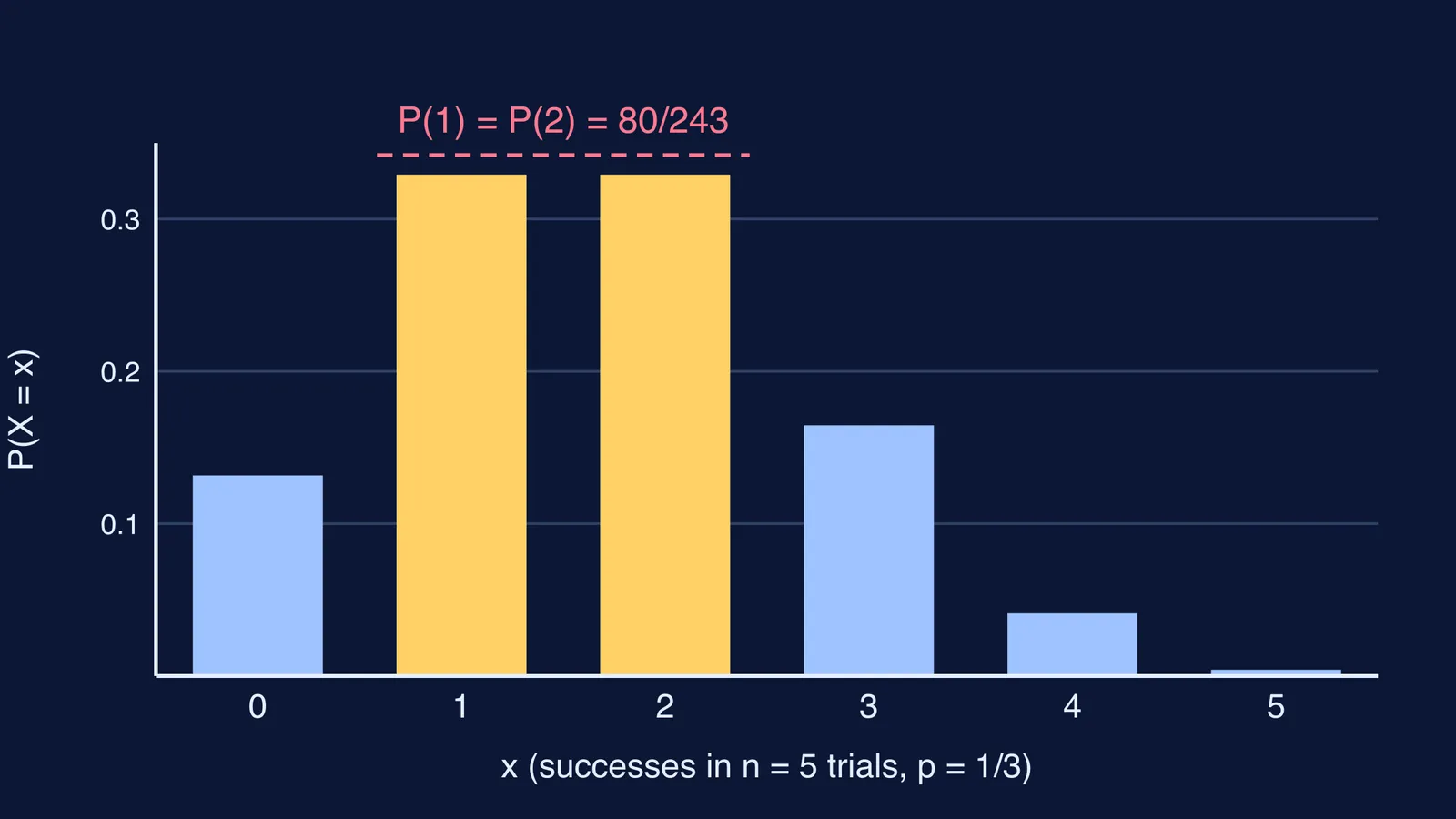
Check. p = 1/3 lies between 0 and 1. P(X = 1) = 5 × (1/3) × (2/3)^4 = 80/243, and P(X = 2) = 10 × (1/9) × (8/27) = 80/243. They match.
The same steps work for any n. Writing nC2 = n(n − 1)/2 and cancelling n p q^(n − 2) leaves q = (n − 1)p/2, which gives p = 2/(n + 1). For n = 5 that is 2/6 = 1/3, as before.
This connects to the mode. Wikipedia's binomial distribution article notes that when (n + 1)p is an integer and p is neither 0 nor 1, the distribution has two modes, (n + 1)p and (n + 1)p − 1. With n = 5 and p = 1/3, (n + 1)p = 2, so x = 1 and x = 2 tie for most likely. Our post on the most probable number of successes works through that rule.
How do you solve 9P(X = 4) = P(X = 2)?
Take n = 6.
Write both sides. P(X = 4) = 6C4 p^4 q^2 = 15p^4 q^2. P(X = 2) = 6C2 p^2 q^4 = 15p^2 q^4.
Set up the equation: 9 × 15p^4 q^2 = 15p^2 q^4.
Cancel 15 and p^2 q^2 (again assuming p is not 0 or 1): 9p^2 = q^2.
Take square roots: q = 3p or q = −3p.
From q = 3p: 1 − p = 3p, so p = 1/4. From q = −3p: 1 − p = −3p, so p = −1/2.
Check. p = −1/2 is not a probability, so reject it. p = 1/4 lies between 0 and 1, so keep it.
Verify with numbers: P(X = 4) = 15 × (1/256) × (9/16) = 135/4096, and P(X = 2) = 15 × (1/16) × (81/256) = 1215/4096. Nine times 135 is 1215, so the condition holds.
What mistakes cost marks on these questions?
Using nC1 on both sides. The coefficients differ: 5C1 = 5 but 5C2 = 10.
Dividing by p or q without saying they are non-zero.
Keeping only the positive square root (step 4 of the 9P(X = 4) example) without stating why, or keeping both and forgetting to reject the negative one.
Stopping at p and never substituting back.
Mixing up p and q: q = 2p gives p = 1/3, not 2/3.
Once you have p, the follow-up part is often the mean np or the variance npq; our explainer on why the mean is np and the variance is npq covers that next step.
A five-line method to remember
Write P(X = a) and P(X = b) with their own nC values.
Put in the given relation, including any coefficient like 9.
Cancel the shared powers of p and q, noting p and q are non-zero.
Replace q with 1 − p and solve.
Keep only answers with 0 < p < 1, then substitute back to check.
If you get stuck at the cancelling step, the Fermi Problem Library has worked problems with a step-by-step solver that explains the reasoning rather than printing an answer. If the gap is the binomial idea itself, start with the lesson in the Fermi Concept Library.