

On this page
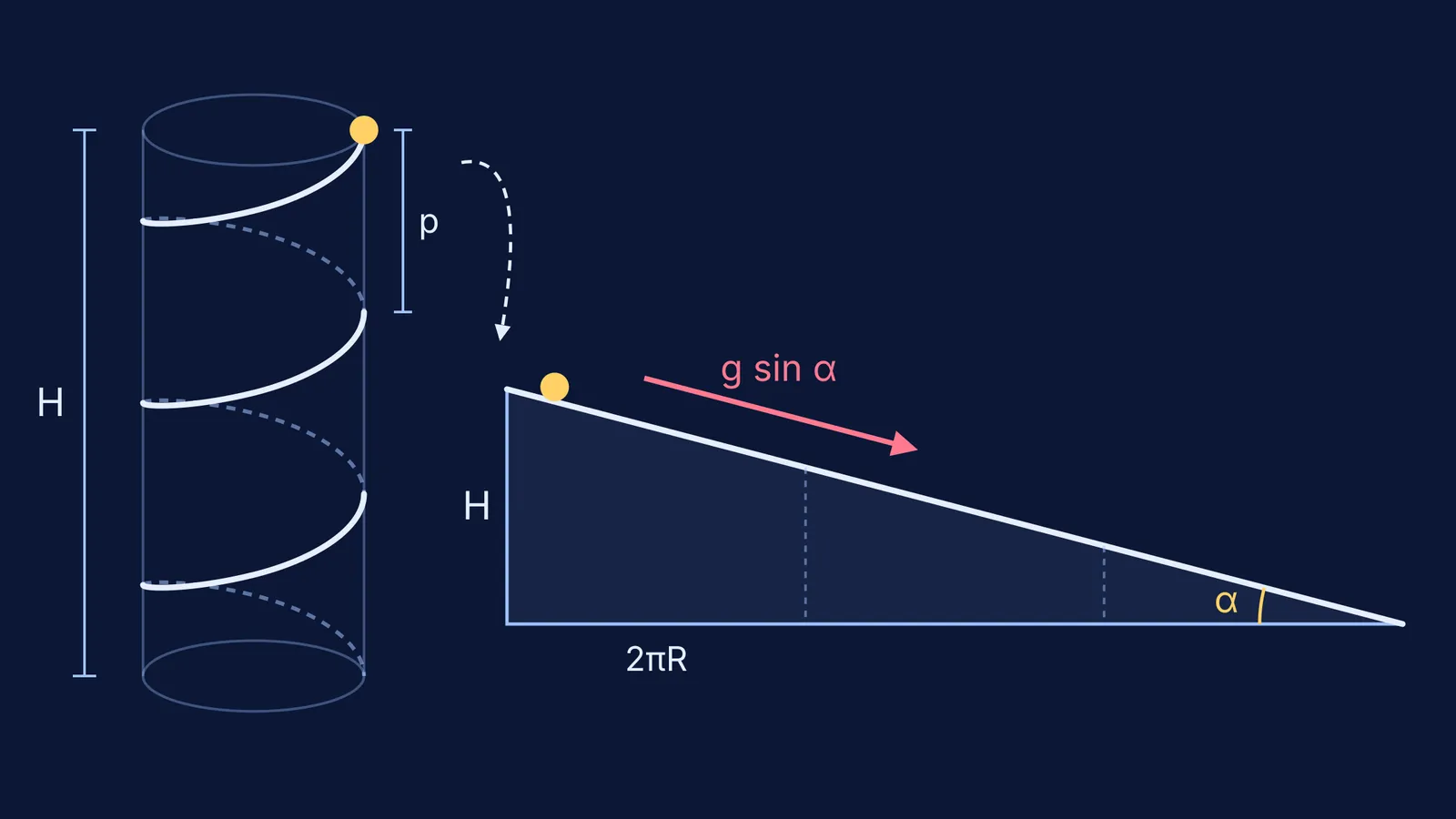
A bead on a smooth helical wire is released from the top. How long does it take to reach the bottom? Flatten the cylinder the helix wraps around and the wire becomes a straight incline, a Class 11 problem you already know.
How do you find the time for a bead sliding down a smooth helical wire?
A circular helix can be written as x = a cos t, y = a sin t, z = bt, with radius a and pitch 2πb, the height gained in one full turn (Wikipedia: Helix). Below we call the radius R and the pitch p.
The shortest path between two points on a cylinder is a piece of a helix: cut the cylinder along one side, flatten it, and the straight line joining the points becomes helical when you roll it back up (Wolfram MathWorld: Helix). Run that in reverse and one turn of the wire unrolls into a right triangle:
Base: the circumference, 2πR.
Height: the pitch, p.
Hypotenuse: the wire itself, √((2πR)² + p²).
So tan α = p / (2πR), the same at every point on the wire. A bead released from rest at height H behaves like a block on a smooth incline of angle α:
Length of wire: L = H / sin α.
Acceleration along the wire: a = g sin α, the standard frictionless-incline result (HyperPhysics: Inclined plane).
Time from rest: L = ½at², so t = √(2L/a) = (1/sin α)√(2H/g).
That is the free-fall time from height H, stretched by a factor of 1/sin α.
Why can you treat a 3D helix as a flat incline?
Only the component of gravity along the wire changes the bead's speed. The smooth wire pushes perpendicular to itself, so it does no work. The wire's tangent always makes the same angle α with the horizontal, so gravity's component along the wire is mg sin α everywhere.
Unlike a flat incline, part of the wire's force points toward the axis, supplying the centripetal force for the circling motion. It does no work, so it never enters the time or the speed. If components trip you up, see our guide to resolving forces on an inclined plane without the sin-cos swap.
HyperPhysics notes that on a frictionless incline the speed at the bottom does not depend on the angle (HyperPhysics: Inclined plane). See also whether the speed at the bottom of a smooth track depends on its shape.
Worked example: five turns of wire
Take a smooth helical wire with circumference 2πR = 0.80 m (radius about 12.7 cm), pitch p = 0.60 m and 5 turns. The bead starts from rest at the top. Use g = 9.8 m/s² and a = g sin α (HyperPhysics: Inclined plane).
Angle: tan α = 0.60 / 0.80 = 0.75, so sin α = 0.6 (a 3-4-5 triangle).
Height: H = 5 × 0.60 = 3.0 m.
Wire length: each turn is √(0.80² + 0.60²) = 1.0 m, so L = 5.0 m. Check: 3.0 / 0.6 = 5.0 m.
Acceleration: a = 9.8 × 0.6 = 5.88 m/s².
Time: t = √(2 × 5.0 / 5.88) ≈ 1.30 s.
Speed at the bottom: v = at ≈ 7.67 m/s, matching √(2 × 9.8 × 3.0) ≈ 7.67 m/s.
Dropped straight down 3.0 m, the bead would take about 0.78 s. Stretch that by 1/sin α = 5/3 and you get the same 1.30 s.
What mistakes do students make with helix problems?
Flipping the angle. Some references define a helix's 'slope' as circumference divided by pitch (Wikipedia: Helix). In our notation that is cot α, not tan α. Draw the unrolled triangle and read the angle off it.
Using the radius instead of the circumference. The base of the triangle is 2πR, not R.
Adding a centripetal term to the time. The circling motion changes the normal force, not the acceleration along the wire.
Using the trick on a rough wire. With friction, the normal force (and so friction) depends on speed, and the acceleration is no longer constant.
The same find-the-hidden-incline thinking explains why every smooth chord of a vertical circle takes the same time.
How should you practise constraint problems like this?
Sketch the unrolled path first, then write one line for the angle and one for the acceleration. Then double the pitch and predict the new time before calculating it.
If you get stuck on why a step works, the Fermi Problem Library has worked problems with a step-by-step solver that explains the reasoning rather than printing an answer. For the incline idea itself, the Fermi Concept Library gives each physics concept its own lesson and its place in the map.


