

On this page
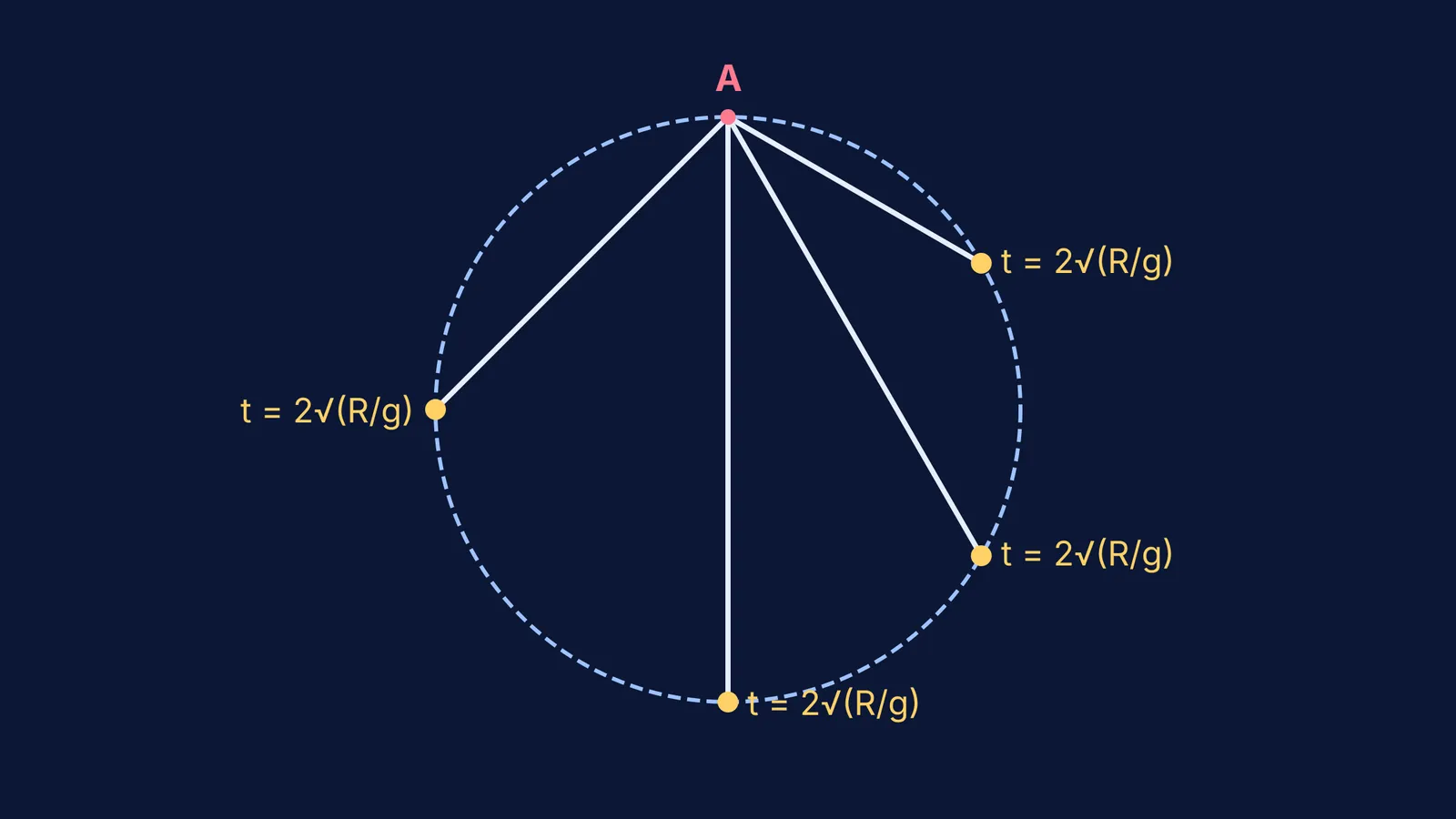
Picture a bicycle wheel standing upright. If you build a straight, frictionless slide from the very top of the wheel to any other point on its rim, how long will it take a bead to slide down?
Surprisingly, the time is identical for every possible slide. Whether the path is steep and long (going straight down the middle) or shallow and short (going to a point near the top), the bead reaches the edge at the exact same moment.
This beautiful, counterintuitive fact is known as Galileo's law of chords. Here is how to prove it for JEE Main and NEET-UG physics.
What is Galileo's law of chords?
In his 1638 book *Two New Sciences*, Galileo Galilei showed that if you draw inclined planes from the highest or lowest point of a vertical circle to any point on its circumference, objects sliding down them from rest will take equal times.
For a circle of radius R, that time is always 2√(R/g).
The result relies on two things balancing perfectly: a steeper chord is longer and forces the object to travel further, but it also has a greater component of gravity pulling the object along it. This fact was a stepping stone in the history of physics. Galileo used it to investigate the path of quickest descent, noticing that a broken path of two chords was faster than a single chord. This eventually led later mathematicians, like Johann Bernoulli in 1696, to discover the brachistochrone curve.
Why is the time to slide down any chord of a vertical circle the same?
To prove it, we need to find the length of the chord and the acceleration along it, and then use the standard kinematic equations.
The geometry: Let the circle have radius R, making its vertical diameter 2R. Let the straight chord make an angle θ with the vertical diameter. From the right-angled triangle formed by the diameter and the chord, the length of the chord is L = 2R cos θ.
The physics: The acceleration due to gravity is g, acting straight down. The component of this acceleration along the smooth, frictionless chord is a = g cos θ.
The time: The bead starts from rest (u = 0). Using the second equation of motion, s = ut + ½at², we substitute our expressions for distance and acceleration:
2R cos θ = ½(g cos θ)t²
Notice that cos θ appears on both sides. As long as the angle is not 90° (which would mean a horizontal line with zero length and zero acceleration), we can cancel cos θ: 2R = ½gt² t² = 4R/g t = 2√(R/g)
The angle θ has vanished from the final equation. Because the time does not depend on θ, it is identical for every chord starting at the top point. The symmetry of the circle means the rule also works in reverse: chords from any point on the circumference down to the lowest point of the circle take exactly the same time.
Worked example: comparing a chord to free fall
Let's test the formula with two very different paths.
Path 1: Straight down the middle Imagine dropping the bead straight down the vertical diameter. The length of this path is the diameter, 2R. The acceleration is pure gravity, g. Using s = ½at²: 2R = ½gt² t = √(4R/g) = 2√(R/g).
Path 2: A 60° chord Now draw a chord from the top that makes a 60° angle with the vertical.
Length: L = 2R cos 60° = 2R × 0.5 = R. The path is R.
Acceleration: a = g cos 60° = 0.5g. The acceleration is 0.5g.
Using s = ½at²: R = ½(0.5g)t² R = 0.25gt² t² = 4R/g t = 2√(R/g).
Even though the 60° path is shorter, the weaker acceleration perfectly compensates for it, resulting in the exact same time.
Checklist for vertical circle kinematics
When a mechanics problem asks for the time to slide down an inclined plane inside a circle:
Identify the start and end points. Does the path start at the highest point or end at the lowest point? If so, the time is 2√(R/g).
Check for friction. Galileo's law of chords assumes a smooth surface. If the problem states the chord is rough with a coefficient of friction μ, the acceleration becomes a = g(cos θ − μ sin θ), and the times will no longer be equal.
Look out for non-vertical circles. If the circle is tilted or horizontal, gravity's component changes. The law of chords only holds for a vertical circle in a uniform gravitational field.
In physics exams, mechanics problems often hide simple geometries inside complicated-looking diagrams. The Fermi Problem Library has worked problems with a step-by-step solver that explains the reasoning rather than printing an answer. When you bring a kinematics problem, Fermi's AI tutor works out what you already know and builds a plan for the session, teaching through it by drawing the figure and checking understanding as it goes.
For a related problem, see how to find the time for a block to slide down a rough incline when friction is involved, or how to calculate the distance in the nth second for uniformly accelerated motion.


