

On this page
A common wrong answer to this classic question comes from one assumption: that "dropped" means the stone starts at rest. It does not. Here is the physics, a worked example and a checklist for any version of the problem.
Why does a stone dropped from a rising balloon go up first?
Before release, the stone moves up with the balloon at speed u. Letting go removes the hand, not the velocity. OpenStax University Physics, Volume 1, section 3.5 puts it this way: "When the object is thrown, it has the same initial speed in free fall as it did before it was released."
From the moment of release, only gravity acts (we ignore air resistance), so the stone is in free fall even while it is still moving up, as the same OpenStax section notes. Its upward velocity drops by g every second: it rises, stops for an instant, then falls past the release point to the ground.
The standard acceleration of gravity is 9.80665 m/s², according to NIST's CODATA reference values. We round it to 10 m/s² to keep the arithmetic clean.
Which equations of motion do you use?
Take upward as positive, the ground as y = 0 and the moment of release as t = 0. With acceleration −g, the free-fall equations in OpenStax section 3.5 become:
v = u − gt
y = y₀ + ut − ½gt²
v² = u² − 2g(y − y₀)
For a release at height h with upward speed u, three results follow:
Maximum height: the stone climbs a further u²/2g, so H = h + u²/2g, reached at t = u/g.
Time to hit the ground: set y = 0 and y₀ = h, so 0 = h + ut − ½gt², which gives t = [u + √(u² + 2gh)]/g.
Speed on impact: √(u² + 2gh).
Keep the positive root; the negative root is a time before release.
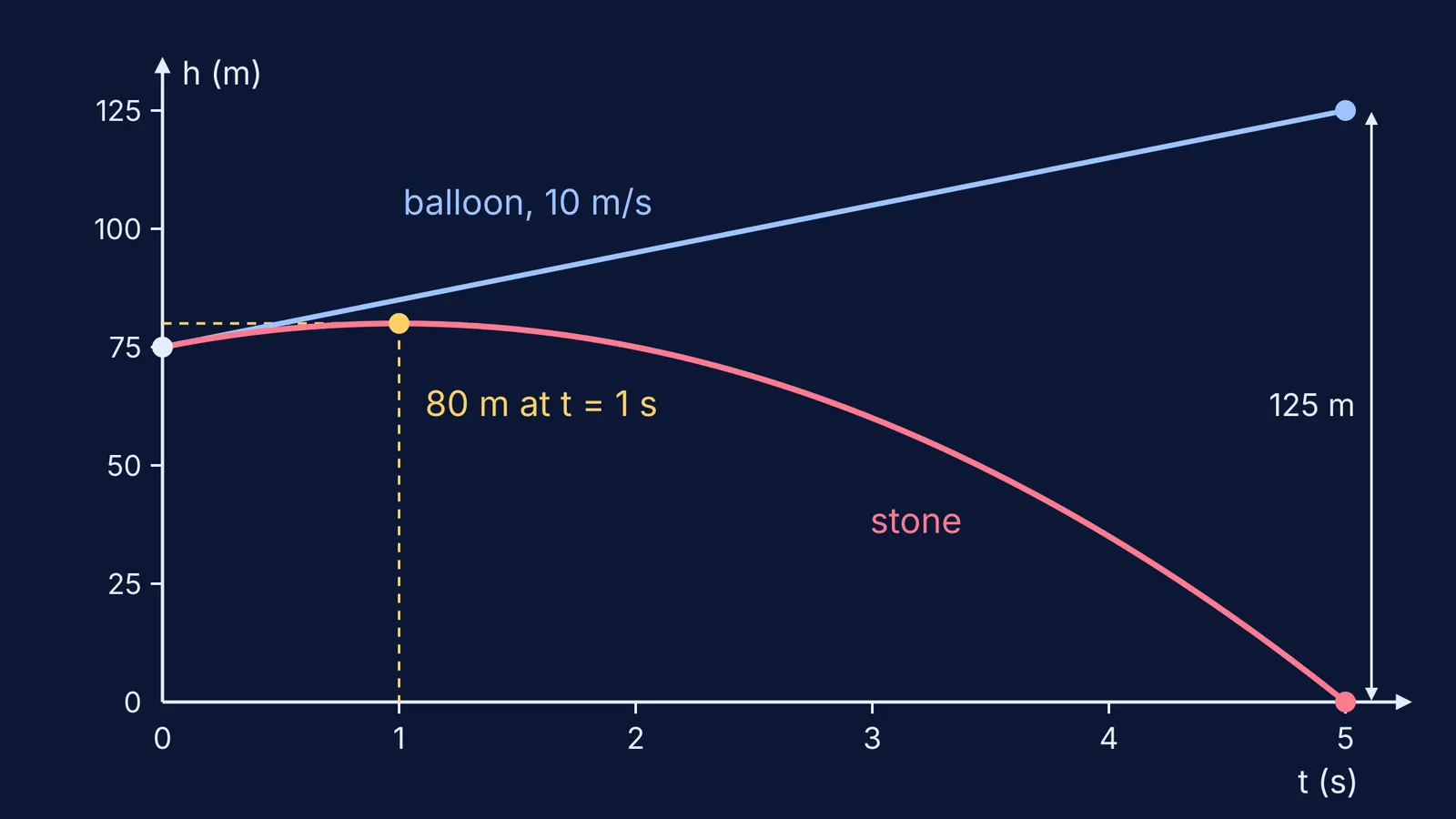
Worked example: a balloon at 75 m rising at 10 m/s
A balloon rises at a steady 10 m/s. At 75 m above the ground, it releases a stone. Take g = 10 m/s².
Initial velocity of the stone: +10 m/s, not zero.
Time to reach the top: t = u/g = 10/10 = 1 s.
Extra rise: u²/2g = 100/20 = 5 m, so the maximum height is 75 + 5 = 80 m above the ground.
Time to hit the ground: 0 = 75 + 10t − 5t², so t² − 2t − 15 = 0, or (t − 5)(t + 3) = 0. The answer is t = 5 s.
Check by splitting the motion: falling from rest at 80 m takes √(2 × 80/10) = 4 s, and 1 s up plus 4 s down is 5 s.
Velocity on impact: v = 10 − 10 × 5 = −40 m/s, so 40 m/s downward. Check: v² = 10² + 2 × 10 × 75 = 1600.
Starting the stone at rest gives t = √(2 × 75/10) = √15, about 3.9 s: more than a second short, and it misses the 5 m climb.
What if the balloon is accelerating?
The stone takes the balloon's velocity at the moment of release, but not its acceleration. Once free, it accelerates at g downward. So solve in two stages: release height and speed from the balloon's motion, then free fall. Say a balloon starts from rest with an upward acceleration of 2 m/s², and a stone falls off after 10 s.
At release: u = 2 × 10 = 20 m/s and h = ½ × 2 × 10² = 100 m.
Maximum height: 100 + 20²/(2 × 10) = 100 + 20 = 120 m.
Time to ground: 0 = 100 + 20t − 5t², so t² − 4t − 20 = 0, which gives t = 2 + 2√6, about 6.9 s.
A checklist for any balloon or lift release problem
Velocity at release: the carrier's velocity at that instant, with its sign.
Acceleration after release: g downward, nothing else.
Write your sign convention and origin at the top of your working.
Set y = 0 at the ground and keep the positive root.
Check one answer a second way, such as splitting the motion at the top.
For the gap between stone and carrier, use the carrier's frame only if it moves at constant velocity.
If you keep losing marks on signs or the starting velocity, the Fermi Problem Library has worked problems with a step-by-step solver that explains the reasoning rather than printing an answer, so you can see exactly where u enters each line.
Next, compare free fall on Earth, the Moon and Jupiter, see why projectiles with the same maximum height have the same time of flight, or learn how to check AI answers to equations of motion numericals.


