

On this page
You are in the back seat, the car is taking a long curve at a steady speed, and you toss a ball straight up. It does not come back to your hand. Nothing pushed it away. The car moved, and the ball did not follow.
Where does a ball thrown up in a turning car land?
It lands towards the outside of the curve, and very slightly towards the back of the car. On a left-hand bend that means to your right.
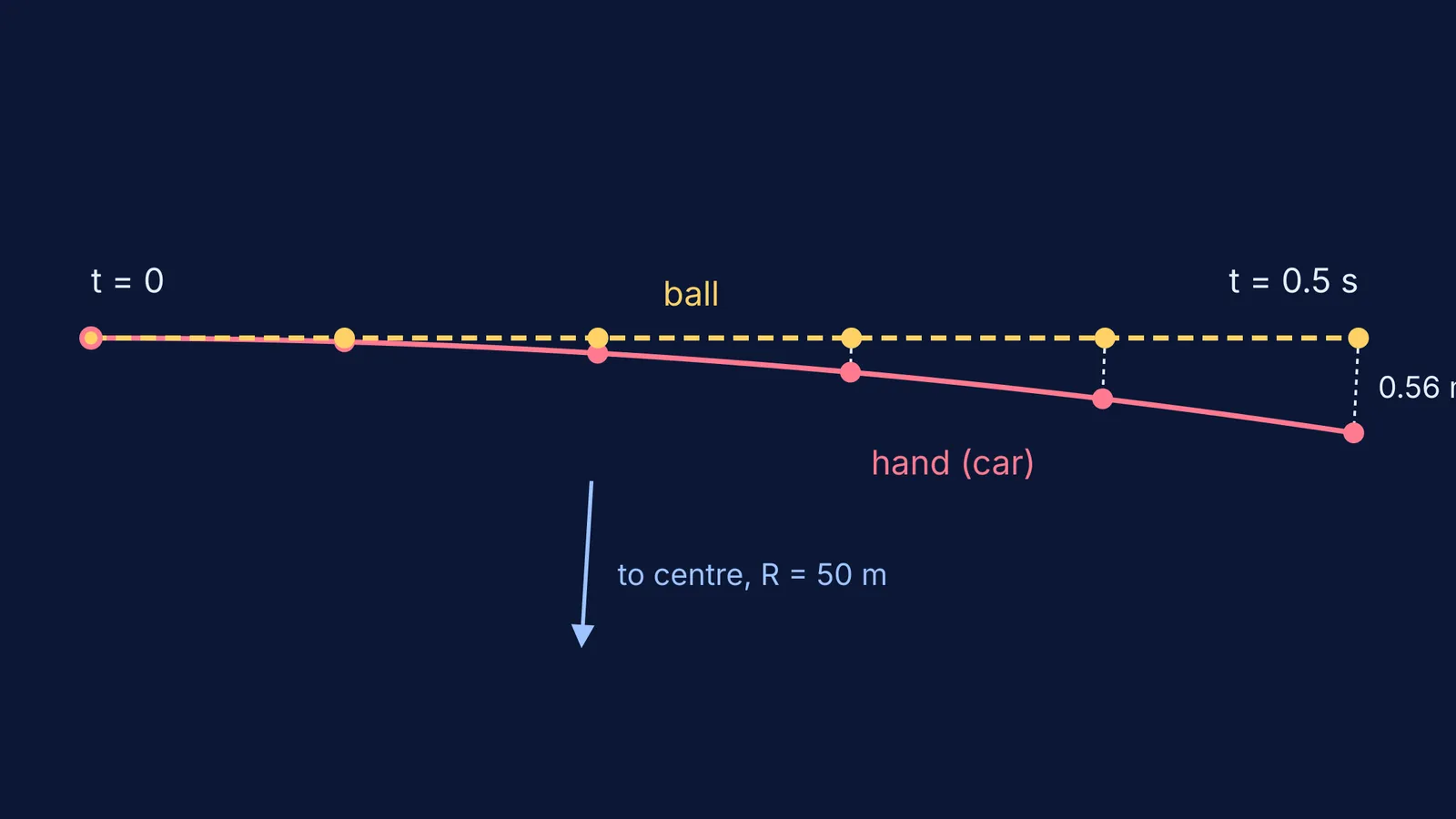
Seen from the road, the ball does nothing strange. As it leaves your hand it moves with the car, along the line the car was heading at that instant. In the air the only force on it is gravity, acting straight down, so its horizontal motion is a straight line at constant speed (ignoring air). The car keeps turning, and the seat curves away inward. To you, the ball seems to drift outward.
Why does the ball miss your hand on a curve?
Because the car is accelerating, even at constant speed. Going round a curve means the direction of velocity keeps changing. The centripetal acceleration is a = v²/r, pointing towards the centre of the curve, as the OpenStax University Physics chapter on centripetal force sets out. On a flat road, the same page notes, friction from the tyres is the centripetal force that makes the car turn.
Your hand gets that inward push through the car. The ball in the air does not.
In the textbook's section on fictitious forces and non-inertial frames, OpenStax says that on a right turn you feel thrown left, but a physicist would say you are going in a straight line while the car moves to the right. A fictitious force is an unreal force that seems real because the observer's frame is accelerating or rotating, in that textbook's definition. The outward centrifugal force you seem to feel in the car is one of these.
How far does a ball thrown up in a turning car drift?
Assume the car moves at 54 km/h, which is 15 m/s, round a flat curve of radius 50 m. You toss the ball up at 2.45 m/s relative to the car, so it rises about 31 cm and stays in the air for 0.5 s (using g = 9.8 m/s²). The only formula needed is a = v²/r from OpenStax.
Car's acceleration: 15² / 50 = 4.5 m/s², towards the centre.
Seen from inside the car, the ball acts as if pushed outward with that acceleration. Drift = ½ a t² = ½ × 4.5 × 0.5² ≈ 0.56 m.
Check from the road: the ball travels 7.5 m in a straight line, while the car travels 7.5 m along the arc and turns through 0.15 rad. Working out both positions exactly puts the ball 0.56 m to the outside of your hand and about 6 cm towards the back.
More than half a metre, from a 31 cm toss. Double the speed and the drift becomes about four times as large, because a grows with v². One limit: cabin air moves with the car, so a very light ball such as a ping-pong ball can drift less than this.
What happens on a straight road, when braking, or speeding up?
Use the same rule each time: find the car's acceleration, and the ball lands the other way.
Straight road, steady speed: no acceleration, so the ball lands back in your hand.
Braking: the ball lands towards the front.
Speeding up: the ball lands towards the back.
Turning at steady speed: the ball lands towards the outside of the curve.
Turning while braking: outward and forward together.
The rotating version of this puzzle is in our post on the path of a ball rolled on a rotating merry-go-round. For the car itself, see when an accelerating car skids on a circular track, and for v²/r from the friction side, when a coin slips off a turntable.
How should you answer this in an exam?
These questions test whether you pick one frame and stay in it. A four-step script:
Name the frame: from the ground, or from inside the car.
Ground frame: the ball moves in a straight line at the car's velocity at release; the car follows the arc. Compare positions after time t.
Car frame: add a pseudo force of m × a, pointing outward, then use ½ a t² for short times.
Sanity check: the drift should shrink to zero when the road is straight or the car is slow.
The common mistake is mixing the two, which counts the effect twice.
If a step keeps going wrong, the Fermi Problem Library has worked problems with a step-by-step solver that explains the reasoning rather than printing an answer. If frames of reference themselves feel shaky, the Fermi Concept Library gives each concept its own lesson.
Next time you are a passenger on a winding ghat road, toss a soft ball gently and predict where it lands before it does.


