

On this page
Push a loaded almirah across the floor and it fights you all the way. Put the same almirah on a trolley and you can move it with one hand. Ball bearings do the same thing inside most bicycle wheels and many fans: they replace sliding with rolling.
How do ball bearings reduce friction?
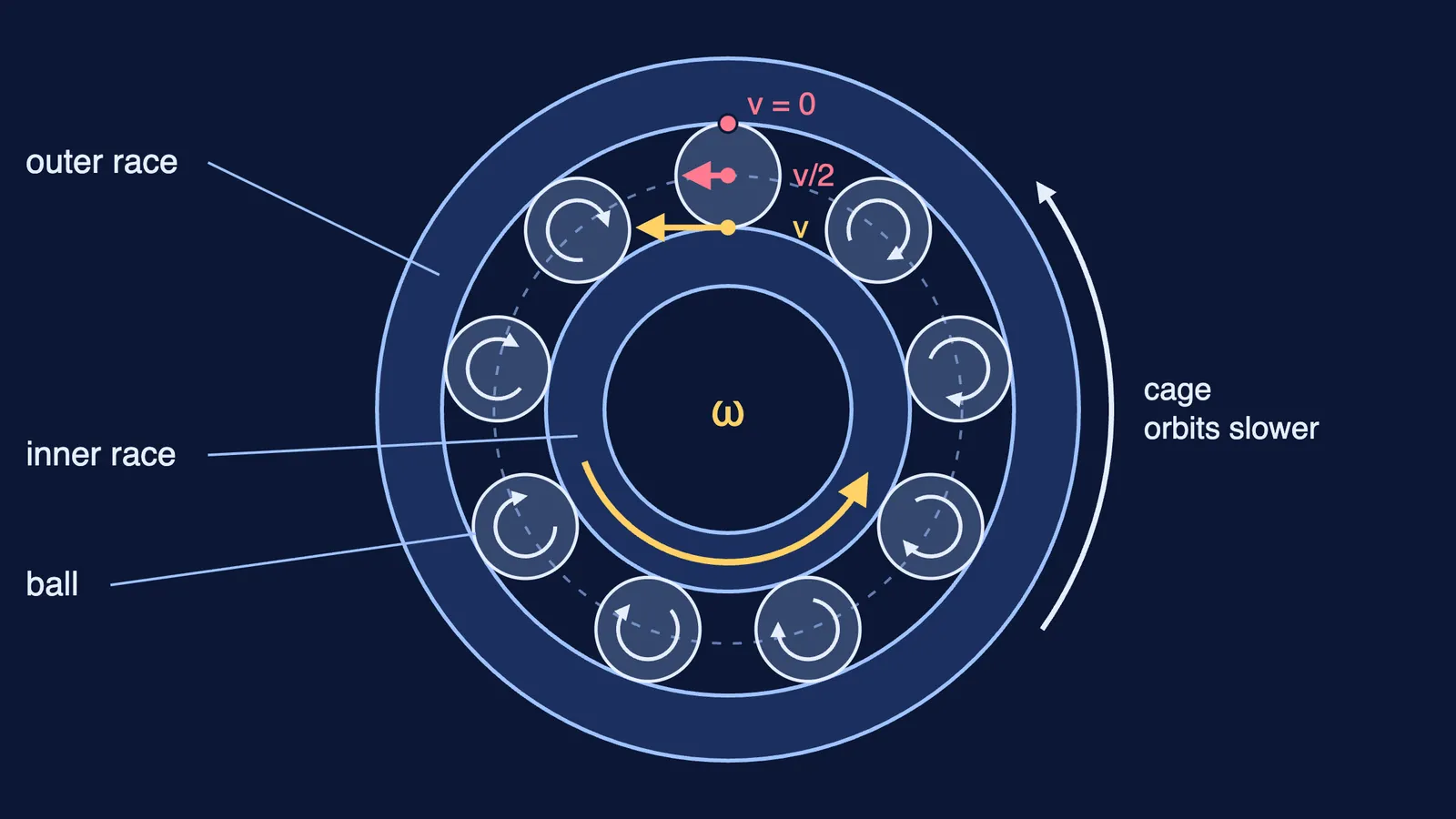
A ball bearing is a set of balls held between two rings, called races, which carry the load through the balls (Wikipedia: Ball bearing). Usually one race stays still and the other turns; in the diagram the inner race turns with the shaft and a cage keeps the balls evenly spaced. Because the balls roll, they have a much lower coefficient of friction than two flat surfaces sliding against each other, as the same article puts it.
Look at the diagram at the top. The inner race turns, and its surface moves at speed v. The ball touches it without slipping, so that point of the ball also moves at v. The point touching the fixed outer race moves at 0. A ball with v on one side and 0 on the other spins about its own centre while its centre moves at v/2, so the cage goes round more slowly than the shaft.
Why is rolling friction so much smaller than sliding friction?
When two surfaces slide, their tiny high points catch and scrape past each other the whole time. You can read what Coulomb's 1781 experiments found about sliding friction for how this was first measured.
Rolling avoids that scraping. What remains is smaller: the ball and race squash very slightly where they press together and do not spring back perfectly. The rolling resistance article says rolling resistance is mainly caused by such non-elastic effects, with hysteresis losses as one form. Steel springs back more quickly and completely than rubber, and the same article notes that a rubber tyre on a paved road has higher rolling resistance than a steel railway wheel on a steel rail. Its table gives hardened steel ball bearings on steel a rolling resistance coefficient of 0.0010 to 0.0015.
Real bearings still slide a little: the elements roll "with little sliding" (Wikipedia: Rolling-element bearing). For the exam order static > sliding > rolling, see static, sliding or rolling friction: which is least?
How much smaller? A worked example with a bicycle wheel
JTEKT's (Koyo's) reference table gives 0.0010 to 0.0015 for a deep-groove ball bearing, and 0.01 to 0.02 in general for a sliding (plain) bearing (JTEKT: friction coefficient of bearings). Clean, dry steel sliding on steel has a kinetic friction coefficient of 0.42 (Engineering Toolbox: friction coefficients).
Now a rough comparison. Say a rider and cycle together weigh 80 kg, which is about 784 N (80 × 9.8), and the rear axle carries roughly half: 400 N. Taking friction as μ × load at the axle:
Dry steel axle sliding in a steel hole: 0.42 × 400 = 168 N.
Plain (sliding) bearing, JTEKT's general range: 0.01 to 0.02 × 400 = 4 to 8 N.
Ball bearing: 0.0010 to 0.0015 × 400 = 0.4 to 0.6 N.
The ball bearing's friction is 280 to 420 times smaller than dry sliding (0.42 ÷ 0.0015 and 0.42 ÷ 0.0010). Against a plain bearing, the fairer comparison, it is about 7 to 20 times smaller (0.01 ÷ 0.0015 and 0.02 ÷ 0.0010). This is a simplification: JTEKT notes that the real coefficient depends strongly on bearing type, load, speed and lubrication. For the other ways engineers cut friction, from lubricants to streamlining, see ways to increase and decrease friction, with real numbers.
Where are the ball bearings in a cycle and a fan?
On a bicycle, start with the wheel hubs: most use steel or ceramic ball bearings (Wikipedia: Bicycle wheel). The headset, the joint the handlebar steers on, usually turns on angular-contact ball bearings (Wikipedia: Ball bearing). The same article says Jules Suriray designed the first radial ball bearing in 1869; it was fitted to the winning bicycle James Moore rode in the Paris–Rouen race that November.
In a fan, the motor's spinning rotor needs a bearing on its shaft. Small electric fans, such as the ones that cool a computer, commonly use a sleeve bearing (two lubricated surfaces sliding) or a ball bearing (Wikipedia: Computer fan). Ball-bearing fans generally cost more, but avoid the orientation limits of sleeve-bearing fans, cope better with heat and are quieter at high speeds; their typical lifespan may be over 60,000 hours at 50 °C, the same article says. Ceiling fans turn on bearings too: on fans that need oiling, the switch housing below the motor often hides the oil reservoir for them (Wikipedia: Ceiling fan).
Try it at home in five minutes
Put a heavy book on a table and push it with one finger.
Slide a handful of marbles or round pencils under the book and push again.
Turn a cycle upside down, spin a wheel and watch how long it keeps going. Then rest a finger lightly on the tyre and feel sliding friction take over.
Write one line for each step: what was sliding, and what was rolling.
If the v and v/2 picture is hard to hold, the Fermi Simulation Lab has interactive simulations for ideas that are easier to see than to read. And if friction keeps tripping you up in problems, Fermi's AI tutor works out what you already know and builds a plan for the session, drawing the figure as it goes.


