On this page
Leo Baekeland described Bakelite in March 1909 in The Synthesis, Constitution, and Uses of Bakelite, a paper in the Journal of Industrial & Engineering Chemistry. His US patent 942,699, titled Method of making insoluble products of phenol and formaldehyde, was granted on 7 December 1909. The chemistry has two stages: a meltable chain, then a rigid network that heat cannot melt again. Explain why the second stage is permanent and you understand thermoplastic versus thermosetting polymers.
How is Bakelite prepared from phenol and formaldehyde?
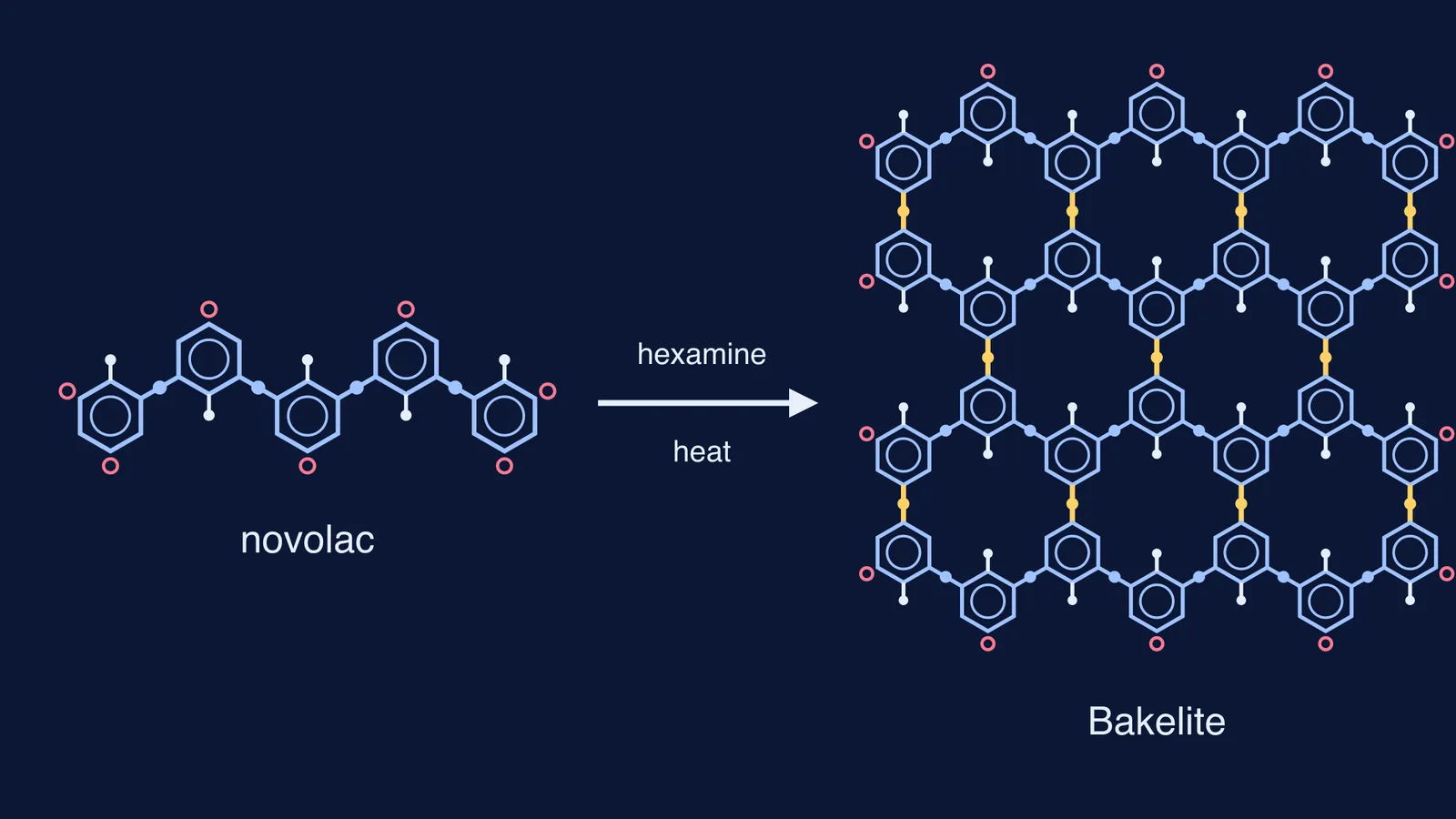
Phenol reacts with formaldehyde at three places on its ring: the two ortho positions and the para position, numbered 2, 4 and 6, so up to three formaldehyde units can attach to one ring (phenol formaldehyde resin overview). In a novolac, the rings are mainly joined by CH2 (methylene) bridges, each formed in a condensation step that gives off water.
Stage 1: novolac. A novolac is a phenol-formaldehyde resin made with a formaldehyde-to-phenol molar ratio of less than one, usually with an acid catalyst such as sulfuric, oxalic or hydrochloric acid (phenol formaldehyde resin overview). In a guest post on the Polymer Innovation Blog, Dr Robert Humphreys describes the product as "a non-cross-linked, more or less linear oligomer of aromatic rings connected by methylene groups". Because it is short of formaldehyde, a novolac will not cure until more formaldehyde is added and heat is applied (Polymer Innovation Blog).
Stage 2: curing into Bakelite. The missing formaldehyde is usually supplied by hexamethylenetetramine (hexamine). It acts as the hardener: above 90 °C it forms methylene and dimethylene amino bridges between chains (phenol formaldehyde resin overview). A study in the Journal of Applied Polymer Science mapped how novolac and hexamine mixtures gel and harden at different temperatures (Pérez et al., DOI). Baekeland's patent gives a practical hardening temperature of 110 to 140 °C and says the final heating should be done in a closed vessel under pressure if the temperature goes above 90 to 100 °C (US 942,699).
Why is novolac a chain but Bakelite a network?
Count the bridges. Take 10 phenol molecules and 8 formaldehyde molecules, a ratio of 0.8, and assume every formaldehyde becomes one CH2 bridge and no bridge closes a loop.
Every bridge joins two pieces into one, so 10 rings with 8 bridges leave 10 − 8 = 2 molecules.
The average molecule is therefore 10 ÷ 2 = 5 rings long. In general, the average length is 1 ÷ (1 − ratio): a ratio of 0.9 gives 10 rings and 0.5 gives 2.
Each ring has 3 reactive sites, so a 5-ring chain has 15 sites. Its 4 bridges use 8 of them, leaving 7 free.
As the ratio approaches 1, rings minus bridges approaches zero: everything has joined up.
That matches the chemistry: when the formaldehyde-to-phenol ratio reaches one, in theory every phenol is linked into a single molecule and the system is fully cross-linked (phenol formaldehyde resin overview). Novolac stops short of that on purpose, so it stays meltable and easy to handle. Hexamine supplies the rest of the formaldehyde at the moulding stage, and the free sites from step 3 become cross-links.
Why can't Bakelite be remoulded?
In a thermoplastic such as polythene, separate chains are held only by weak forces, so heat lets them slide past each other and the plastic can be reshaped. In cured Bakelite, the rings are tied to their neighbours by covalent bridges in three dimensions. The whole moulded piece is close to one giant molecule, so no chain is free to slide.
A thermosetting polymer is one that cross-links as it is heated and shaped, and afterwards cannot be softened and reshaped. Baekeland's patent describes the hardened material as "insoluble in alcohol and acetone, infusible" and resistant to acids and most ordinary reagents (US 942,699). That heat resistance is one reason it is used on hot kitchen tools, as we explain in why pressure cooker handles are made of Bakelite.
What should you write in an exam answer on Bakelite?
Use this checklist for any Bakelite question.
Monomers: phenol and formaldehyde (methanal).
Type: condensation polymer, since water is lost as each bridge forms.
Intermediate: novolac, linear and meltable, made with acid and less formaldehyde than phenol.
Curing: heating novolac with hexamine as the extra formaldehyde source cross-links it.
Product: Bakelite, a hard, infusible, insoluble thermosetting polymer.
Why no remoulding: covalent cross-links in a 3D network, not weak forces between chains.
A common slip is calling novolac a thermoset. It melts; only cured Bakelite is a thermoset. If "cross-link" still feels vague, the Fermi Concept Library covers every concept in chemistry, each with its own lesson and its place in the map. To practise, the Fermi Problem Library has worked problems with a step-by-step solver that explains the reasoning rather than printing an answer.
See also our guide to addition and condensation polymers and, for the history, Leo Baekeland and the plastic made under pressure.