

On this page
A ketone has two sides, so a peracid could in principle give you two different esters. The Baeyer-Villiger oxidation gives mainly one, and a single ranking tells you which. Learn that ranking and a four-step method, and you can answer most exam questions on this reaction quickly and with confidence.
What does the Baeyer-Villiger oxidation do?
Adolf Baeyer and Victor Villiger reported the reaction in October 1899, treating ketones with Caro's reagent (Crossref record of the paper). Today it is usually run with peracids such as mCPBA, or with hydrogen peroxide and a Lewis acid (Organic Chemistry Portal).
The whole reaction in one line: an oxygen atom is inserted between the carbonyl carbon and one of its neighbours, so R-CO-R' becomes R-CO-O-R'. A cyclic ketone gives a lactone, which is a cyclic ester (Wikipedia: Baeyer-Villiger oxidation).
How does the mechanism work?
There are two steps, as set out in the Wikipedia article:
The peracid attacks the carbonyl carbon, giving a tetrahedral intermediate called the Criegee intermediate.
In one concerted step, one group on that carbon shifts onto the peroxide oxygen, the O-O bond breaks, a carboxylic acid leaves, and the C=O bond forms again. The product is an ester.
In 1953, William von E. Doering and Edwin Dorfman tested this with oxygen-18 labelled benzophenone (JACS paper record); their results supported the Criegee pathway, which is now the generally accepted one (Wikipedia).
The migration is stereoretentive: if the moving carbon is a stereocentre, it keeps its configuration in the ester (Wikipedia).
Which group migrates in Baeyer-Villiger oxidation?
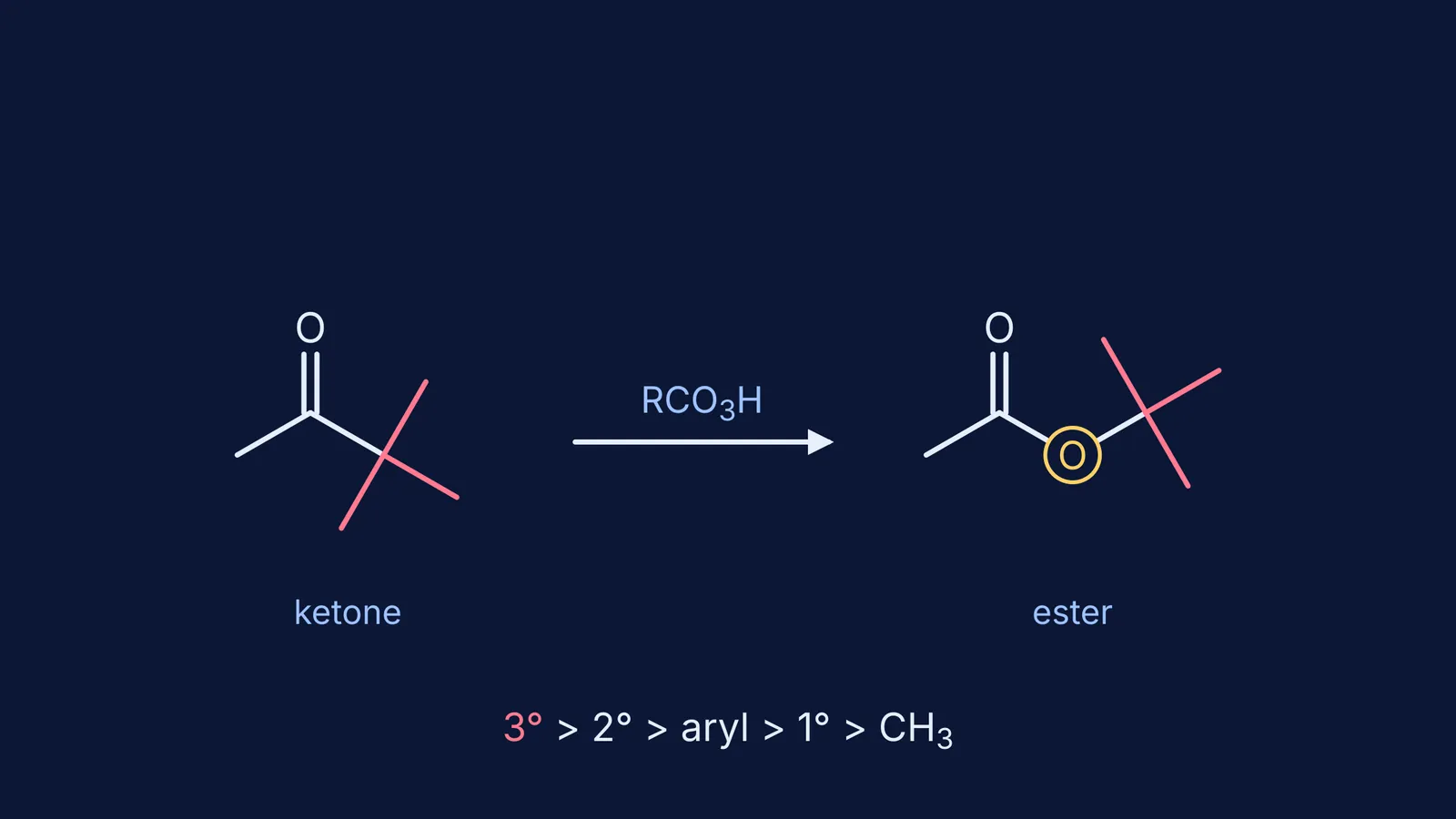
The Organic Chemistry Portal puts it simply: substituents that can stabilise a positive charge migrate more readily. It gives the order as tertiary alkyl > cyclohexyl > secondary alkyl > phenyl > primary alkyl > methyl. One explanation is that positive charge builds up in the transition state as the Criegee intermediate breaks down, and electron-withdrawing groups on a substituent slow its migration (Wikipedia).
If the idea of a migratory aptitude ranking looks familiar, it should: a similar ranking decides the moving group when you are predicting which group migrates in the pinacol-pinacolone rearrangement.
How do you predict the Baeyer-Villiger product?
Draw the ketone and label both groups on the carbonyl carbon: 3°, cyclohexyl or other 2°, aryl, 1° or methyl.
Pick the group higher on the ladder. That group migrates.
Write the oxygen between the carbonyl carbon and the migrating group. Keep the C=O on the other side.
If the migrating carbon is a stereocentre, copy its configuration unchanged.
Worked examples:
Pinacolone, CH3-CO-C(CH3)3. Tertiary butyl beats methyl, so the oxygen goes on the tert-butyl side: CH3-CO-O-C(CH3)3, tert-butyl acetate. This is the reaction in the diagram above.
Acetophenone, C6H5-CO-CH3. Phenyl beats methyl: CH3-CO-O-C6H5, phenyl acetate. Methyl benzoate is the classic wrong answer.
Cyclohexyl phenyl ketone, C6H5-CO-C6H11. Cyclohexyl sits above phenyl on the ladder: C6H5-CO-O-C6H11, cyclohexyl benzoate.
Cyclohexyl methyl ketone, CH3-CO-C6H11. Cyclohexyl beats methyl: CH3-CO-O-C6H11, cyclohexyl acetate.
Cyclohexanone. Both neighbours are ring carbons, so the oxygen enters the ring and the six-membered ring becomes a seven-membered lactone.
Where do students lose marks?
Writing the ester backwards. Check that the migrated group is bonded to the single-bonded oxygen, not to the C=O.
Forgetting the ring grows. A cyclic ketone with n atoms in the ring gives a lactone with n + 1.
Mixing up peracid reactions. With an alkene, the same reagent gives an epoxide instead; see how epoxidation with peracids leads to anti-dihydroxylation.
Confusing routes to esters. Two aldehyde molecules can also end up as an ester by a different route, covered in how the Tishchenko reaction converts aldehydes to esters.
To practise, take ten ketones from your textbook's exercises, cover the answers, and run the four steps on each. When you get one wrong, write down which step slipped. The Fermi Problem Library has worked problems with a step-by-step solver that explains the reasoning rather than printing an answer, so you can see exactly where your choice of migrating group went wrong.
If the idea of stabilising a positive charge itself feels shaky, the ladder will keep slipping until that is fixed. The Fermi Concept Library gives every chemistry concept its own lesson and its place in the map, so you can go back one step and then return to this reaction.


