

On this page
Your NCERT Class 11 Biology book says it in one line: "ATP acts as the energy currency of the cell" (NCERT, Chapter 12, Respiration in Plants). "Currency" does not mean ATP is where your body stores energy. It means ATP is what your cells spend.
Why is ATP called the energy currency of the cell?
A currency works because everyone accepts it. The same NCERT chapter explains that the energy released in respiration "is not (or rather cannot be) used directly but is used to synthesise ATP, which is broken down whenever (and wherever) energy needs to be utilised" (NCERT).
Three features make ATP work like money:
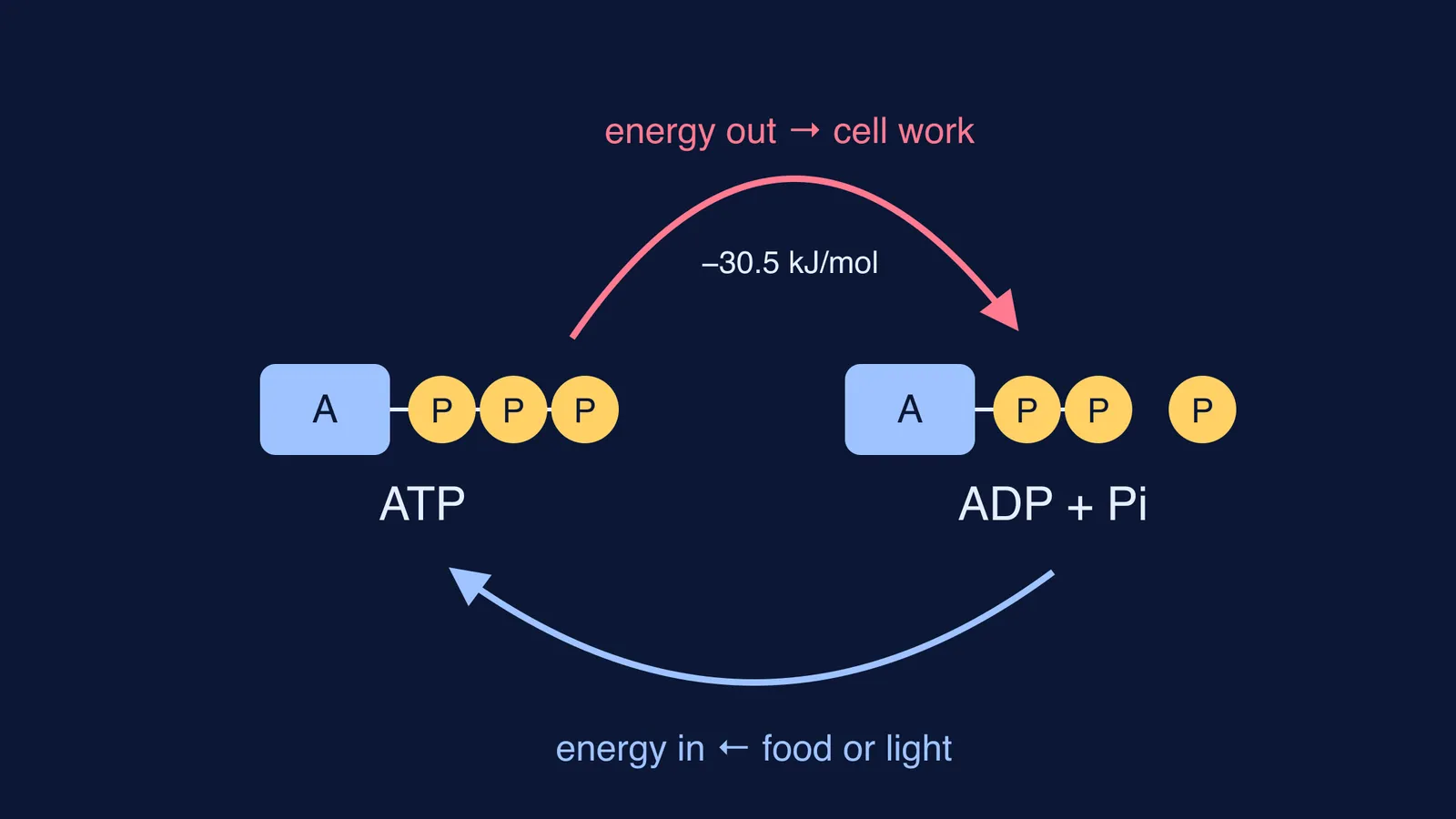
A standard coin. Breaking ATP into ADP and inorganic phosphate (Pi) releases 30.5 kJ per mole under standard conditions, and about 57 kJ per mole in a living cell (OpenStax Biology 2e).
Accepted everywhere. ATP powers cell signalling, muscle contraction, nerve firing, and DNA and RNA synthesis (NIGMS, US National Institutes of Health).
Easy to refill. The reaction runs backwards: ADP + Pi + free energy gives ATP + water (OpenStax).
Why do cells keep so little ATP?
Your body holds only about 250 g of ATP at any one time, according to Paul May's Molecule of the Month page at the University of Bristol. Yet each of us turns over roughly our own body weight in ATP every day (NIGMS).
Inside cells, ATP concentration averaged 4.41 mM across the normal cells and tissues, from many species, surveyed by Greiner and Glonek in a 2021 review in Biology. That stock is small next to the daily turnover above, so it must be topped up all the time. In muscle, Hargreaves and Spriet write in Nature Metabolism (2020) that "because the muscle stores of ATP are small, metabolic pathways must be activated to maintain the required rates of ATP resynthesis", using phosphocreatine, glycogen and fat.
Think of glycogen, starch and fat as the bank account. ATP is the cash in your pocket: enough for the next few moments, topped up constantly.
Worked example: how often is one ATP molecule recycled?
Take a 50 kg student and the two figures above.
Daily turnover: about 50 kg, or 50,000 g of ATP (NIGMS).
Amount present at any moment: about 250 g (University of Bristol).
Times each molecule is reused: 50,000 ÷ 250 = 200 times a day.
Time per cycle: 1,440 minutes ÷ 200 = about 7 minutes.
Moles per day: ATP's molar mass is 507.18 g/mol (PubChem), so 50,000 ÷ 507 ≈ 99 mol.
So an average ATP molecule in your body is spent and rebuilt roughly every 7 minutes. This is a rough estimate: both figures are rounded, the 250 g figure is for a typical human body rather than a 50 kg student, and the result is an average across all your tissues.
Where is ATP made and used in the cell?
NCERT notes that the breakdown of food to release energy happens "in the cytoplasm and in the mitochondria" (NCERT). Glycolysis runs in the cytoplasm, and on its own (as in fermentation) gives a net gain of only 2 ATP per glucose. Most ATP is made in mitochondria by ATP synthase, where 4 H+ ions pass through the F0 channel for each ATP produced, according to the same chapter. Our post on the F0 and F1 parts of ATP synthase walks through that machine. In plants, chloroplasts also make ATP during the light reactions.
How much per glucose? NIGMS puts it at around 32 ATP (NIGMS). NCERT's balance sheet gives 38, and says this "can remain only a theoretical exercise" because it rests on assumptions. Our explainer on how many ATP one glucose gives explains the gap.
ATP is then spent all over the cell. One clear example: the sodium-potassium pump uses one ATP per cycle to push 3 Na+ out and bring 2 K+ in (OpenStax). See why the pump moves 3 Na+ and 2 K+ for the full cycle.
How should you write this answer in an exam?
Use this four-line plan for a short answer, with values from OpenStax Biology 2e:
Energy from oxidising food cannot be used directly, so it is trapped as ATP.
ATP is hydrolysed to ADP + Pi, releasing a usable amount of energy (30.5 kJ/mol under standard conditions).
The same molecule powers many processes: muscle contraction, active transport, biosynthesis.
ADP is quickly turned back into ATP in respiration (and photosynthesis in plants), so a small stock is recycled constantly.
If a link in this chain is still shaky, for example free energy or how ATP synthase works, the Fermi Concept Library gives each concept its own lesson and shows its place in the map of biology and chemistry. For numericals, the Fermi Problem Library has worked problems with a step-by-step solver that explains the reasoning rather than printing an answer.
Next, redo the worked example with your own body weight and see how the recycling time changes.


