

On this page
The vertical strokes on the board look crisp, but the horizontal ones look smudged. Blur that depends on direction is the signature of astigmatism, and the physics is the lens optics of Class 10 and Class 12 with one twist.
What is astigmatism?
The US National Eye Institute describes astigmatism as "a common eye problem that can make your vision blurry or distorted", which happens when the cornea or the lens inside the eye "has a different shape than normal" (National Eye Institute). Its listed symptoms include squinting, headaches and eye strain.
The American Academy of Ophthalmology compares a normal eye to a basketball, with the same curve whichever way it is turned, and an astigmatic eye to a North American football, with one curve longer than the other (AAO).
It is common. A 2018 meta-analysis in the Journal of Current Ophthalmology pooled studies from around the world and estimated astigmatism at 14.9% of children and 40.4% of adults, making it the most common refractive error in both groups (Hashemi et al., 2018).
Why does unequal curvature blur lines in one direction?
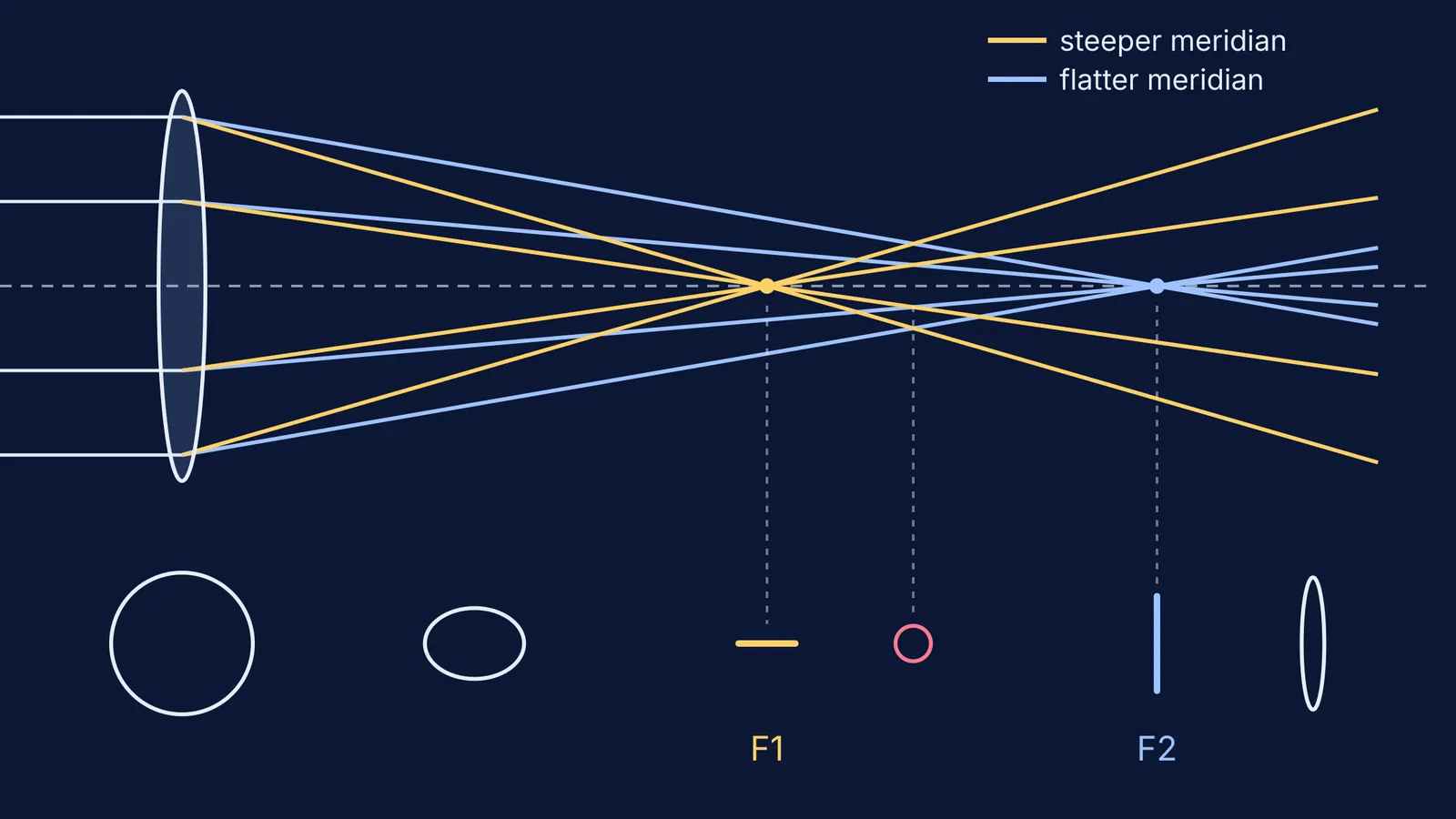
A refracting surface gets its power from its curvature: the smaller the radius, the stronger the bending, as the lens maker's formula and its sign rules show. An astigmatic eye has a steepest direction and a flattest direction. In regular astigmatism these two principal meridians sit at right angles to each other (Eyecare Business).
So the eye has two powers at once. Light in the steep meridian comes to a focus sooner than light in the flat meridian. Instead of one point, you get two short focal lines at different distances, with a round blurry patch, the circle of least confusion, between them (Wikipedia: astigmatism in optics)).
Which lines look sharp? Suppose the vertical meridian focuses on the retina but the horizontal one does not. Every point is smeared sideways, so a horizontal line stays sharp while a vertical line goes fuzzy. That is why eye tests can use a clock dial or sunburst chart to find the astigmatic axis (Wikipedia: Astigmatism).
How does a cylindrical lens correct astigmatism?
A spherical lens adds the same power in every direction. A cylindrical lens "focuses light into a line instead of a point" and leaves light unaltered in the direction parallel to its axis (Wikipedia: Cylindrical lens). In optician's terms, it has "no power in one direction and the maximum power 90 degrees away" (Eyecare Business).
Put the cylinder's power in the meridian that is off, and both meridians focus at the same distance. In with-the-rule astigmatism the vertical meridian is the steepest, and a minus cylinder on the horizontal axis corrects it (Wikipedia: Astigmatism). The National Eye Institute says glasses or contact lenses are the most common treatment, surgery can reshape the cornea, and mild astigmatism may need no treatment at all (National Eye Institute).
Worked example: what does −1.00 / −1.50 × 180 mean?
A prescription has three numbers per eye: sphere (SPH), cylinder (CYL) and axis, with the axis written in degrees from 1 to 180 (AAO). On this scale 180 is horizontal and 90 is vertical, and a minus cylinder is most divergent 90° from its axis (Wikipedia: Eyeglass prescription). Take the prescription −1.00 / −1.50 × 180:
Along the axis (180°, horizontal), the cylinder adds nothing: −1.00 D.
At 90° to the axis (vertical), it adds its full power: −1.00 + (−1.50) = −2.50 D.
Using focal length in cm = 100 ÷ power in dioptres, that is −100 cm horizontally and −40 cm vertically.
The vertical meridian needs the extra minus power, so it is the eye's steeper meridian: with-the-rule astigmatism.
In plus-cylinder form, add sphere and cylinder, flip the cylinder's sign and turn the axis by 90°: −2.50 / +1.50 × 90 (Wikipedia: Eyeglass prescription). Check: along 90° the power is −2.50 D; along 180° it is −2.50 + 1.50 = −1.00 D. Same lens.
If step 5 gives you the same two powers back, you have understood cylindrical lenses. The Fermi Concept Library gives each concept its own lesson and its place in the map, so you can trace astigmatism back to curvature and lens power. The Fermi Problem Library has worked problems with a step-by-step solver that explains the reasoning rather than printing an answer.
What should you do if lines look blurry in one direction?
The physics is for your exam; your own eyes need a professional. The National Eye Institute says astigmatism is diagnosed with a simple, painless dilated eye exam (National Eye Institute). The WHO notes that uncorrected refractive error remains a leading cause of vision impairment in children and adults in all countries (WHO).
A short checklist for students and parents:
Notice the pattern: squinting at the board, headaches after reading, some strokes sharper than others.
An online chart is not a diagnosis. Book an eye test with an optometrist or ophthalmologist.
Ask the examiner to explain the SPH, CYL and axis on your slip, then do the worked example above with your own numbers.
To see how the healthy eye changes its own power for near and far objects, read our post on how the eye's accommodation works for near and far.


