

On this page
An asbestos-cement roof looks like harmless grey sheeting, yet asbestos is a major cause of work-related cancer. The reason is its crystal structure: it splits into fibres thin enough to breathe in and tough enough that your body struggles to break them down.
What is asbestos, chemically?
Asbestos is a generic term for six naturally occurring fibrous silicate minerals in two groups, serpentine and amphibole, according to the US Agency for Toxic Substances and Disease Registry (ATSDR toxicological profile, chapter 4).
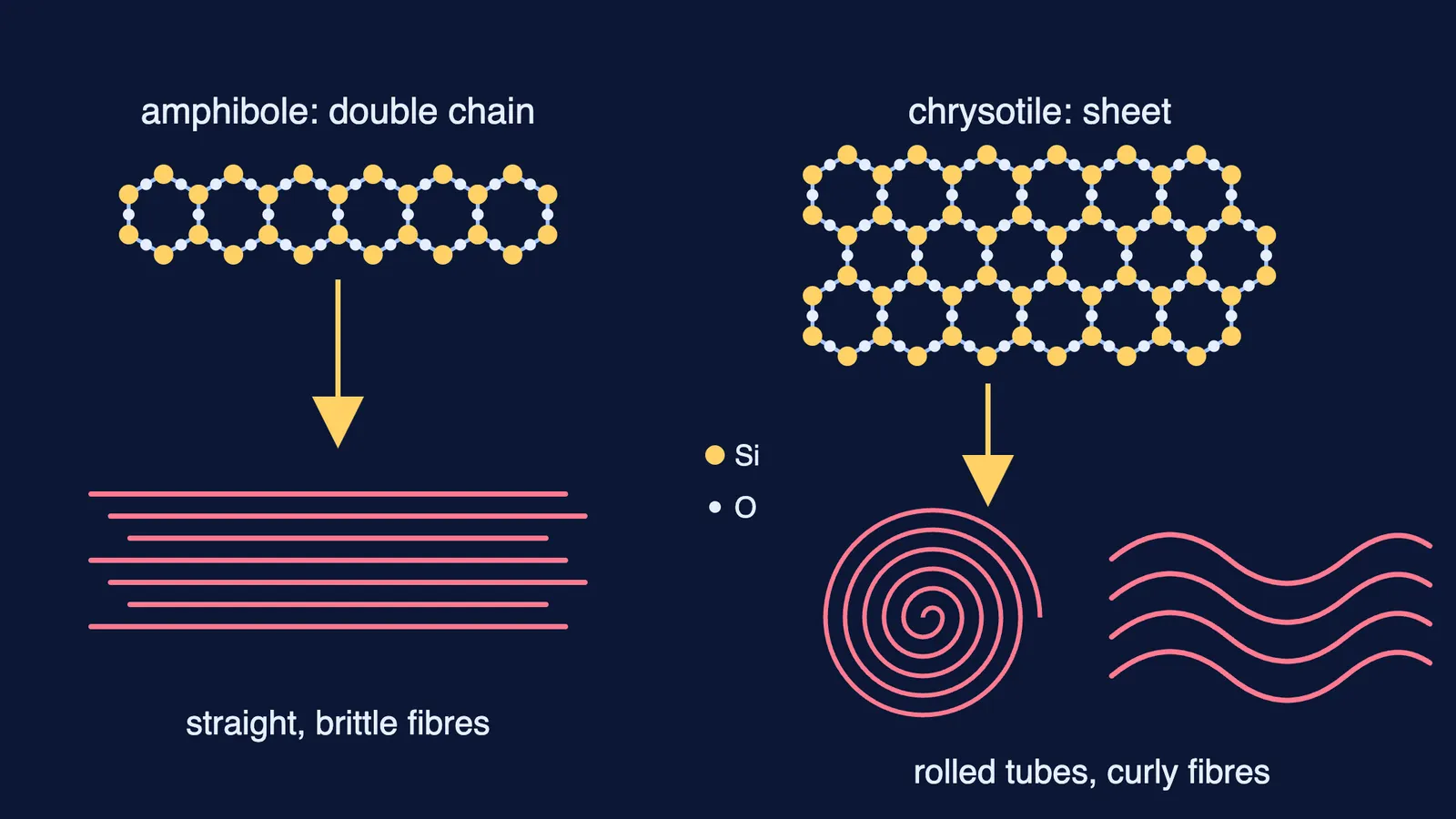
Both are SiO₄ tetrahedra joined through Si–O–Si bonds; they differ in how these link:
Chrysotile (white asbestos), the only serpentine asbestos, is Mg₃Si₂O₅(OH)₄. Its silicate units form a sheet that wraps around itself into a tube, so its fibres are usually curved.
Amphiboles (amosite, crocidolite, tremolite, actinolite, anthophyllite) are double chains that crystallise into long, thin, straight fibres, much more brittle than chrysotile.
The individual fibrils separate readily from the fibre bundles, ATSDR notes, so disturbing the material can release microscopic fibres. The US regulator OSHA counts a particle as an asbestos fibre if it is longer than 5 µm with a length-to-width ratio above 3:1, the same ATSDR chapter records.
Why is asbestos dangerous to your lungs?
Shorter, thicker fibres settle in the upper airways and are carried up by mucus and swallowed, while longer, thinner ones reach the alveoli, according to the UK Health Security Agency's toxicological overview of asbestos. Fibres short enough for macrophages to engulf are thought to be removed by phagocytosis, a process you study in biology. Longer fibres are cleared much more slowly, so more of them stay.
UKHSA says the fibres resist breakdown in the lungs, which keeps inflammation going even after exposure stops. How they cause cancer is not fully understood; fibres may induce reactive oxygen species that may damage DNA. Amphibole fibres persist longer in the body than chrysotile.
Some fibres reach the pleura, the membrane around the lungs. In a 2010 review in Particle and Fibre Toxicology, Ken Donaldson and colleagues set out the hypothesis that particles drain from the pleural space through tiny openings called stomata, and that long fibres which cannot pass are trapped there, causing inflammation that can lead to mesothelioma. It is not yet a settled fact.
The World Health Organization's asbestos fact sheet says all forms of asbestos, including chrysotile, are carcinogenic to humans, causing cancer of the lung, larynx and ovaries, and mesothelioma, as well as asbestosis, a scarring (fibrosis) of the lungs. Compare it with asthma, emphysema and other occupational lung diseases.
These diseases are slow. The UKHSA overview puts the usual latency for mesothelioma at about 30 years, and the UK Health and Safety Executive says symptoms can take 15 to 60 years to appear (HSE asbestos FAQ). Smoking and asbestos each raise lung cancer risk and together act synergistically, UKHSA adds.
How many people does asbestos kill?
WHO estimates that asbestos exposure at work causes more than 200,000 deaths worldwide every year, based on 2016 figures (WHO fact sheet). That is over 70% of deaths from work-related cancers. WHO says the most efficient prevention is to stop using all forms of asbestos, and more than 50 WHO Member States have legislated to prohibit it. For how cancer-causing agents are grouped, see our guide to types of carcinogens.
Where is asbestos still found in India?
India stopped asbestos mining by not issuing new licences or renewing existing ones, but chrysotile has not been banned and its import has not been restricted, according to a 2023 analysis of government statements in Public Health Action by R Singh and A L Frank. Government replies cited there say imported asbestos goes into asbestos-cement pipes, household roofing and brake linings; in 2022 the government said there was no proposal to prohibit it. Chrysotile is most often used for asbestos-cement roofing, the authors note, so the asbestos you are most likely to meet is a cement roof sheet.
What should you do if your home has an asbestos cement roof?
The UK Health and Safety Executive says the presence of asbestos alone should not be a cause for concern; it becomes a risk when fibres are released into the air and breathed in (HSE asbestos FAQ). HSE classes asbestos cement as lower risk, but lists drilling or cutting with power tools, and breaking or smashing it, among activities likely to release many fibres. A household checklist:
Leave sheets in good condition alone; HSE says such materials are often best left in place and checked from time to time.
Do not drill, cut, grind or break them, or let workers use power tools on them.
If a sheet is damaged, or you are renovating or demolishing, do not repair or remove it yourself; HSE encourages using trained professionals.
If a family member worked with asbestos and is worried, HSE suggests telling their doctor so the possible exposure is noted in their records.
If silicate structures or phagocytosis feel shaky, the Fermi Concept Library covers every concept in physics, chemistry, biology, mathematics and computing, so you can revise silicate chains and macrophages side by side.
Next time you see a grey corrugated roof, you will know what is in it and why it is safest left whole.


