

On this page
If a conversion question asks you to turn an acid into the acid with one more carbon, the Arndt-Eistert synthesis is the neatest answer on paper: four arrows, one new CH₂, and the original carboxyl carbon kept. Here is how it works, where the new carbon ends up, and how to tell it apart from the other one-carbon routes you meet in Class 12 and JEE preparation.
What is the Arndt-Eistert synthesis?
The Arndt-Eistert synthesis is a one-carbon chain extension that converts a carboxylic acid into its next higher homologue through a diazoketone, as the Organic Chemistry Portal entry on the reaction describes it.
Fritz Arndt and Bernd Eistert published it in 1935 in Berichte der deutschen chemischen Gesellschaft, under a German title that translates as a method for converting carboxylic acids into their higher homologues (Crossref record of the paper, volume 68, pages 200-208).
Its key step is older. Ludwig Wolff reported in 1902 that diazoacetophenone treated with silver(I) oxide and water gave phenylacetic acid, a reaction now called the Wolff rearrangement.
How does the Arndt-Eistert mechanism work, step by step?
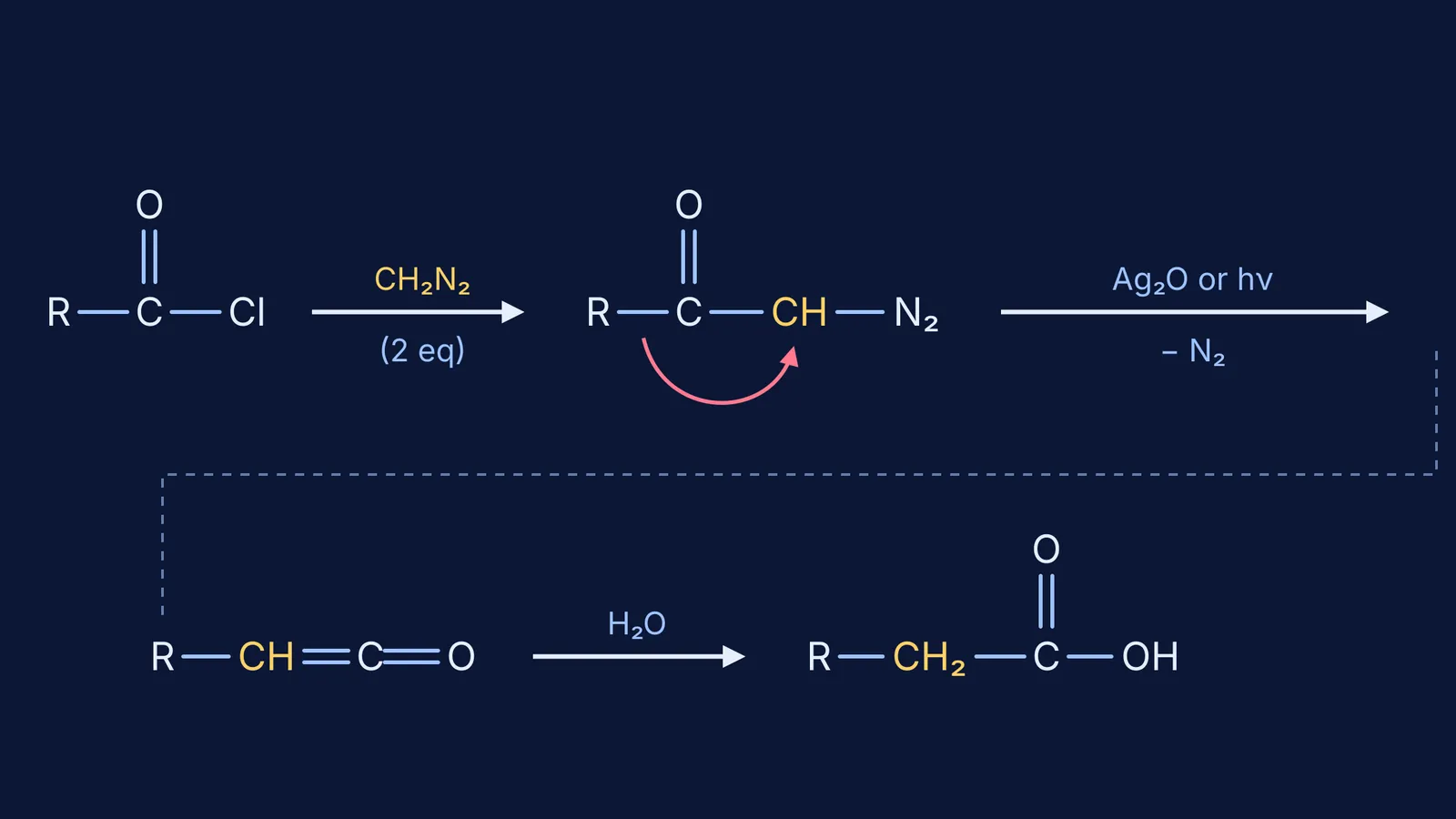
Write the acid as RCOOH. The sequence follows the Arndt-Eistert reaction entry, and steps 2 to 4 match the diagram at the top of this post.
Make the acid chloride. A common choice is thionyl chloride, which turns RCOOH into RCOCl.
Add diazomethane, CH₂N₂. Its carbon attacks the acyl chloride and, after HCl is lost, you get the α-diazoketone RCOCHN₂. Diazomethane is used in excess because a second equivalent mops up that HCl; without it, HCl attacks the diazoketone and gives an unwanted chloromethyl ketone, RCOCH₂Cl.
Trigger the Wolff rearrangement. Silver(I) oxide, heat or light makes the diazoketone lose N₂. As it does, the R group shifts from the carbonyl carbon to the neighbouring carbon, giving a ketene, R–CH=C=O.
Trap the ketene. Water adds to it to give RCH₂COOH. An alcohol gives an ester instead, and an amine gives an amide.
The Organic Chemistry Portal lists the same three ways to run step 3 (heat, light or silver catalysis) and the same three nucleophiles for step 4. The migrating group keeps its configuration, so if R is joined through a stereocentre, that centre comes out unchanged (Wolff rearrangement).
Worked example: benzoic acid to phenylacetic acid
Benzoic acid has seven carbons; phenylacetic acid has eight. Count them before and after to check yourself.
C₆H₅COOH + SOCl₂ → C₆H₅COCl + SO₂ + HCl
C₆H₅COCl + 2 CH₂N₂ → C₆H₅COCHN₂ + CH₃Cl + N₂
C₆H₅COCHN₂ → C₆H₅CH=C=O + N₂ (with Ag₂O)
C₆H₅CH=C=O + H₂O → C₆H₅CH₂COOH
Steps 3 and 4 together are the reaction Wolff saw in 1902. Swap water for ethanol in step 4 and the product is ethyl phenylacetate. Run the same four steps on acetic acid and you get propanoic acid; on propanoic acid, butanoic acid.
How is it different from other ways to add or remove a carbon?
Arndt-Eistert: RCOOH to RCH₂COOH, starting from the acid itself.
Cyanide route: reduce the acid to RCH₂OH, convert it to RCH₂Cl, substitute with KCN to get RCH₂CN, then hydrolyse to RCH₂COOH. Same product, more steps. Our post on stepping up ethanol to propanoic acid compares routes like this.
Going down instead: the Hunsdiecker reaction of a silver carboxylate with bromine removes the carboxyl carbon, and step-down conversions such as acetic acid to methylamine show the reverse direction.
A quick spotting checklist for exam questions:
Acid in, acid out, one extra carbon, CH₂N₂ in the reagents: Arndt-Eistert.
Ag₂O, light or heat right after CH₂N₂: Wolff rearrangement, so draw a ketene.
Product is an ester or amide: look at the nucleophile in the last step.
An RCOCH₂Cl by-product: not enough diazomethane.
Why isn't diazomethane used in school labs?
NIOSH describes diazomethane as a yellow gas that may explode violently on heating, in sunlight or on contact with rough edges such as ground glass (NIOSH Pocket Guide entry). The same entry gives an exposure limit of 0.2 ppm averaged over a work shift and lists 2 ppm as immediately dangerous to life or health.
Chemists have found workarounds. Trimethylsilyldiazomethane has been developed as a substitute (Arndt-Eistert reaction entry), and the Kowalski ester homologation is described as a safer alternative because it avoids diazomethane altogether (Organic Chemistry Portal). For your exam, the paper version is what counts: learn it on the page, never at a bench.
If you keep mixing up which carbon is new, work a few conversion chains in the Fermi Problem Library, where a step-by-step solver explains the reasoning rather than printing an answer. If ketenes or rearrangements themselves feel shaky, the Fermi Concept Library gives each chemistry concept its own lesson and its place in the map.
Next time you see CH₂N₂ in a conversion, count the carbons, draw the diazoketone, and let R move.


