

On this page
Four straight lines in two parallel pairs always enclose a parallelogram. A standard Class 11 coordinate-geometry question gives you the four equations and asks for its area. You can use the gaps between the pairs and the angle between them, or find the four corners. Below, both methods solve one example.
What is the formula for the area of a parallelogram formed by four lines?
Write the lines as two parallel pairs: a₁x + b₁y + c₁ = 0 and a₁x + b₁y + d₁ = 0, then a₂x + b₂y + c₂ = 0 and a₂x + b₂y + d₂ = 0.
The distance between parallel lines Ax + By + C₁ = 0 and Ax + By + C₂ = 0 is d = |C₁ − C₂|/√(A² + B²), as given in NCERT's Class 11 chapter on straight lines. Call the two gaps p₁ and p₂.
The acute angle θ between lines with slopes m₁ and m₂ satisfies tan θ = |(m₂ − m₁)/(1 + m₁m₂)|, from the same NCERT chapter. Then:
Area = p₁p₂ / sin θ
Substitute everything and the square roots cancel, leaving a shortcut: Area = |(c₁ − d₁)(c₂ − d₂)| / |a₁b₂ − a₂b₁|. Use it only when each pair has identical x and y coefficients.
Why is the area p₁p₂ divided by sin θ?
Let the sides be a and b, meeting at angle θ, so the area is ab sin θ. The gap between the two lines carrying side a is the height on that side, b sin θ, so p₁ = b sin θ. Likewise p₂ = a sin θ. Multiply: p₁p₂ = ab sin²θ, so ab sin θ = p₁p₂ / sin θ. The same ab sin θ is the size of a cross product, which our dot and cross product visualisation shows as an area.
Worked example: one question, solved both ways
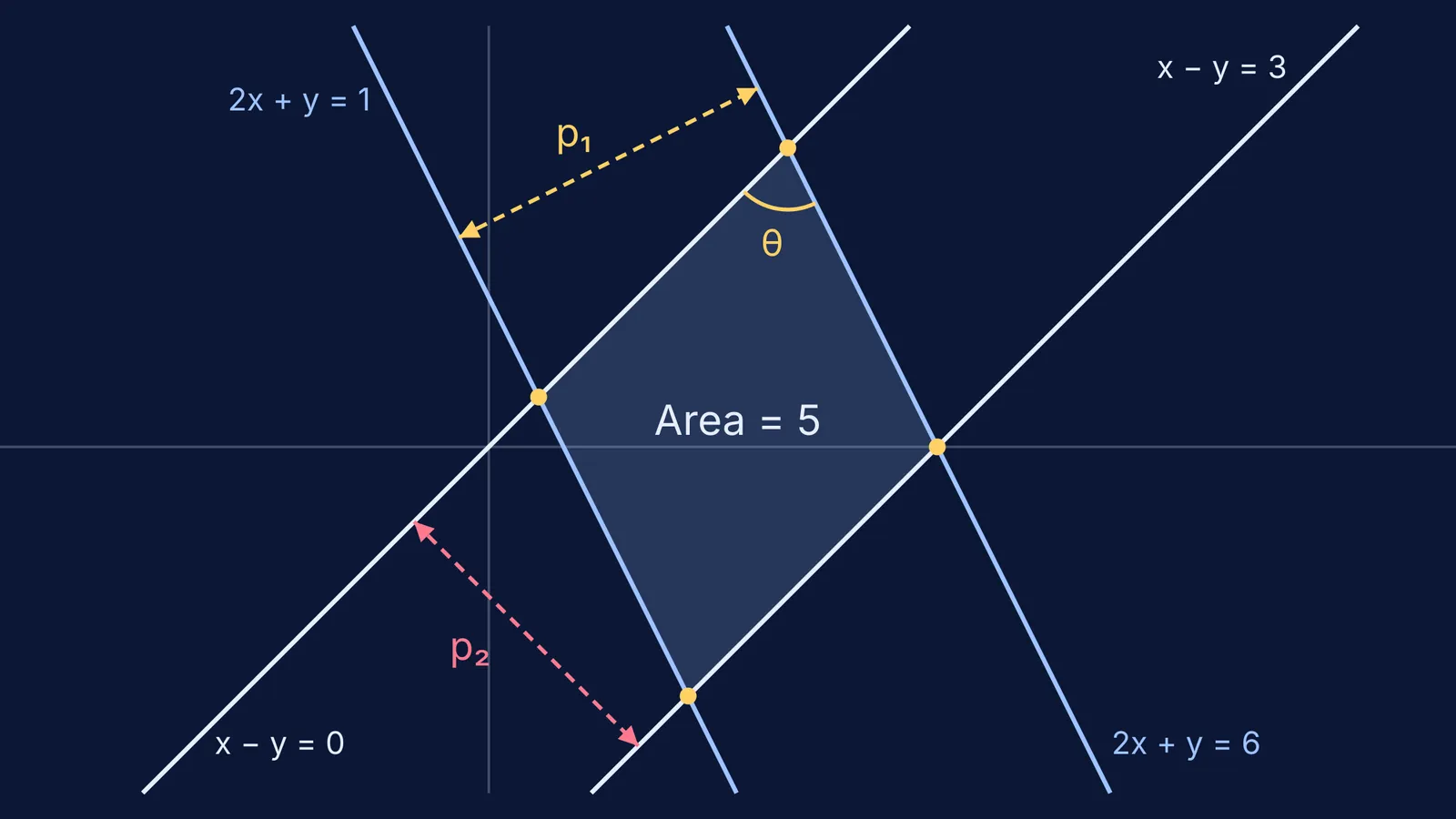
Find the area of the parallelogram formed by 2x + y = 1, 2x + y = 6, x − y = 0 and x − y = 3.
Method 1: distances and angle
Pair 1 is 2x + y − 1 = 0 and 2x + y − 6 = 0, so p₁ = 5/√5 = √5.
Pair 2 is x − y = 0 and x − y − 3 = 0, so p₂ = 3/√2.
The slopes are −2 and 1, so tan θ = |3/(1 − 2)| = 3 and sin θ = 3/√10.
Area = √5 × (3/√2) ÷ (3/√10) = √25 = 5 square units.
Shortcut check: |(−1 + 6)(0 + 3)| / |2(−1) − 1(1)| = 15/3 = 5.
Method 2: find the vertices
Cross each line of one pair with each line of the other:
2x + y = 1 and x − y = 0 meet at (1/3, 1/3)
2x + y = 1 and x − y = 3 meet at (4/3, −5/3)
2x + y = 6 and x − y = 3 meet at (3, 0)
2x + y = 6 and x − y = 0 meet at (2, 2)
A diagonal splits a parallelogram into two equal triangles, so take three consecutive corners. The triangle-area formula ½|x₁(y₂ − y₃) + x₂(y₃ − y₁) + x₃(y₁ − y₂)| from the NCERT chapter, on (1/3, 1/3), (4/3, −5/3) and (3, 0), gives ½|−5/9 − 4/9 + 6| = 5/2. Double it: 5 square units, matching Method 1. To use all four corners at once, the shoelace method for a quadrilateral gives the same answer.
Which method should you use in an exam?
Only the area is asked: use p₁p₂/sin θ or the shortcut.
A vertex, diagonal or centre is also asked: use the vertex method.
Time left at the end: run the other method as a check.
If the angle step is the shaky part, our guide to the tan θ formula for the angle between two lines covers the signs.
What mistakes cost marks on this question?
Not matching coefficients. 2x + y = 1 and 4x + 2y = 12 are parallel, but divide the second by 2 before using the distance formula.
Reading off c before writing each line as ax + by + c = 0.
Using tan θ where sin θ belongs. If tan θ = t, then sin θ = t/√(1 + t²).
Forgetting the modulus. Area is never negative.
Stopping at p₁p₂. That is the area only when the pairs are perpendicular (sin θ = 1); otherwise the area is larger.
If the distance formula still feels shaky, the Fermi Concept Library gives every concept in mathematics its own lesson and its place in the map. For more questions like this, the Fermi Problem Library has worked problems with a step-by-step solver that explains the reasoning rather than printing an answer.
Try it now, both ways: x + 2y = 3, x + 2y = 8, 3x − y = 1 and 3x − y = 5. You should get 20/7 square units.


