

On this page
Most students meet the dot and cross product as two formulas to memorise. They stick far better once you can see what happens as one vector swings around the other. Here is that rotation, one angle at a time, so you can predict the sign, the direction and the length before you calculate anything.
What does the dot product mean geometrically?
For u = ⟨u1, u2, u3⟩ and v = ⟨v1, v2, v3⟩, the dot product is the number u1v1 + u2v2 + u3v3, as defined in OpenStax Calculus Volume 3, section 2.3. The same section shows it also equals |u||v| cos θ, where θ is the angle between the vectors.
That second form is the picture: how much of v lies along u, scaled by the length of u. Because cos θ decides the sign, the rule is short:
Angle under 90°: positive.
Angle exactly 90°: zero. OpenStax states that nonzero vectors are orthogonal if and only if u · v = 0.
Angle over 90°: negative.
In physics this is work, W = F · d, which is why a force at right angles to the motion does no work.
Which way does the cross product point?
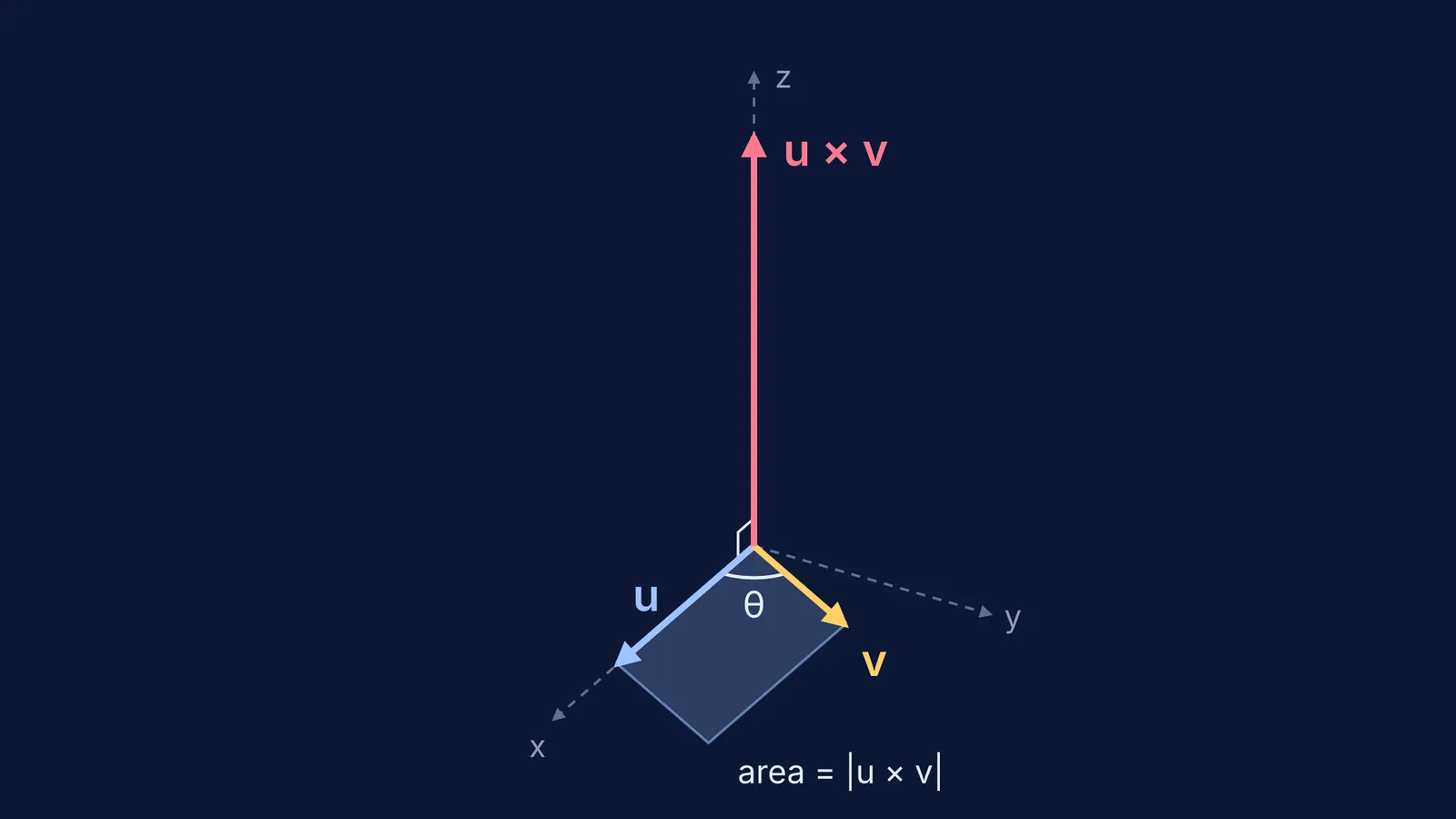
The cross product u × v is a vector, and OpenStax section 2.4 shows it is orthogonal to both u and v. To pick between the two perpendicular directions, use the right-hand rule: fingers along u, curl them towards v, and your thumb gives u × v. Order matters: u × v = −(v × u).
Its length is |u||v| sin θ, and OpenStax states that when u and v form adjacent sides of a parallelogram, the area of that parallelogram is |u × v|. Direction from your right hand, length from the area. Torque, τ = r × F, is the same idea in mechanics.
What happens as you rotate one vector around the other?
Fix u = (3, 0, 0) along the x-axis. Let v have length 2 in the xy-plane at angle θ from u, so v = (2 cos θ, 2 sin θ, 0). The component formulas give u · v = 6 cos θ and u × v = (0, 0, 6 sin θ). Now swing v anticlockwise, seen from above:
θ = 0°: dot 6, cross zero. The parallelogram is flat.
θ = 60°: dot 3, cross about 5.20 along +z.
θ = 90°: dot 0, cross 6 along +z. The parallelogram is a 3 by 2 rectangle, its largest area.
θ = 120°: dot −3, cross about 5.20 along +z.
θ = 180°: dot −6, cross zero again.
θ = 240°: dot −3, cross about 5.20 along −z.
The dot product follows cos θ; the cross product's length follows sin θ. When one is largest, the other is zero.
How do you check a 3D answer by hand?
Take u = (1, 2, 2) and v = (2, −1, 1), a pair with no zeros to hide behind.
Dot product: 1×2 + 2×(−1) + 2×1 = 2. Positive, so the angle is acute.
Cross product, from the OpenStax component formula: (2×1 − 2×(−1), 2×2 − 1×1, 1×(−1) − 2×2) = (4, 3, −5).
Perpendicular check: u · (4, 3, −5) = 4 + 6 − 10 = 0, and v · (4, 3, −5) = 8 − 3 − 5 = 0.
Parallelogram area: |u × v| = √50, about 7.07 square units.
Cross-check: |u|²|v|² = 9 × 6 = 54. Because cos²θ + sin²θ = 1, this must equal (u · v)² + |u × v|² = 4 + 50. It does.
Step 3 is the one that catches sign slips: flip the sign of the middle component and step 5 still balances, but the perpendicular check fails. For more practice, see our guide to dot, cross and triple products for JEE maths, and for mechanics, finding torque about a point as r × F.
How should you practise predicting before calculating?
Before any vector question, spend ten seconds predicting:
Is the angle under, at or over 90°? That fixes the sign of the dot product.
Curl your right hand from the first vector to the second. That fixes the cross product's direction.
Picture the parallelogram. Nearly parallel vectors mean a thin sliver and a small cross product.
Compute, then run both checks above.
If prediction and answer disagree, find out which was wrong before moving on. That gap is where understanding is built.
Rotation in three dimensions is easier to see than to read, and the Fermi Simulation Lab has interactive simulations for exactly that kind of idea. For when an animation helps and when a diagram is enough, read what studies found about simulations versus static diagrams.
Next vector problem: predict the sign, direction and area first, then let the arithmetic confirm it.


