

On this page
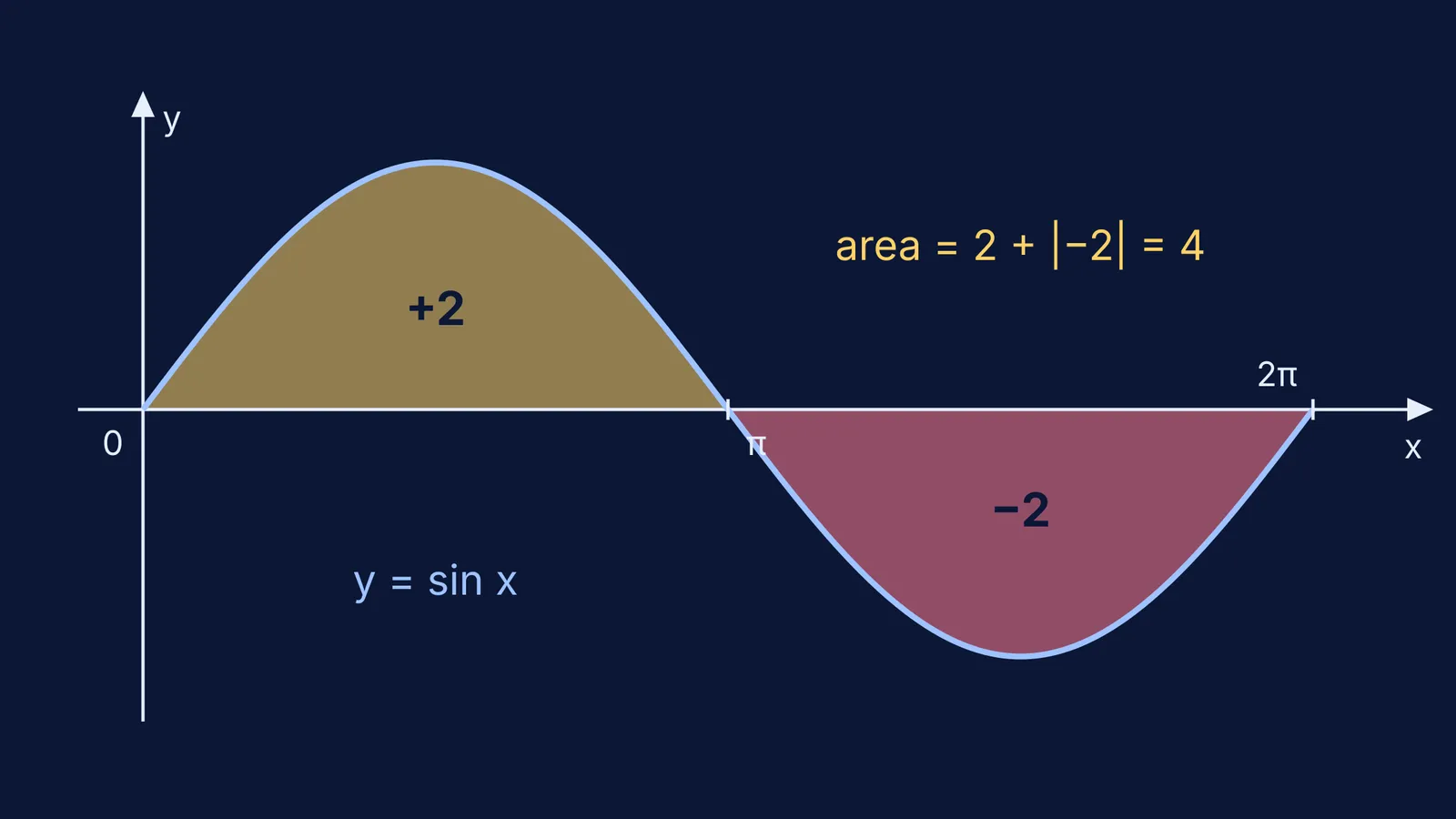
You integrate sin x from 0 to 2π, get 0, and write "area = 0". The graph clearly shows two shaded humps, so something has gone wrong. The mistake is treating a definite integral and an area as the same thing. They only match when the curve stays on one side of the x-axis.
Why does the integral of sin x from 0 to 2π come out as zero?
A definite integral adds up f(x) times a small width dx. Where f(x) is negative, each of those products is negative too. OpenStax Calculus Volume 1 puts it this way: below the axis, the product is "the negative of the area of the rectangle".
The same OpenStax section separates two quantities. Net signed area is the integral of f(x) from a to b, which equals A1 − A2, the area above the axis minus the area below it. Total area is the integral of |f(x)| from a to b, which equals A1 + A2.
The NCERT Class 12 chapter on Application of Integrals agrees. When the curve is below the x-axis, the area it gives "come[s] out to be negative", and "if the area is negative, we take its absolute value" (NCERT Mathematics Part II, Chapter 8). For a curve that is partly below and partly above the axis, the chapter writes the area as A = |A1| + A2.
For sin x on 0 to 2π, the two humps are the same size, so their signed values cancel exactly.
How do you find the area when the curve goes below the x-axis?
Use the same five steps every time:
Solve f(x) = 0 to find every root inside the interval [a, b].
Split [a, b] at those roots, so the curve keeps one sign on each piece.
Integrate each piece on its own.
Take the modulus of each answer.
Add the moduli. That sum is the area in square units.
Worked example: y = sin x from 0 to 2π.
Step 1: sin x = 0 at x = 0, π and 2π. The only root strictly inside the interval is π.
Step 2: The pieces are [0, π], where sin x is positive, and [π, 2π], where it is negative.
Step 3: An antiderivative of sin x is −cos x.
On [0, π]: (−cos π) − (−cos 0) = 1 + 1 = 2.
On [π, 2π]: (−cos 2π) − (−cos π) = −1 − 1 = −2.
Step 4: |2| = 2 and |−2| = 2.
Step 5: Area = 2 + 2 = 4 square units.
Check: the net signed area is 2 + (−2) = 0, which matches the integral you got at first.
Should the modulus go inside or outside the integral?
Inside. The area is the integral of |f(x)|, not the absolute value of the integral of f(x). The two agree only when f keeps one sign over the whole interval. Otherwise the outside version lets the pieces cancel first, and the answer comes out too small.
Splitting at the roots is how you remove the modulus: on each piece, |f(x)| is simply f(x) or −f(x).
Physics uses the same idea. Displacement is the signed integral of velocity, but distance travelled needs the modulus, as in our post on finding distance travelled when velocity changes sign. If the sign rule itself still feels shaky, read why a definite integral can be negative but area can't first.
How do you read the question in an exam?
The wording tells you which quantity is wanted:
"Evaluate the integral" asks for the signed value. Negative answers and 0 are allowed.
"Find the area bounded by the curve, the x-axis and the lines x = a, x = b" asks for total area. The answer must be positive, so split at the roots.
If your area comes out as 0 or negative, it is wrong. Go back to step 1.
A wrong area with a correct integral usually means a missed root. The Fermi Problem Library has worked problems with a step-by-step solver that explains the reasoning rather than printing an answer, so you can see where the interval should have been split.
Try one yourself
Find the area bounded by y = x² − 2x, the x-axis, and the lines x = 0 and x = 3.
Roots: x(x − 2) = 0 gives x = 0 and x = 2.
Using the antiderivative x³/3 − x², the piece on [0, 2] is −4/3 and the piece on [2, 3] is 4/3.
Area = 4/3 + 4/3 = 8/3 square units, even though the plain integral from 0 to 3 is 0.
For a case where the whole curve sits above the axis, see how integration derives the area of a circle, πr². To revise the definite integral itself, open its lesson in the Fermi Concept Library.


