

On this page
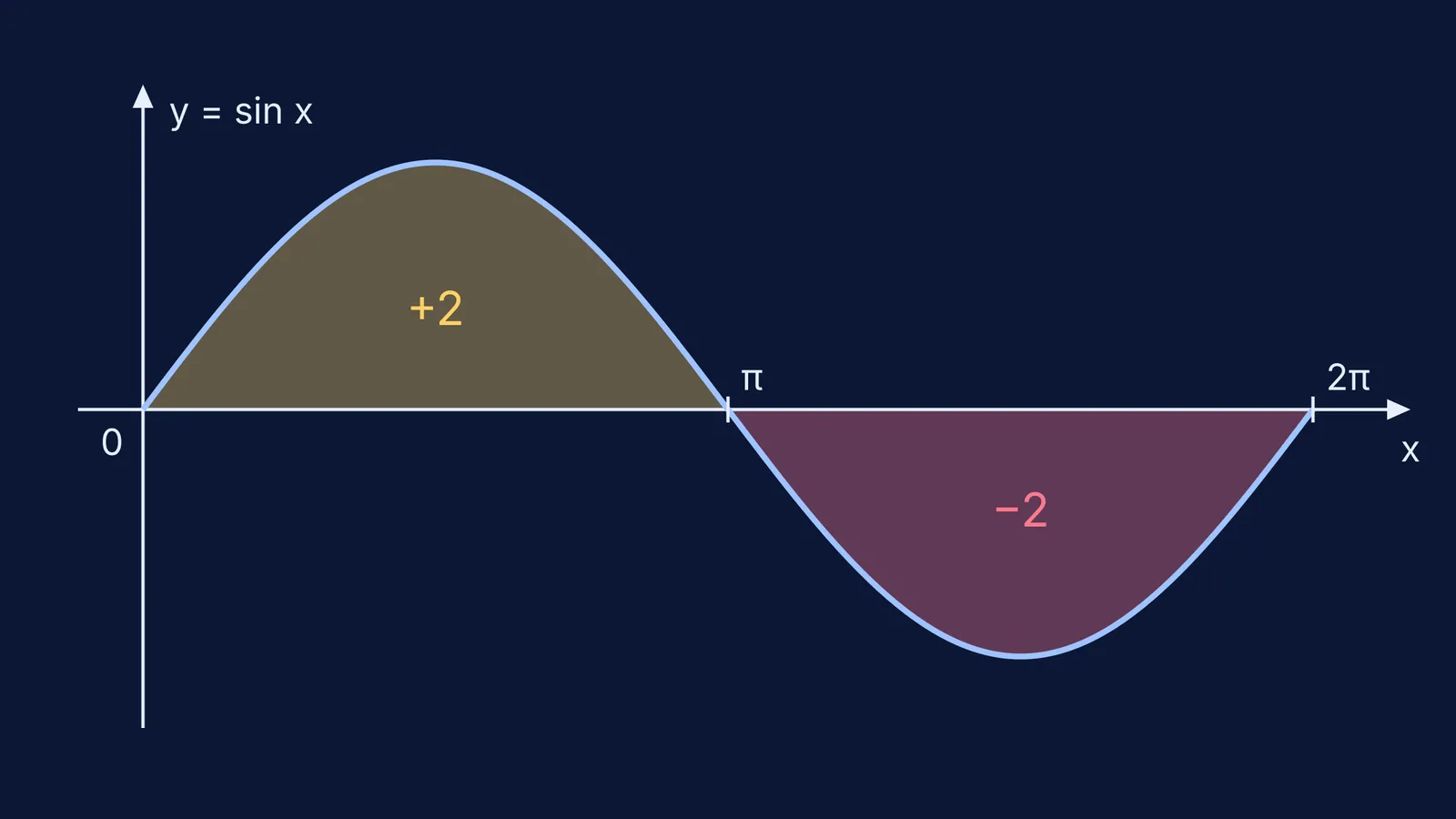
Type the integral of sin x from 0 to 2π into a calculator and you get 0. Sketch the curve and you can see two humps of real, shaded region. Both answers are right because they answer different questions, and mixing them up can cost marks on area questions in board exams and JEE Main.
Why can a definite integral be negative when area can't?
A definite integral adds up thin strips of height f(x) and width dx. When the curve is above the x-axis, f(x) is positive, so each strip adds. When the curve dips below, f(x) is negative, so each strip subtracts. OpenStax Calculus Volume 1 puts it plainly: below the axis, the product f(x)Δx "represents the negative of the area of the rectangle."
So a definite integral measures net signed area: if A₁ is the area above the axis and A₂ the area below, the integral from a to b equals A₁ − A₂, as defined in OpenStax section 5.2.
Area is a different quantity. The total area between f(x) and the x-axis is the integral of |f(x)|, which equals A₁ + A₂ in the same OpenStax section. Because |f(x)| is never negative, total area can never be negative.
Why is the integral of sin x from 0 to 2π zero when the area is 4?
Work it in two pieces, splitting at the root x = π.
From 0 to π, sin x is above the axis: [−cos x] from 0 to π = (−cos π) − (−cos 0) = 1 + 1 = 2.
From π to 2π, sin x is below the axis: [−cos x] from π to 2π = (−cos 2π) − (−cos π) = −1 − 1 = −2.
Net signed area: 2 + (−2) = 0. That is the definite integral.
Total area: 2 + 2 = 4 square units.
The two humps are mirror images, so they cancel exactly. The diagram at the top of this post shows it: the yellow region counts as +2 and the pink region as −2.
How do you find the area when a curve crosses the x-axis?
Find the roots of f(x) inside [a, b]. These are the only places the sign can change.
Split the interval at those roots.
Integrate each piece separately.
Take the absolute value of each piece and add.
Worked example: find the area between y = x² − 1 and the x-axis from x = 0 to x = 2.
Root inside the interval: x = 1.
From 0 to 1: [x³/3 − x] gives (1/3 − 1) − 0 = −2/3. The curve is below the axis here.
From 1 to 2: (8/3 − 2) − (1/3 − 1) = 2/3 + 2/3 = 4/3.
Area = 2/3 + 4/3 = 2 square units.
Integrating straight from 0 to 2 gives 8/3 − 2 = 2/3, the net signed value, not the area.
The same move works between two curves. In its section on areas between curves, OpenStax splits sin x and cos x on [0, π] at their crossing x = π/4 and adds the two pieces to get 2√2 square units. For more practice, see our walkthrough of the integral of the modulus of x − 1 from 0 to 2.
If the gap is in the idea rather than the algebra, the Fermi Concept Library has a lesson for every concept in mathematics, each with its place in the map.
Where does signed area matter in physics?
Often the signed value is exactly what you want. Integrate velocity over time and you get displacement, which has a direction. OpenStax describes a car that drives north at 60 mph for 2 hours, then south at 40 mph for 3 hours: it ends up back where it started, so its displacement is zero, even though it travelled 240 miles in total.
Distance travelled is the total area under the speed, the integral of |v|. Our post on finding displacement from a velocity function works through the same split for a physics problem.
A useful rule: keep the sign when direction matters (displacement, net charge, work done by a force that reverses); drop it when you are measuring a size (area of a plot, distance on an odometer).
What should you check before writing the final answer?
Does the question say "area"? Then your answer must be positive.
Does the curve cross the x-axis between the limits? Find the roots before integrating.
Did you get 0 or a negative number for an area? A piece below the axis was probably not split off.
Is the function odd on a symmetric interval, like x³ from −2 to 2? Expect the integral to be 0 and the area not to be.
If you keep getting the method right but the sign wrong, work a few area questions in the Fermi Problem Library, where the step-by-step solver explains the reasoning rather than printing an answer.


