

On this page
When you know an object's velocity as a function of time, v(t), you can find its change in position using calculus. The method you need depends entirely on what you are asked to find: the net displacement or the total distance traveled.
What is the displacement formula?
Displacement is defined as the net change in position between a starting time and an ending time. Because velocity is the rate of change of position, integrating the velocity function directly provides the displacement.
According to OpenStax Calculus, the displacement of an object moving along a straight line over the time interval [t₁, t₂] is simply the definite integral of its velocity function: Displacement = ∫ v(t) dt
When you evaluate this definite integral, you are finding the difference between the final position and the initial position. On a velocity-time graph, this mathematical operation represents finding the net area between the velocity curve and the horizontal time axis. Any area located above the axis corresponds to positive velocity, meaning the object is moving forward in the positive direction. Conversely, any area located below the axis represents negative velocity, meaning the object is moving backward. The definite integral naturally subtracts this backward movement from the forward movement, yielding the net change in position regardless of the path taken.
How do you find distance when velocity changes sign?
Total distance traveled is a different physical quantity from displacement. Distance measures all the ground covered, regardless of the direction of motion. As Khan Academy explains, if a car drives 10 metres forward and then 4 metres backward, its net displacement is 6 metres, but its total distance traveled is 14 metres.
To find the total distance mathematically, you must integrate the speed of the object, which is the absolute value of its velocity function. Distance = ∫ |v(t)| dt
Because integrating an absolute value function directly is difficult, you split the integral at the exact moments when the object changes direction. This ensures every segment of motion contributes positively.
How do you split the integral in practice?
The process of splitting the integral requires you to determine exactly when the object stops and turns around.
Set v(t) = 0 and solve for t to find when the object is momentarily at rest.
Split your definite integral into smaller integrals at these turning points.
Calculate the definite integral for each section individually.
Add the absolute values of these individual results together.
If you find yourself stuck setting up these split boundaries, the Fermi Problem Library has a step-by-step solver that explains the reasoning behind each boundary rather than just printing an answer.
What is a worked example of finding both values?
To demonstrate this, let's look at a problem similar to those in OpenStax Calculus. We will find the displacement and the total distance traveled for a particle whose velocity is given by v(t) = 4 − 2t m/s from t = 0 to t = 3 seconds.
First, to find the displacement, we integrate the velocity function directly over the entire interval from 0 to 3: Displacement = ∫ (4 − 2t) dt
Evaluating this integral gives the antiderivative [4t − t²] from 0 to 3. (4 × 3 − 3²) − (0 − 0) = 12 − 9 = 3 m.
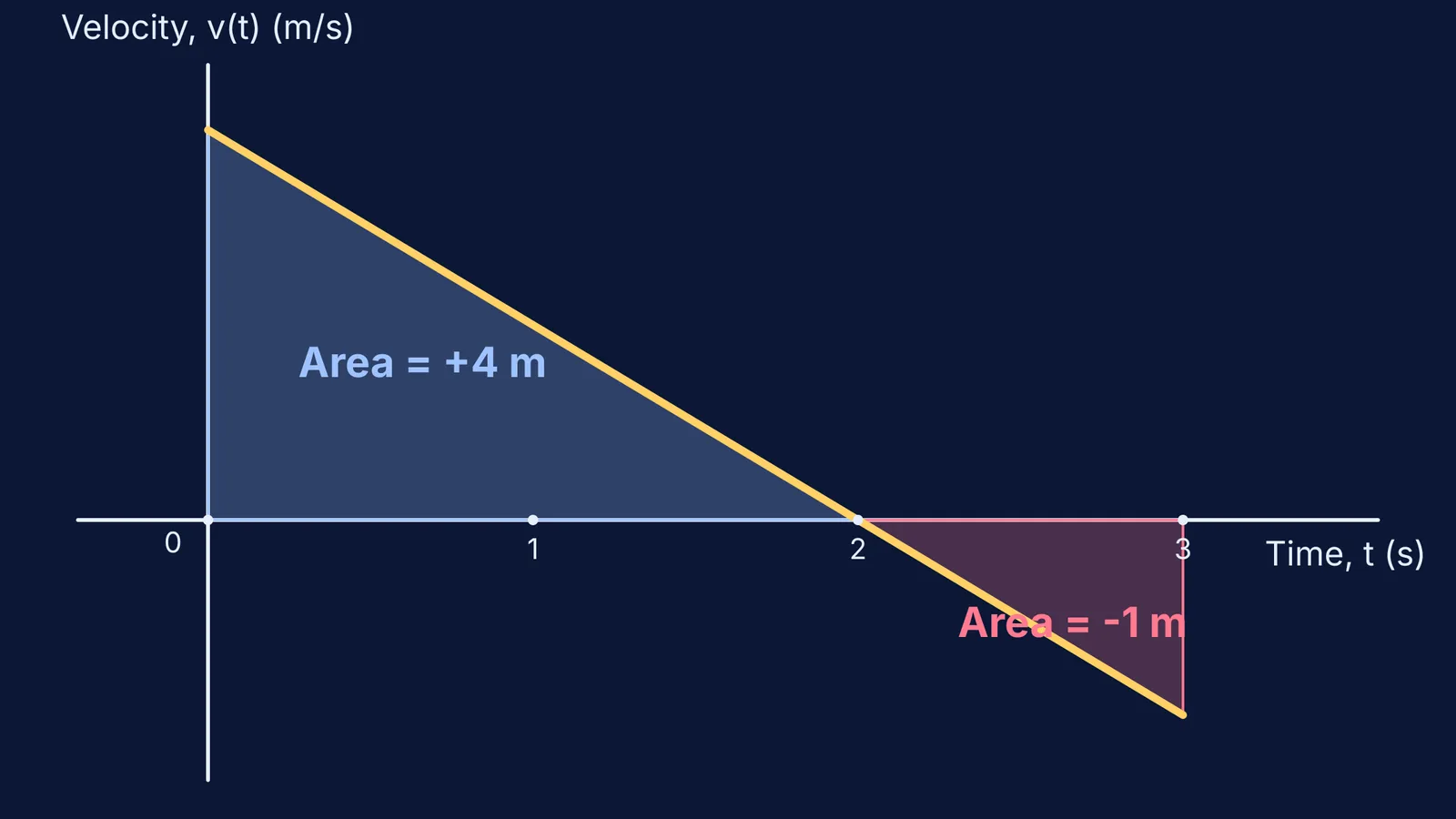
Next, to find the total distance, we must check if the velocity changes sign. Setting v(t) = 0 gives 4 − 2t = 0, which means the object stops at t = 2 seconds. The object moves forward from t = 0 to t = 2, and backward from t = 2 to t = 3.
We split our integral at the turning point t = 2:
Area 1 (from 0 to 2 seconds): ∫ (4 − 2t) dt = [4t − t²] from 0 to 2 = (8 − 4) = 4 m.
Area 2 (from 2 to 3 seconds): ∫ (4 − 2t) dt = [4t − t²] from 2 to 3 = (12 − 9) − (8 − 4) = 3 − 4 = −1 m.
The total distance is the sum of the absolute values of these two areas: Distance = |4| + |−1| = 4 + 1 = 5 m.
How does the graphical approach prevent mistakes?
As Khan Academy demonstrates, plotting the velocity makes the concepts clearer. When you plot the function v(t) = 4 − 2t, you see a straight line that crosses the time axis at t = 2. The area of the triangle above the axis (from t = 0 to 2 seconds) represents the 4 metres traveled forward. The area of the smaller triangle below the axis (from t = 2 to 3 seconds) represents the 1 metre traveled backward. Visualising these two triangles makes it immediately clear why the net displacement is 3 metres while the total distance is 5 metres.
For more examples of how to set up calculus equations in mechanics, see our detailed guides on determining motion in a plane from r(t) and finding the area using horizontal strips.


