

On this page
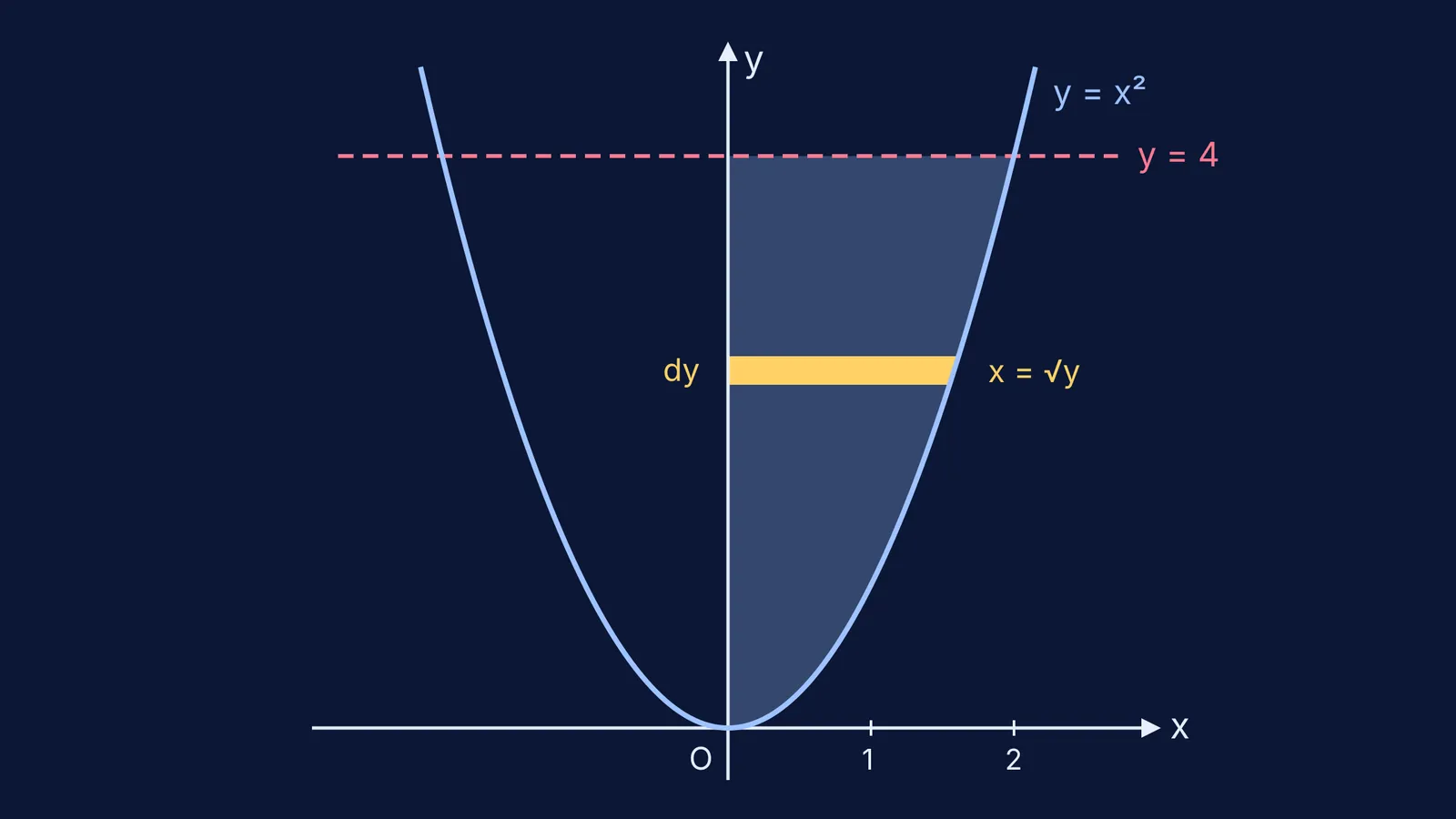
Faced with a region drawn against the y-axis, the usual reflex is y dx. That often means splitting the region or subtracting a rectangle. Writing the curve as x = g(y) and slicing horizontally usually gives one clean integral. Here is how to decide, with y = x² and the line y = 4 worked both ways.
How do you integrate with respect to y?
The region sits between the curve and the y-axis, cut off by horizontal lines y = c and y = d, so the natural strips are horizontal: each starts on the y-axis and ends on the curve.
NCERT's Class 12 Mathematics textbook states that the area bounded by the curve x = g(y), the y-axis and the lines y = c and y = d is A = ∫ from c to d of x dy = ∫ from c to d of g(y) dy, found with horizontal strips (NCERT Class 12 Mathematics Part II, Chapter 8: Application of Integrals). Each strip has length x = g(y) and thickness dy.
OpenStax Calculus Volume 1 gives the general rule as Theorem 6.3: if u(y) ≥ v(y) on [c, d], the area between them is ∫ from c to d of [u(y) − v(y)] dy (OpenStax Calculus Volume 1, section 6.1). Area against the y-axis is the special case v(y) = 0.
In three steps:
Solve the curve for x. For y = x² in the first quadrant, x = √y (the positive root, because x ≥ 0 there).
Read the limits off the y-axis, not the x-axis.
Integrate (right boundary − left boundary) dy.
Worked example: y = x², the y-axis and y = 4
Find the area in the first quadrant bounded by y = x², the y-axis and the line y = 4.
In y: the strip at height y runs from x = 0 to x = √y, and y goes from 0 to 4. So A = ∫ from 0 to 4 of √y dy = (2/3)[y^(3/2)] from 0 to 4 = (2/3)(8) = 16/3 square units.
Check in x: the 2 by 4 rectangle has area 8, and the part under the parabola is ∫ from 0 to 2 of x² dx = 8/3, leaving 8 − 8/3 = 16/3. Same answer, but you had to spot the rectangle first.
Now move the bottom edge up: the same curve and y-axis, but between y = 1 and y = 4.
In y, it is still one integral: ∫ from 1 to 4 of √y dy = (2/3)(8 − 1) = 14/3 square units.
In x, the top edge is y = 4 throughout, but the bottom edge changes at x = 1. For 0 ≤ x ≤ 1 the bottom is the line y = 1, so that piece is a rectangle of area 3. For 1 ≤ x ≤ 2 the bottom is the parabola, giving ∫ from 1 to 2 of (4 − x²) dx = 4 − 7/3 = 5/3. Total: 3 + 5/3 = 14/3. Two pieces, against one line in y. OpenStax's Example 6.5 makes the same point: two integrals in x become one in y.
When should you integrate in y instead of x?
Switch to y when:
The region is bounded by the y-axis or by horizontal lines such as y = 4, which hand you the limits directly.
The curve is easier to write as x = g(y), for example y² = 4x becoming x = y²/4.
A vertical strip would change its top or bottom boundary partway across, forcing you to split the integral.
Solving for y would give a ± square root, while solving for x gives a single expression.
Stay in x when vertical strips run between the same two curves all the way across and the curve is already written as y = f(x).
What mistakes cost marks here?
Using x-limits in a dy integral. For y = x² and y = 4, the limits are 0 and 4, not 0 and 2.
Forgetting which root you need. In the first quadrant x = √y; the branch x = −√y belongs to the left half.
Writing left minus right. A horizontal strip's length is right boundary minus left boundary, so a negative answer means you swapped them. Our post on why a definite integral can be negative while area cannot covers this sign trap.
Skipping the sketch. One strip drawn on a rough graph shows which variable works.
To practise, try NCERT Exercise 8.1, question 4: the area bounded by y² = 4x, the y-axis and the line y = 3 (NCERT Class 12 Mathematics Part II, Chapter 8). Write x = y²/4 and integrate from 0 to 3; you should get 9/4. Then try the area enclosed by an ellipse and a line, and revisit how definite and indefinite integrals differ if limits feel shaky.
If you keep choosing the wrong strip, the Fermi Problem Library has worked problems with a step-by-step solver that explains the reasoning rather than printing an answer.


