

On this page
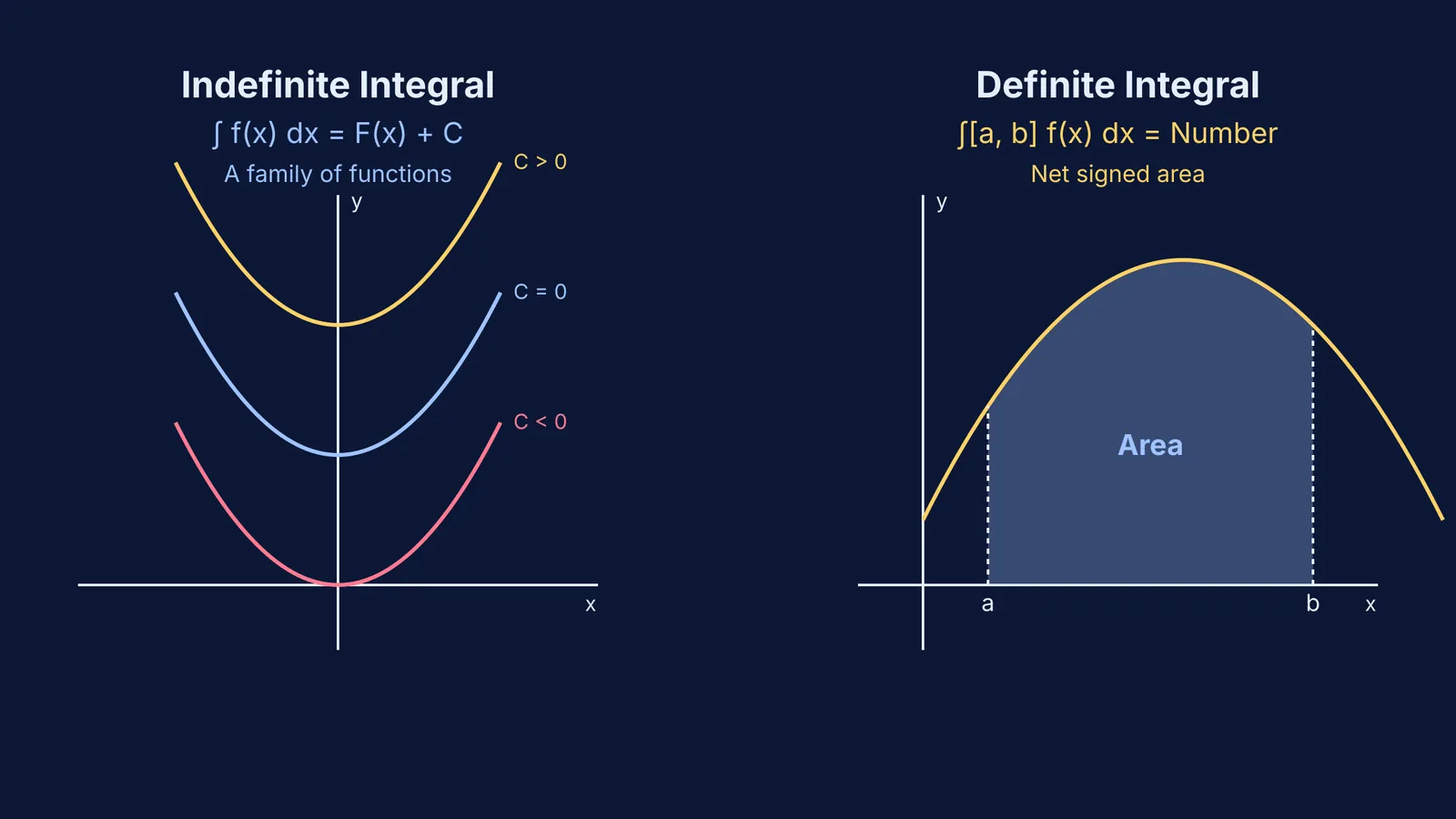
In short The main difference between a definite and an indefinite integral is what they output. According to LibreTexts Mathematics/05%3A_Integration/5.04%3A_The_Fundamental_Theorem_of_Calculus), an indefinite integral results in a family of functions and includes a constant +C, whereas a definite integral results in a specific number, such as the area under a curve. You use definite integrals when calculating total change between two limits, and indefinite integrals when finding a general formula.
When you first learn calculus, the integral sign (∫) usually means two completely different operations that happen to be linked. One gives you a general mathematical formula, and the other gives you a specific numerical value.
Mixing them up is a common reason for lost marks in physics and mathematics exams. Here is exactly how they differ, why the constant +C matters for one but not the other, and how to know which one your final answer should be.
What is an indefinite integral?
An indefinite integral is the exact reverse of differentiation. It answers a fundamental question: *what function did I differentiate to get this expression?*
Because the derivative of any constant number (like 5, 10, or −42) is zero, there are infinitely many original functions that could work. According to LibreTexts Mathematics/05%3A_Integration/5.04%3A_The_Fundamental_Theorem_of_Calculus), an indefinite integral results in a "family of functions", all sharing the exact same shape but shifted vertically up or down. To represent all of these possibilities at once, you must add the constant of integration, +C.
Think of it like being given the slope of a hill at every point. You can use that information to perfectly reconstruct the shape of the hill. However, unless someone tells you your starting altitude, you do not know exactly how high above sea level the hill is. The +C represents that unknown starting altitude.
For example, integrating velocity without any time limits gives you a general position function: ∫ v(t) dt = x(t) + C
What is a definite integral?
A definite integral calculates a specific value over a defined interval. It answers the question: *how much did this quantity accumulate between point a and point b?*
According to LibreTexts Mathematics/05%3A_Integration/5.04%3A_The_Fundamental_Theorem_of_Calculus), a definite integral measures specific values like displacement, total change, or the net signed area under a curve. You recognise a definite integral because it always has upper and lower boundary limits attached to the top and bottom of the integral sign.
Because a definite integral measures "net signed area", any area below the x-axis counts as negative. For instance, if a car travels forwards and then reverses back to its starting point, the definite integral of its velocity over that whole trip will be zero. It gives the net displacement, not the total distance driven.
You can use definite integrals to find the area using horizontal strips or vertical strips between two curves on a graph.
Why does +C cancel in definite integrals?
Although they do different things, indefinite and definite integrals are connected by the Fundamental Theorem of Calculus. To calculate a definite integral from a starting point a to an end point b, you first find the indefinite integral (the general function F(x)). Then, you substitute your upper limit b and subtract what you get when you substitute your lower limit a.
If you were to include the constant +C in this calculation, it would always cancel itself out. Consider calculating the definite integral of 2x from x = 1 to x = 2.
The indefinite integral is x² + C.
Substitute the upper limit (2): 2² + C = 4 + C.
Substitute the lower limit (1): 1² + C = 1 + C.
Subtract the lower from the upper: (4 + C) − (1 + C) = 3.
Because the +C disappears every single time, mathematicians simply leave it out when evaluating definite integrals. If you are doing u-substitution with bounds, you change the limits directly and never need to worry about adding the constant.
The physical meaning in kinematics
In physics, the difference between these two integrals is crucial. If you know the constant acceleration a of an object, taking the indefinite integral gives you a general formula for its velocity over time: v(t) = at + C
The +C here is the initial velocity, u, which you must find using initial conditions (for example, knowing that at t = 0, the car was stopped).
However, taking a definite integral of velocity, such as integrating v(t) from t = 2 to t = 5, does not give you a formula for velocity or position. Instead, it gives you a single number: the exact distance (or displacement) covered between second 2 and second 5.
How to know when your answer must contain x
The simplest way to check your work in an exam is to look at the limits on your integral sign.
No limits given (Indefinite): Your answer must contain x (or whatever variable you are integrating with respect to) and a +C. You are finding a general formula.
Limits given (Definite): Your answer must be a number (like 42, a fraction, or an expression involving constants like π). All the x variables should have been substituted with your limits.
If you struggle with calculus concepts or knowing which method to apply, you are not alone. The Fermi Concept Library contains every concept in physics, chemistry, biology, mathematics and computing, each with its own lesson and its place in the map. If you keep making substitution errors in integration, the Fermi Problem Library has worked problems with a step-by-step solver that explains the reasoning rather than printing an answer.


