

On this page
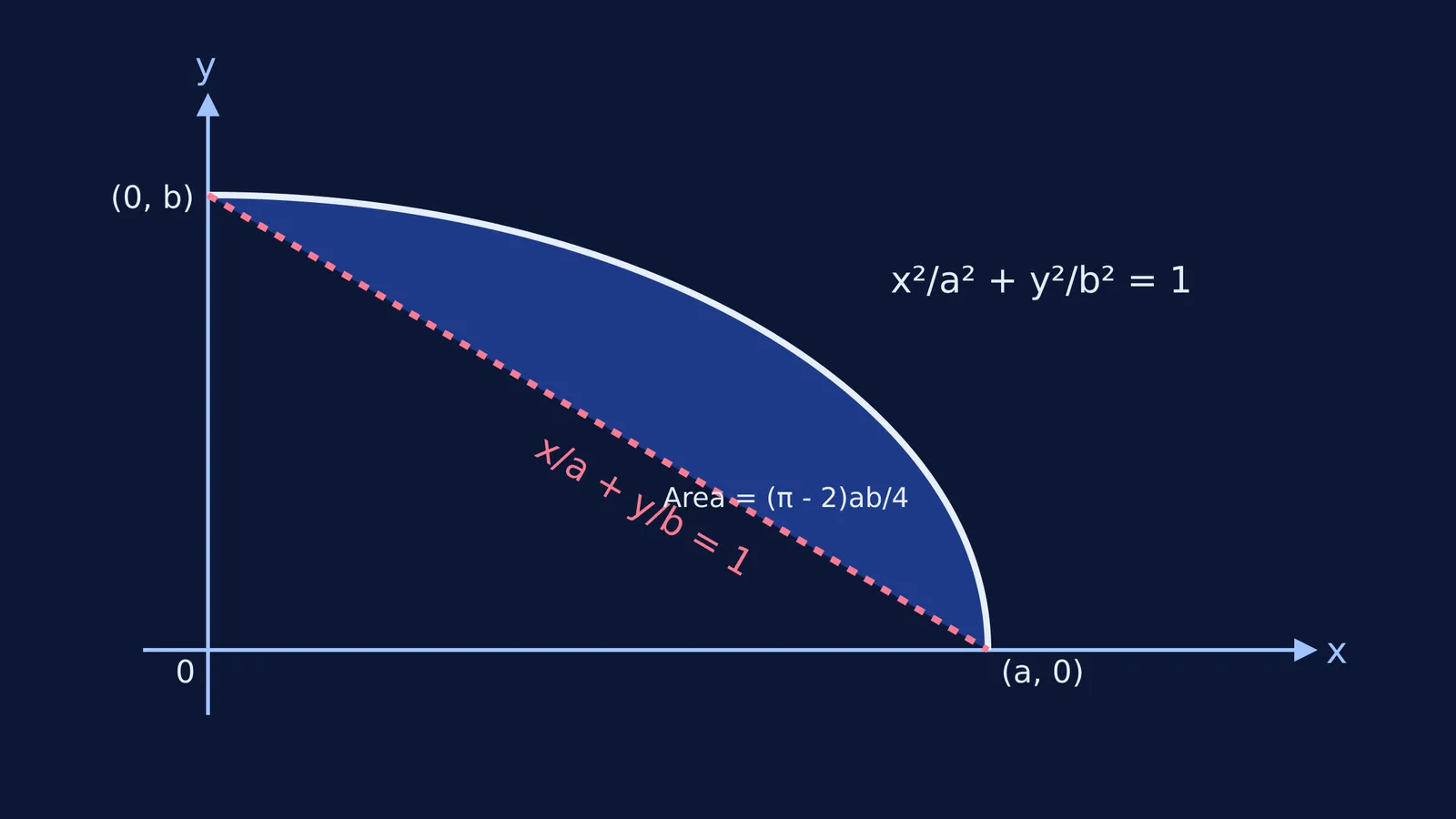
If you are asked to find the area of the smaller region bounded by the ellipse x²/a² + y²/b² = 1 and the straight line x/a + y/b = 1, you can set up a definite integral, or you can use basic geometry. The standard geometric result is that this area equals (π - 2)ab/4 square units.
According to the NCERT Class 12 Mathematics textbook (Chapter 8: Application of Integrals), this is a fundamental problem where definite integrals are used to verify geometric truths. However, in multiple-choice exams like JEE Main, you can skip the integration steps if you know how to break the shape into a quadrant and a triangle.
Why does the subtraction method work?
Instead of integrating the curve equation √(a² - x²) from 0 to a, look at the two distinct geometric shapes on the graph in the first quadrant.
The Ellipse Quadrant: The total area of the ellipse defined by x²/a² + y²/b² = 1 is πab. Because the shape is perfectly symmetric across both the x-axis and the y-axis, the area of a single quadrant (for example, the region bounded by x=0 to x=a and y=0 to y=b) is exactly one-quarter of the total area, which gives us πab/4.
The Right-Angled Triangle: The linear equation x/a + y/b = 1 represents the chord that joins the ellipse's intercepts on the axes, specifically the points (a, 0) and (0, b). Together with the x-axis and the y-axis, this chord forms a right-angled triangle at the origin (0, 0). The base of this triangle is a and its height is b. Using the standard formula for the area of a triangle, the area is ab/2.
The Enclosed Area: The smaller region between the curved edge of the ellipse and the straight chord is the difference between these two shapes. The chord effectively slices off the triangular portion from the quadrant, leaving only the curved sliver.
You can write this out algebraically. The enclosed Area is the Quadrant Area minus the Triangle Area. Substituting the formulas gives Area = (πab/4) − (ab/2). Finding a common denominator transforms this to Area = (πab/4) − (2ab/4). Factoring this out leaves the final result: Area = (π - 2)ab/4.
You can explore similar visual proofs and formulas for every shape in the Fermi Concept Library, which connects calculus directly to the geometry you already know.
What is a worked example with numbers?
Let's apply this geometric shortcut to a numerical problem often seen in Class 12 exams. Suppose you need to find the smaller area bounded by the ellipse x²/16 + y²/9 = 1 and the line x/4 + y/3 = 1.
By comparing the given equation to the standard forms, you can identify the constants. First, a² = 16, which means a = 4. Second, b² = 9, which means b = 3.
First, calculate the area of the ellipse quadrant. Using the formula πab/4, the area is (π × 4 × 3)/4, which simplifies to 3π.
Next, find the area of the right-angled triangle. With a base of 4 and a height of 3, the area is (4 × 3)/2, which equals 6.
Finally, subtract the triangle's area from the quadrant's area. The enclosed area is 3π - 6.
Taking 3 as a common factor, you get 3(π - 2) square units. This perfectly matches our derived formula (π - 2)ab/4, since substituting the values gives (π - 2)(4)(3)/4 = 3(π - 2).
If you want to see how the integral is evaluated step by step to reach this same answer, you can load the question into the Fermi Problem Library. Fermi's AI tutor will write out the integration lines for you, explaining how the substitution works, rather than just printing the final number.
How can you use this in competitive exams?
When time is limited, drawing the shapes and using geometry is faster than performing calculus operations. This approach works because the line x/a + y/b = 1 is a special chord that perfectly cuts off the triangle bounded by the intercepts.
If the line was different, you would need to find new intersection points, set up the definite integral, and evaluate it carefully to avoid mistakes. Understanding the geometric intuition behind the formulas not only saves time but also provides a method to double-check your calculus answers. When you know what the shape looks like, you can often estimate the area and immediately spot if an integration error has given you an unreasonable result.
For more on calculating curved areas, read Area of an Ellipse by Integration Explained. If you are preparing for entrance tests, you might also want to read How to use AI to break a hard JEE problem into steps.


