

On this page
For a long time the textbook answer was short: the appendix is a leftover from our ancestors and does nothing. Newer research has made that answer look too simple. The appendix holds immune tissue, it may shelter helpful gut bacteria, and studies of people who had it removed give mixed results. Here is what is known, what is still argued about and how to write about it in an exam.
Is the appendix a vestigial organ?
Charles Darwin thought so. In The Descent of Man he called the "vermiform appendage of the caecum" a rudiment, left behind when the caecum "had become much shortened" after a change in diet. His evidence was its small size and how much it varies between people.
"Vestigial" does not have to mean "useless", though. It means a structure has lost or changed the job it did in our ancestors. Our post on vestigial organs in humans and what they show covers the idea with other examples.
Comparative anatomy has since complicated Darwin's story. A 2009 study in the Journal of Evolutionary Biology found that the appendix evolved independently at least twice in mammals and has been kept for 80 million years or longer. The authors suggest that a useful function could explain why it has lasted. A later analysis of 533 mammal species concluded that the caecum and appendix evolve together as one unit, and found that having an appendix goes with more lymphoid tissue in the caecum, which supports the idea of an immune function.
What does the appendix do?
Two functions are proposed most often.
Immune tissue. A 2016 review in Clinical and Experimental Immunology says an essential part of the appendix's immune function is its interaction with gut bacteria, and concludes that "the idea of the appendix being a vestigial organ should therefore be discarded".
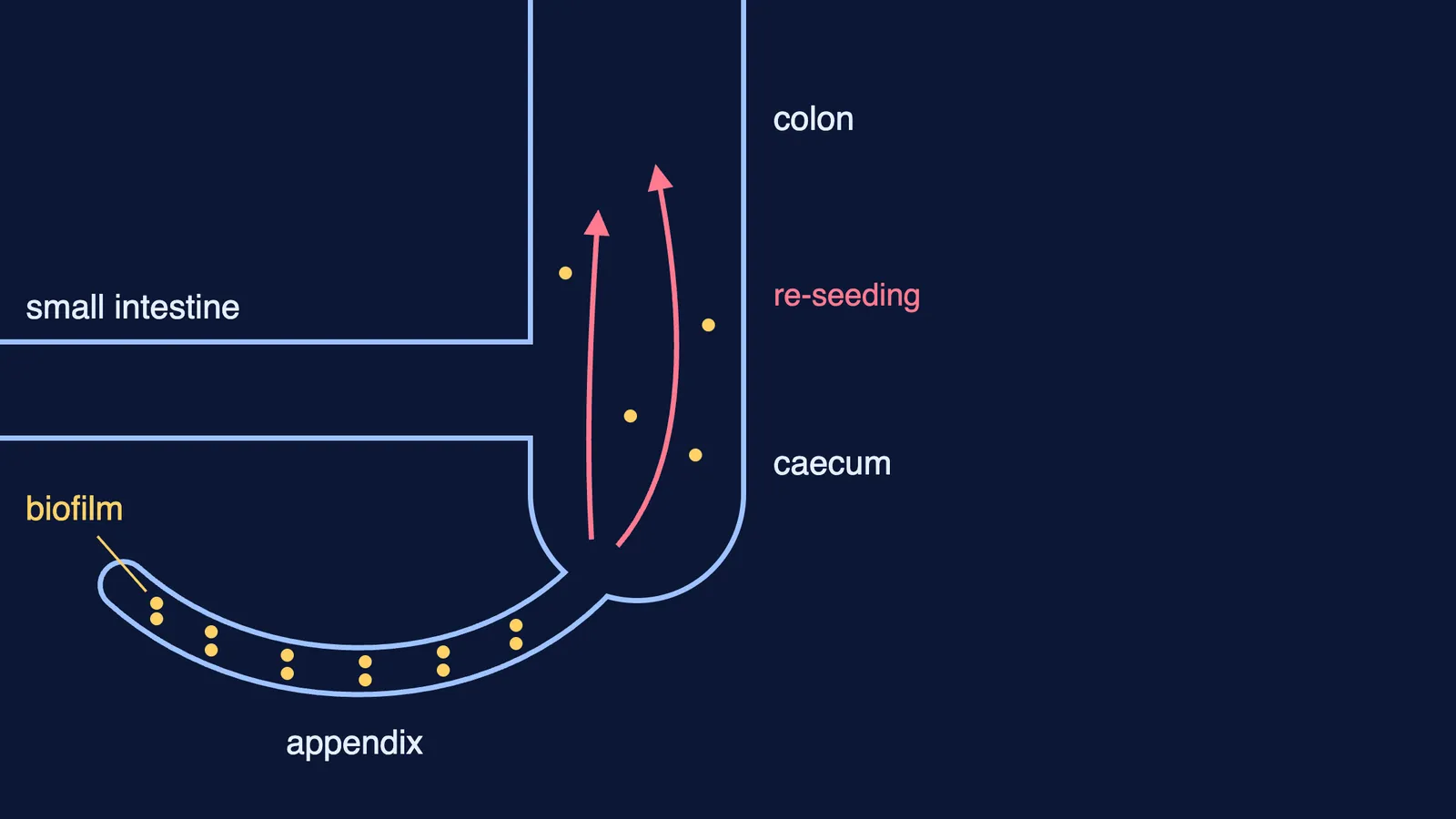
A reserve of gut bacteria. A 2007 paper from Duke University describes the human appendix as a pouch 5 to 10 cm long and 0.5 to 1 cm wide. Its authors proposed that it works as a "safe house" for helpful bacteria living in a biofilm, which could re-seed the colon after diarrhoea flushes the gut.
The safe-house idea is a hypothesis built from anatomy and biofilm biology, not a direct measurement. That is why studies of people without an appendix matter. If you are revising where the appendix sits among immune organs, see primary vs secondary lymphoid organs.
What happens after the appendix is removed?
Removal is common. A US study of national hospital discharge data from 1979 to 1984 estimated a lifetime risk of appendicitis of 8.6% for males and 6.7% for females, with the highest rate in people aged 10 to 19. It put the lifetime risk of having the appendix removed at 12.0% for males and 23.1% for females.
If the appendix reseeds the gut, people without one might recover worse from gut infections. Here the evidence pulls both ways:
A 2011 hospital study of adults with *Clostridioides difficile* infection found that having an appendix was linked to a lower risk of the infection coming back (adjusted relative risk 0.398). The authors said the finding needs checking in a prospective study.
A 2020 study of 862 patients found the infection returned in 12.3% of people with a past appendectomy and 9.3% of those without, a difference that was not statistically significant.
In veterinary records of 1,251 primates from 45 species, species with an appendix had a lower risk of severe diarrhoea.
All three are observational: they show associations, not cause and effect. None of this is a reason to worry about a past operation or to question one a doctor recommends. Belly pain that worries you is for a doctor to assess, not a blog post.
How do you answer "Is the appendix useless?" in an exam?
Questions like this reward weighing evidence, not picking a side. Use this four-step frame for a viva, an essay or a debate:
State the classic view and its source. Darwin treated the appendix as a rudiment of a shortened caecum.
Name the kinds of evidence. Comparative anatomy (it evolved more than once and was kept), mechanism (lymphoid tissue, biofilm), human data (studies after removal) and animal data (primates).
Rate their strength. Hypotheses and observational studies suggest; prospective studies test. Say which kind you are citing.
Give a qualified answer. For example: "The appendix contains immune tissue and may store helpful gut bacteria. Studies disagree on whether losing it changes recovery from gut infections."
In a board exam, write what your textbook says first, then add one line on the newer evidence if the marks allow it.
The same frame works for other "useless organ" claims. Our post on why humans cannot digest cellulose but cows can shows why a large caecum matters in plant-eaters. To see how evolution, immunity and digestion connect, the Fermi Concept Library gives every biology concept its own lesson and its place in the map. And if you want to practise step 3 out loud, Fermi's AI tutor checks understanding as it goes, so you find out where your reasoning is thin before the examiner does.


