

On this page
You know all three sides of a triangle and the question wants a median: the segment from a vertex to the midpoint of the opposite side. You do not need coordinates or angles. One identity, Apollonius's theorem, gets you there in two lines.
What does Apollonius's theorem say?
In words: "The sum of the squares of any two sides of any triangle equals twice the square on half the third side plus twice the square on the median bisecting the third side" (Wikipedia, Apollonius's theorem).
In symbols, for triangle ABC with D the midpoint of BC, the theorem is AB² + AC² = 2(AD² + BD²).
The same article notes that it is a special case of Stewart's theorem, and that for an isosceles triangle it reduces to Pythagoras.
The result appears as proposition VII.122 in the Collection of Pappus of Alexandria, from around 340 AD, and may go back to Apollonius of Perga's lost work Plane Loci (Wikipedia). Apollonius lived from about 262 BC to about 190 BC, according to the MacTutor History of Mathematics archive.
How do you find the length of a median from three sides?
Name the sides the usual way: a = BC, b = CA, c = AB, and call the median from A m_a. Since D is the midpoint, BD = a/2, so the theorem reads b² + c² = 2(m_a² + a²/4). Solve for m_a:
m_a = ½√(2b² + 2c² − a²)
Wolfram MathWorld lists the same formula as m₁² = ¼(2a₂² + 2a₃² − a₁²). A way to remember it: double the squares of the two sides that meet at the vertex, subtract the square of the side the median lands on, take a quarter, then the square root.
The other two medians follow by cycling the letters:
m_b = ½√(2a² + 2c² − b²)
m_c = ½√(2a² + 2b² − c²)
Worked example: a triangle with sides 7, 8 and 9
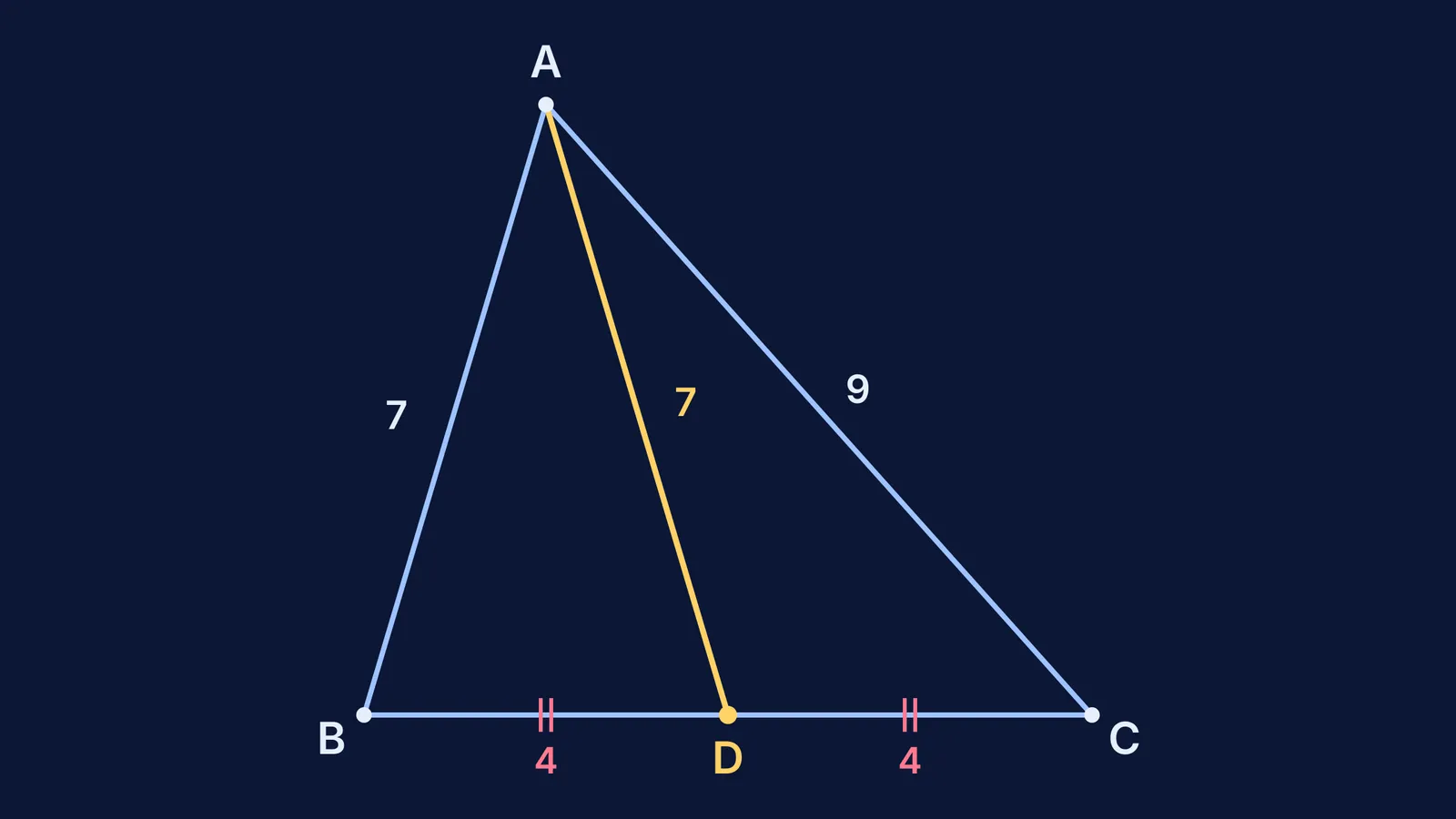
Take AB = 7, BC = 8 and CA = 9, so c = 7, a = 8 and b = 9.
Median from A to BC: m_a² = (2 × 81 + 2 × 49 − 64)/4 = (162 + 98 − 64)/4 = 196/4 = 49, so m_a = 7.
Check it against the theorem: AB² + AC² = 49 + 81 = 130, and 2(AD² + BD²) = 2(49 + 16) = 130. It matches.
Median from B to CA: m_b² = (128 + 98 − 81)/4 = 145/4, so m_b = √145/2, about 6.02.
Median from C to AB: m_c² = (128 + 162 − 49)/4 = 241/4, so m_c = √241/2, about 7.76.
The theorem also runs backwards. If a question gives AB = 7, AC = 9 and median AD = 7 and asks for BC, then 130 = 2(49 + BD²), so BD² = 16, BD = 4 and BC = 8.
Why is Apollonius's theorem true?
The quickest proof uses coordinates. Put D at the origin, B at (−d, 0) and C at (d, 0), and let A be (x, y). Then AB² + AC² = (x + d)² + y² + (x − d)² + y² = 2(x² + y²) + 2d². But x² + y² is AD² and d² is BD², so AB² + AC² = 2(AD² + BD²).
You can also get it from the law of cosines: write AC² and AD² using the same angle B, double the second, and the cosine terms cancel because BC = 2BD. Our piece on why the law of cosines is called Al-Kashi's theorem covers that law.
If the law of cosines feels shaky, the Fermi Concept Library gives each concept in mathematics its own lesson, so you can revisit the law of cosines before the proof.
What mistakes cost marks with medians?
Using the full side instead of half of it, as in the callout above.
Doubling the wrong pair. The two sides you double are the ones meeting at the vertex the median starts from; the side you subtract is the one it lands on.
Dropping the ½ outside the root, or forgetting the root altogether.
Stopping at the median when the question asks about the centroid. The medians meet at the centroid and divide one another in the ratio 2:1 (Wolfram MathWorld), with the longer part next to the vertex, so in the example the distance from A to the centroid is two thirds of 7, which is 14/3.
If the triangle comes with coordinates instead of side lengths, see how to find the equation of a median and altitude of a triangle. For problems built on midpoints, try our step-by-step guide to midpoint theorem problems.
When you keep doubling the wrong pair of sides, work a few questions in the Fermi Problem Library: its step-by-step solver explains the reasoning rather than printing an answer, so you can see which side goes where.


