

On this page
Every triangle has several lines that pass through its vertices, but two of the most common lines you encounter in school and entrance exams are medians and altitudes. While students frequently confuse their formulas under timed pressure, their geometric definitions are completely different.
What is the difference between a median and an altitude?
A median connects a vertex to the midpoint of the opposite side. Because it lands halfway along the opposite boundary, each median divides the triangle into two smaller triangles of equal area. According to Wolfram MathWorld, the three medians meet at a single point called the centroid (G), which also serves as the triangle's physical centre of mass and divides each median in a 2:1 ratio from the vertex to the base. You can confirm this intersection using the algebraic condition for three lines to be concurrent.
An altitude connects a vertex to the opposite side along a perpendicular line, meeting that side (or its extension) at a 90° angle. Altitudes measure the perpendicular height needed to calculate triangular area using the classic base-times-height formula. The three altitudes also meet at a single point, called the orthocenter (H). In an acute triangle, the orthocenter lies inside; in an obtuse triangle, it lies outside; and in a right triangle, it sits directly on the vertex containing the 90° angle.
Only in an equilateral triangle do all medians and altitudes coincide. In an isosceles triangle, only the median and altitude drawn from the vertex between the two equal sides are identical. For every other triangle, a median and an altitude drawn from the same vertex follow entirely different lines.
How do you find the equation of a median?
Finding the equation of a median requires two main steps:
Find the midpoint of the opposite side. If you need the median through vertex A(x₁, y₁), find the midpoint M of the opposite side BC with endpoints B(x₂, y₂) and C(x₃, y₃) using the midpoint formula: M = ((x₂ + x₃) / 2, (y₂ + y₃) / 2).
Find the line through the vertex and the midpoint. Compute the slope of the segment joining A and M: m_median = (y_M − y₁) / (x_M − x₁).
Then write the equation using point-slope form: y − y₁ = m_median(x − x₁).
Rearrange the terms into standard form Ax + By + C = 0. When practising multistep coordinate geometry problems, the Fermi Problem Library offers worked problems with a step-by-step solver that explains the reasoning rather than printing an answer.
How do you find the equation of an altitude?
Finding the equation of an altitude uses the slope perpendicularity condition prescribed in the CBSE Senior Secondary Mathematics curriculum:
Find the slope of the opposite side. For an altitude from vertex A(x₁, y₁) to side BC, compute the slope of BC: m_BC = (y₃ − y₂) / (x₃ − x₂).
Compute the perpendicular slope. Two non-vertical lines are perpendicular if and only if the product of their slopes is −1 (m₁ × m₂ = −1). The slope of the altitude is therefore the negative reciprocal of the base's slope: m_alt = −1 / m_BC.
Write the equation through the vertex. Since the altitude passes through vertex A, substitute A(x₁, y₁) and m_alt into the point-slope form: y − y₁ = m_alt(x − x₁).
If side BC is horizontal (m_BC = 0), the altitude is vertical with equation x = x₁. If side BC is vertical (slope is undefined), the altitude is horizontal with equation y = y₁.
How do you solve both for a triangle with three vertices?
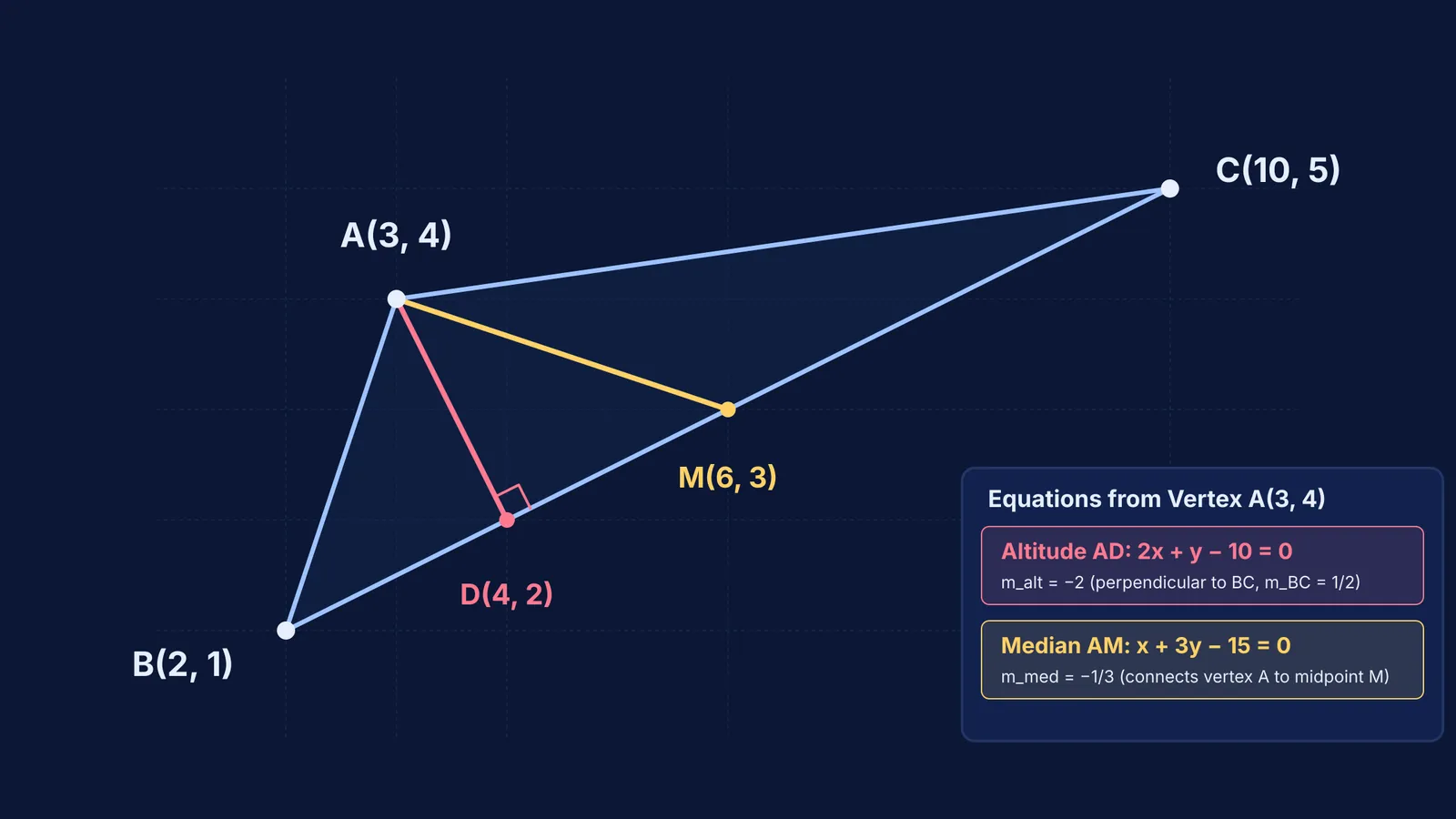
Consider triangle ABC with vertices A(3, 4), B(2, 1), and C(10, 5). Let us find the equations of both the median and the altitude drawn from vertex A.
To find the median from A to BC:
Midpoint M of side BC: M = ((2 + 10) / 2, (1 + 5) / 2) = (12 / 2, 6 / 2) = (6, 3).
Slope of median AM connecting A(3, 4) and M(6, 3): m_AM = (3 − 4) / (6 − 3) = −1 / 3.
Equation of median AM: y − 4 = (−1/3)(x − 3), which gives 3(y − 4) = −(x − 3), or x + 3y − 15 = 0.
To find the altitude from A to BC:
Slope of side BC connecting B(2, 1) and C(10, 5): m_BC = (5 − 1) / (10 − 2) = 4 / 8 = 1/2.
Perpendicular slope for the altitude: m_alt = −1 / (1/2) = −2.
Equation of altitude AD through A(3, 4): y − 4 = −2(x − 3), which simplifies to 2x + y − 10 = 0.
Solving the altitude 2x + y − 10 = 0 with side BC (x − 2y = 0) shows that the altitude meets BC at the foot D(4, 2). Comparing the foot D(4, 2) with the midpoint M(6, 3) confirms that the altitude and median are distinctly separate lines. You can verify the triangle's overall geometry using the area of a triangle using determinants or by determining its circumcentre through the circle through three given points.
What common mistakes cause errors in exam numericals?
Students regularly drop marks in coordinate geometry by rushing through four routine pitfalls:
Using the midpoint for the altitude: An altitude passes through the vertex A, not through the midpoint M of the opposite side. Using M instead of A gives the equation of the perpendicular bisector, an entirely different line that may not pass through vertex A at all.
Inverting without changing sign: The perpendicular condition requires the negative reciprocal (−1/m). Forgetting the minus sign turns a perpendicular line into a line running in the wrong quadrant.
Mixing up vertices: Always sketch a quick reference triangle to confirm which vertex faces which side before writing differences in coordinates.
Zero in the denominator: If two vertices share the same x-coordinate, the side is vertical. Do not attempt division by zero; recognize immediately that the altitude must be horizontal.
To see how straight-line forms connect to conic sections and vectors, explore the Fermi Concept Library, where every concept in mathematics has its own lesson and its place in the map.


