

On this page
Turn to the exercises at the end of Chapter 5, Morphology of Flowering Plants, in the NCERT Class 11 biology textbook and you will find this one: differentiate between apocarpous and syncarpous ovary. It is a short question, and it turns on one idea: whether a flower's carpels stay separate or join together. Here is the difference, the four textbook examples and a quick check for any diagram.
What is the difference between apocarpous and syncarpous gynoecium?
The gynoecium is the female reproductive part of the flower and is made up of one or more carpels, according to the NCERT Class 11 Biology textbook, Chapter 5. Each carpel has three parts: stigma, style and ovary.
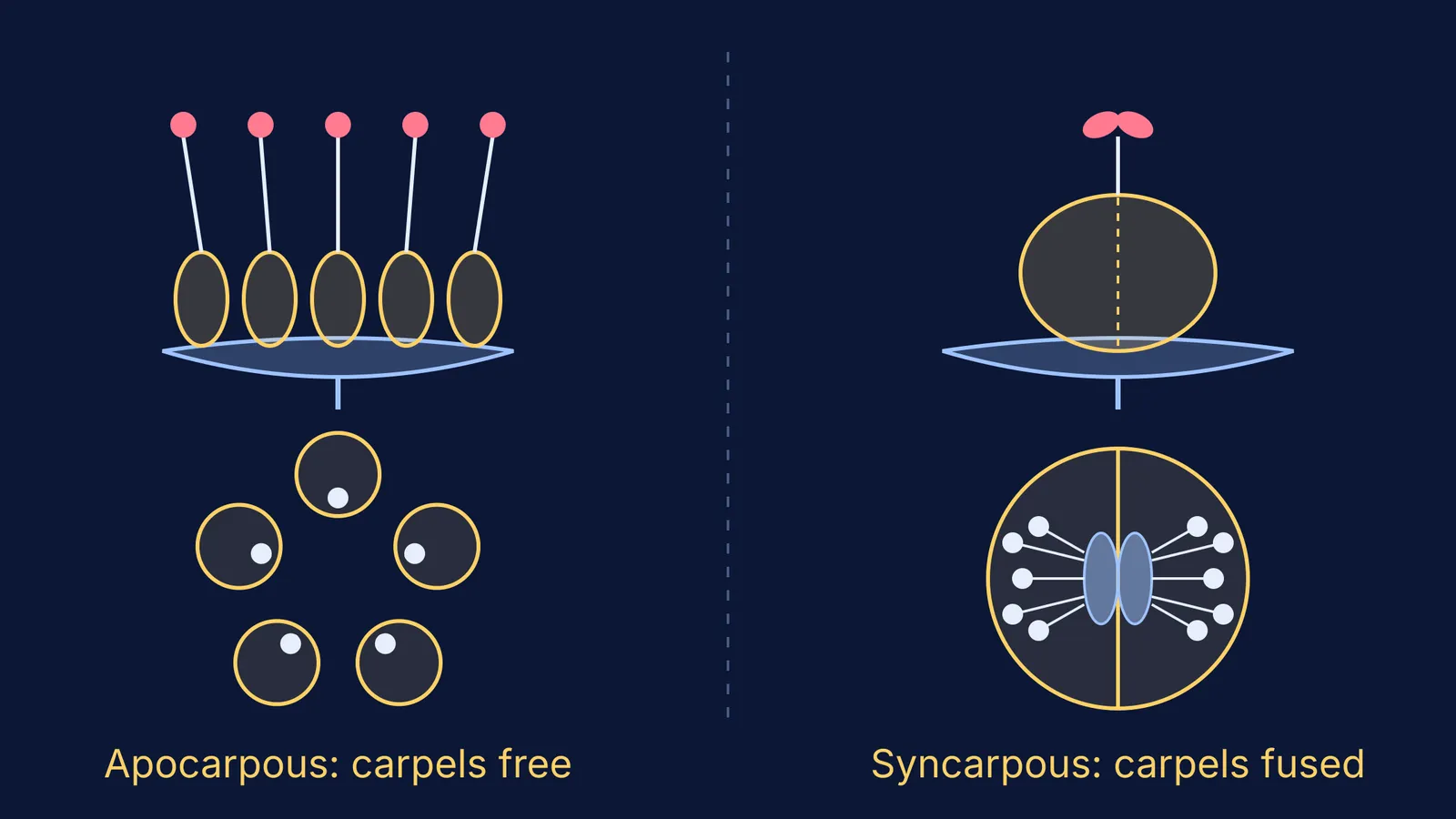
Apocarpous: more than one carpel is present and the carpels are free, as in lotus and rose.
Syncarpous: more than one carpel is present and the carpels are fused, as in mustard and tomato.
Both words only apply when a flower has more than one carpel. A flower with a single carpel is neither; the same chapter calls such an ovary monocarpellary when it describes how mango and coconut fruits form.
Why are lotus and rose apocarpous but mustard and tomato syncarpous?
The NCERT chapter gives lotus and rose as its examples of free carpels. Each free carpel keeps its own ovary, style and stigma, so the centre of the flower holds several separate pistils rather than one.
NCERT uses mustard (family Brassicaceae) for its worked floral diagram and floral formula. The formula writes the gynoecium as a superior ovary with the figure 2 in brackets, and NCERT explains that enclosing a figure in brackets indicates fusion. Two carpels, joined into one ovary. Mustard also has parietal placentation: the ovary is one-chambered but becomes two-chambered because a false septum forms.
Tomato belongs to Solanaceae, whose gynoecium NCERT describes as bicarpellary, syncarpous, with a superior, bilocular ovary and a swollen placenta bearing many ovules in axile placentation. Tomato is also one of the chapter's named examples of axile placentation.
How do you identify apocarpous or syncarpous in a diagram?
Run this three-step check on any flower, longitudinal section or floral formula:
Count the carpels. One carpel means monocarpellary, so stop there. Two or more, go to step 2.
Count the ovaries. If each carpel has its own separate ovary with its own style and stigma, the gynoecium is apocarpous.
If there is one ovary built from several carpels, it is syncarpous. In a floral formula, look for the bracket around the number after G.
One trap: do not decide by counting chambers. Mustard is syncarpous, yet NCERT describes its ovary as one-chambered before the false septum forms. Count carpels, not rooms.
How should you answer the NCERT exercise?
If you are asked to differentiate the two, five lines are enough:
Carpels: free in apocarpous; fused in syncarpous.
Ovaries: as many separate ovaries as carpels in apocarpous; one ovary in syncarpous.
Floral formula: no bracket around the G number in apocarpous; a bracket in syncarpous.
Examples: lotus and rose for apocarpous; mustard and tomato for syncarpous.
Shared condition: both need more than one carpel.
After fertilisation the ovules become seeds and the ovary becomes the fruit, so this question often leads into fruit types. Our guide to seed vs fruit with mango, pea and wheat picks up from there, and types of ovules: orthotropous, anatropous and campylotropous covers what sits inside the ovary.
Why did fused carpels evolve?
Free carpels are usually treated as the older arrangement. In a 1982 paper in the journal Taxon, botanist Peter Endress wrote that in most groups of flowering plants the primitive condition of apocarpy has been surpassed by syncarpy. He listed its advantages: more regular distribution of pollen tubes, stronger selection among pollen tubes, a more economical build, and more ways to disperse the fruit.
A 2002 study in the Journal of Evolutionary Biology by W. S. Armbruster, E. M. Debevec and M. F. Willson counted a minimum of 17 independent evolutionary transitions from apocarpy to syncarpy. About three-quarters of these transitions let pollen tubes cross between carpels and fertilise ovules that would otherwise have been left unfertilised, the authors reported.
That gives you a reason to remember, not just a definition: when carpels fuse, pollen tubes can often reach ovules in neighbouring carpels instead of being confined to one.
Where do these terms fit in the rest of plant morphology?
Placentation types and ovary positions are easy to mix up with these words. If they blur, our list of commonly confused plant biology terms for NEET sorts the usual pairs. The Fermi Concept Library covers every concept in biology, each with its own lesson and its place in the map, so you can see how carpels connect to placentation and fruit. And if a flower diagram still will not make sense, Fermi's AI tutor can draw the figure and check your understanding as it goes.
Next time you cut a tomato or see a rose in bloom, count the carpels before you name them.


