

On this page
If you are revising Sexual Reproduction in Flowering Plants for NEET-UG or the boards, the NCERT Class 12 Biology chapter labels only one ovule type: "a typical anatropous ovule" (Figure 1.7d). To name the straight and curved types, skip memorising shapes and track three landmarks: funicle, chalaza and micropyle.
What are the parts of an ovule?
NCERT defines each part in a line or two, and these are the definitions to learn (NCERT Biology Class 12, Chapter 1):
Funicle: the stalk that attaches the ovule to the placenta.
Hilum: the region where the body of the ovule fuses with the funicle.
Integuments: one or two protective envelopes around the nucellus.
Micropyle: the small opening at the tip, where the integuments do not meet.
Chalaza: the basal part of the ovule, opposite the micropylar end.
Nucellus: the mass of cells inside the integuments, with abundant reserve food.
Embryo sac: the female gametophyte, located in the nucellus; an ovule generally has a single one.
How do the micropyle, chalaza and funicle line up in each type?
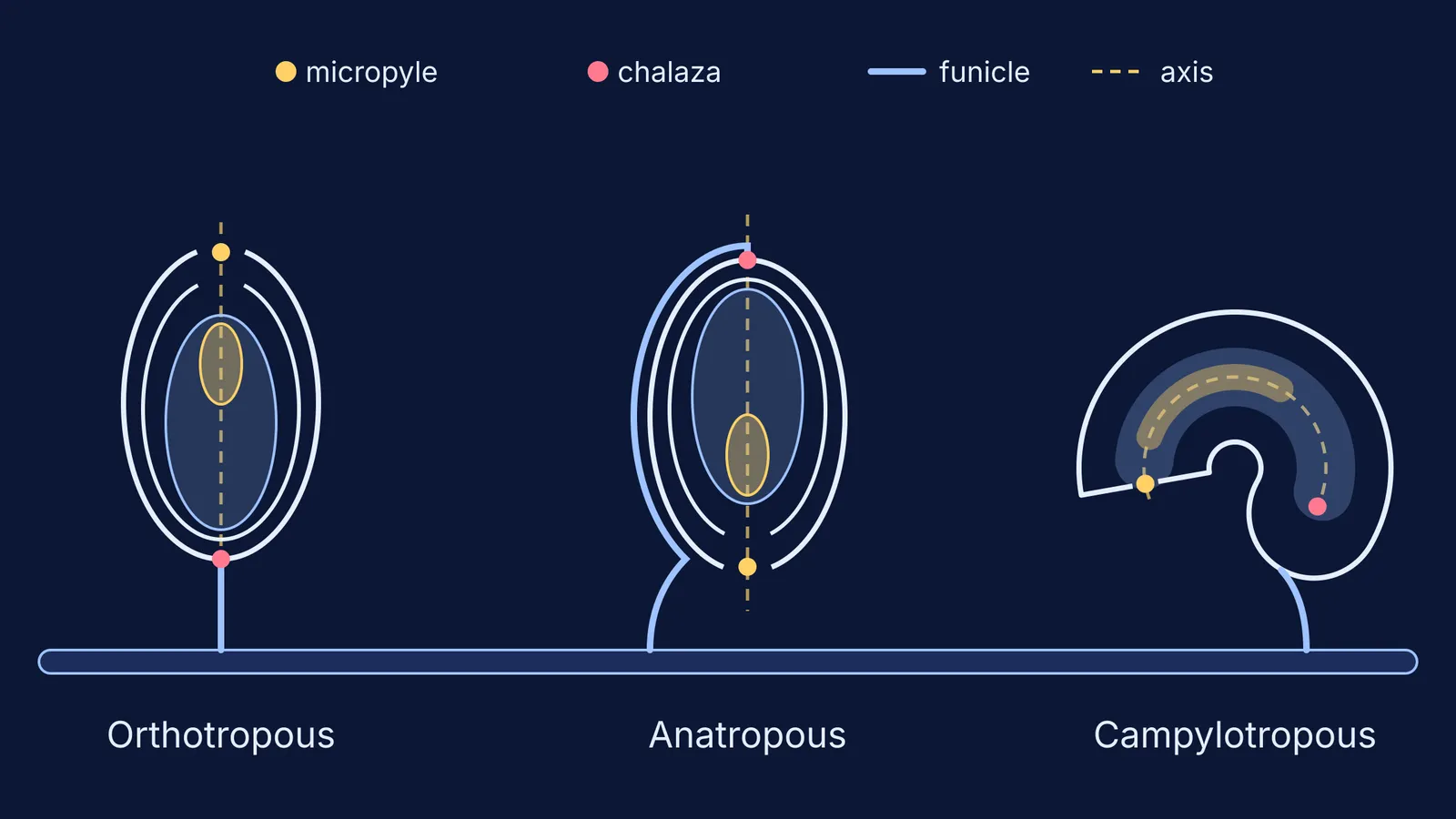
One thing never changes: the chalaza sits opposite the micropyle, at the base of the nucellus. A review of angiosperm ovules by Peter Endress in Annals of Botany (2011) adds that, most commonly, a vascular bundle runs from the placenta through the funiculus to the chalaza. So the types differ in two ways: whether the micropyle-chalaza axis is straight or bent, and where the funicle joins it.
Orthotropous (atropous): straight and uncurved, as Endress puts it. Funicle, chalaza and micropyle fall on one line, and the micropyle points away from the placenta. Endress lists Piperales, Urticaceae and Polygonaceae among the groups with orthotropous ovules.
Anatropous: the ovule is curved so that the micropyle is directed towards the placenta, while the nucellus itself stays straight (Endress). The micropyle-chalaza line is still straight, but the funicle now runs alongside the body and the micropyle ends up next to the hilum.
Campylotropous: the nucellus is also involved in the curvature (Endress), so the micropyle-chalaza axis is itself curved. Wikipedia's glossary of botanical terms describes it as lying transversely to its stalk, with a curved embryo sac.
Two more names turn up in reference books. Endress describes hemitropous ovules as only slightly curved, and the glossary defines an amphitropous ovule as bent so that both ends are near each other.
Which type of ovule is the most common?
The anatropous ovule is the most common ovule orientation in flowering plants, according to the glossary of botanical terms. Endress adds that in living angiosperms, "anatropous ovules are most probably ancestral" (Annals of Botany). He argues that growth of the outer integument is what makes ovules curve, and that curvature points the micropyle towards the placenta, the direction from which pollen tubes arrive. See how the pistil recognises compatible pollen for the start of that journey.
How do you label the anatropous ovule from NCERT?
Figure 1.7d in the NCERT chapter carries nine labels: hilum, funicle, micropyle, micropylar pole, outer integument, inner integument, nucellus, embryo sac and chalazal pole. Draw it in this order so nothing gets crowded:
Draw a tall oval and a short funicle leaving it near the top; mark the hilum at the join.
Draw the outer and inner integuments just inside the edge, leaving a gap beside the funicle: the micropyle, at the micropylar pole.
Shade the nucellus and draw a small embryo sac inside it.
Label the opposite end chalazal pole.
If your micropyle ends up far from the funicle, you have drawn an orthotropous ovule. For the flower around it, see our guide to labelling the L.S. of a flower; for what the ovule turns into, see what each part of the flower becomes after fertilisation.
How can you identify an ovule type quickly?
Ask two questions, in this order:
Is the line from micropyle to chalaza straight? If it bends, the nucellus is curved: campylotropous, or amphitropous if the two ends nearly meet.
If it is straight, where is the funicle? On the same line, beyond the chalaza: orthotropous. Beside the micropyle, with the body turned over: anatropous.
Worked example: "The micropyle lies close to the funicle and faces the placenta; the chalaza is at the far end; the nucellus is straight." Question 1: the nucellus is straight, so it is not campylotropous. Question 2: the funicle is beside the micropyle, so the answer is anatropous.
If a term still feels shaky, the Fermi Concept Library covers every concept in biology, each with its own lesson and its place in the map. For practice, the Fermi Problem Library has worked problems with a step-by-step solver that explains the reasoning rather than printing an answer.
Tonight, draw the three ovules side by side, mark the three landmarks on each, and run the two questions once.


