

On this page
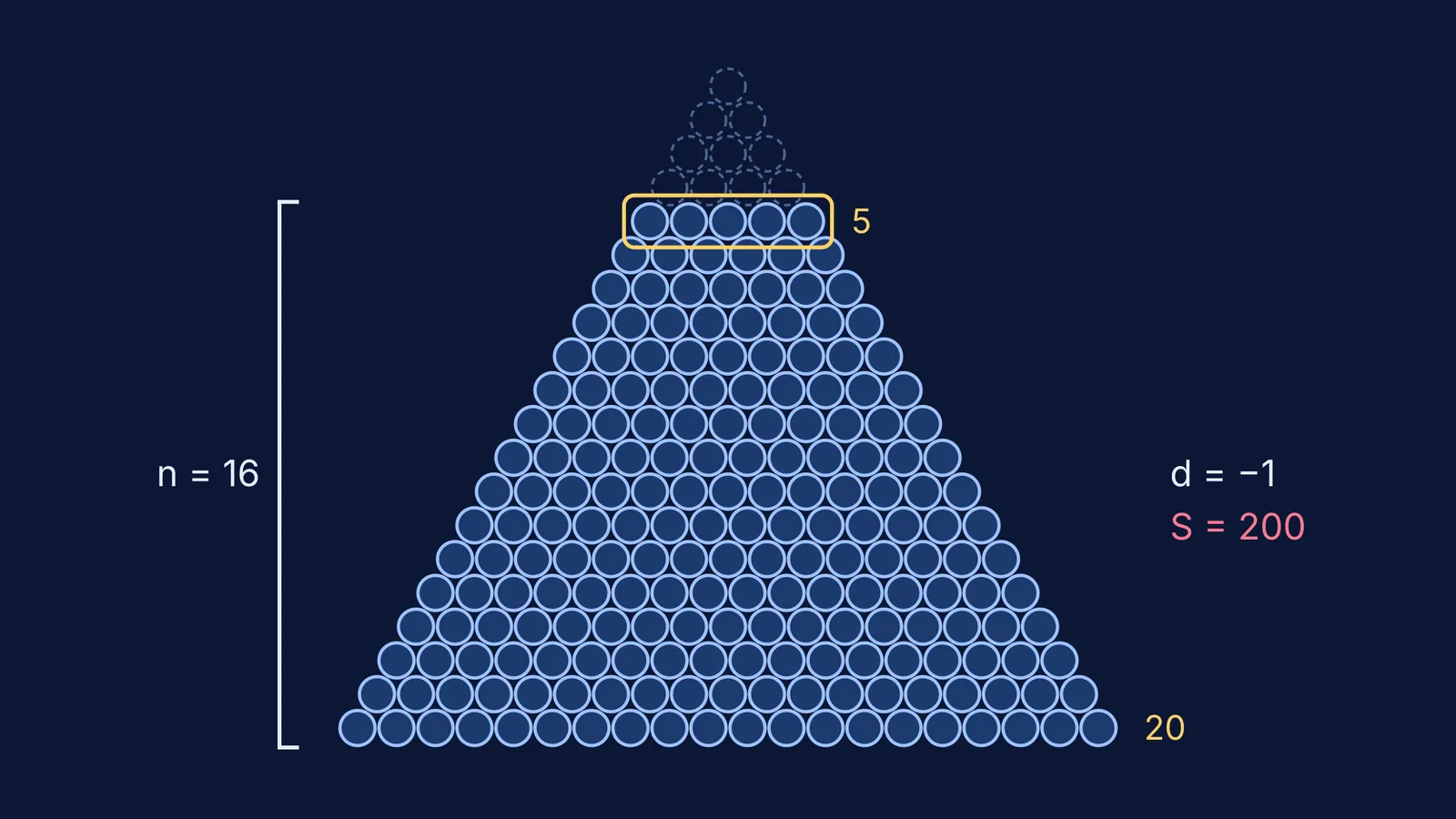
The logs question is Question 19 of Exercise 5.3 in the NCERT Class 10 Mathematics chapter on Arithmetic Progressions. It reads: "200 logs are stacked in the following manner: 20 logs in the bottom row, 19 in the next row, 18 in the row next to it and so on." It asks how many rows there are and how many logs are in the top row. The tricky part is that the quadratic gives two answers.
How do you find the number of rows of logs?
The rows hold 20, 19, 18, … logs, so a = 20, d = −1 and S = 200. The unknown is n, the number of rows. The same NCERT chapter gives the sum of the first n terms of an AP as S = n/2[2a + (n − 1)d]. Substitute and solve:
200 = n/2[40 + (n − 1)(−1)] = n/2(41 − n)
400 = 41n − n²
n² − 41n + 400 = 0
(n − 16)(n − 25) = 0, so n = 16 or n = 25
With n = 16, the top row is a₁₆ = 20 + 15(−1) = 5 logs, and 16/2 × (20 + 5) = 200 checks out. So the answer is 16 rows, with 5 logs in the top row.
Why is n = 25 rejected in the logs problem?
Put n = 25 into the nth-term formula: a₂₅ = 20 + 24(−1) = −4. A row cannot hold −4 logs. Rows 17 to 25 would hold 4, 3, 2, 1, 0, −1, −2, −3 and −4, which add up to zero, so the algebra still reaches 200.
In Example 13 of the chapter, NCERT keeps both roots (n = 4 or 13 for the AP 24, 21, 18, … with a sum of 78), because the 5th to 13th terms cancel out. A plain list of numbers can have negative terms, but a pile of logs cannot.
For more on this, read why an AP sum can give two values of n and how to find the first negative term of an AP.
How do you solve the ladder rungs problem?
Question 3 of Exercise 5.4 in the NCERT chapter describes a ladder with rungs 25 cm apart. The rungs shrink evenly from 45 cm at the bottom to 25 cm at the top, and the top and bottom rungs are 2½ m apart. How much wood do the rungs need? NCERT marks Exercise 5.4 as optional and "not from the examination point of view", but it is good practice anyway.
Count the rungs first. 250 cm ÷ 25 cm gives 10 gaps, and 10 gaps need 11 rungs. You know the first term (45), the last term (25) and n (11), but not d. NCERT notes that S = n/2(a + l) is the useful form when the first and last terms are given but the common difference is not. So S = 11/2 × (45 + 25) = 11 × 35 = 385 cm of wood, or 3.85 m.
What about seats arranged in rows in a hall?
Here is a practice question we wrote. A hall has 20 seats in the front row, and each row has 2 more than the row in front of it, with 1,100 seats in all. How many rows are there, and how many seats are in the last row?
1100 = n/2[40 + 2(n − 1)] = n(n + 19)
n² + 19n − 1100 = 0
(n − 25)(n + 44) = 0, so n = 25, since −44 rows makes no sense
Last row: 20 + 24 × 2 = 68 seats. Check: 25/2 × (20 + 68) = 25 × 44 = 1100
When rows grow, the wrong root is negative and easy to spot. When rows shrink, both roots can be positive, so check both, as you would when finding the maximum sum of a decreasing AP.
A five-step checklist for any rows problem
Write out the first three rows and check that the difference stays the same.
Note a, d and which of n, S and l you know.
Use S = n/2(a + l) if you know the first and last terms, and S = n/2[2a + (n − 1)d] if n is unknown.
Factor any quadratic you get.
Test every root: n must be a positive whole number, the last term must be at least 1, and the total must check out.
If you can set up the equation but get stuck factoring or choosing a root, the Fermi Problem Library has worked problems with a step-by-step solver that explains the reasoning rather than printing an answer. If the sum formula itself feels shaky, the Fermi Concept Library gives each mathematics concept its own lesson.
Next time a question has logs, rungs or seats, write a, d and S first, then check which answer can actually exist.


